




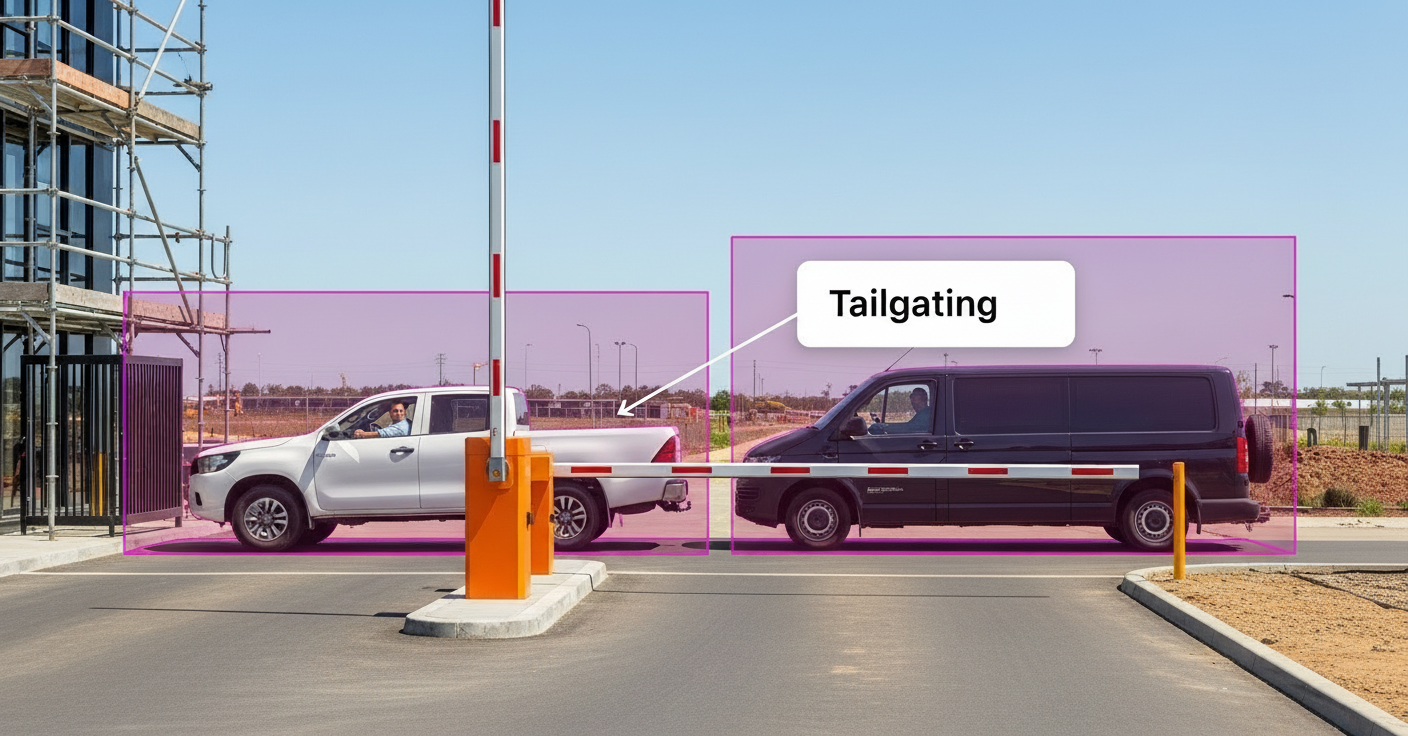


Managing a construction site often feels like controlling chaos. With ten to twenty different trades rotating through, material deliveries arriving just-in-time, and hundreds of workers passing through gates daily, maintaining strict access control is a significant operational roadblock. For site superintendents, the "eyes and ears" of the general contractor, the primary frustration isn't just keeping intruders out—it is ensuring that the people walking onto the job site are authorized, documented, and safe.
Tailgating—where an unauthorized person slips in behind an authorized worker—remains one of the most persistent security vulnerabilities in construction. Traditional methods like keyed locks, standard fences, and passive camera setups often fail to catch these breaches in real time. Superintendents are tired of reactive security solutions that only record incidents after the damage is done, leading to project delays, theft, and liability issues.
Video AI helps teams get more value from existing camera infrastructure by adding automated detection and alerting. By detecting unauthorized access and tailgating as events occur, video AI enables faster response, helping mitigate risk and support site perimeter integrity.
Key terms to know
- Tailgating: a physical security breach where an unauthorized person follows an authorized individual through a secured access point, such as a gate or turnstile.
- Video AI: technology that uses computer vision algorithms to analyze video feeds in real time, detecting specific behaviors like line-crossing or loitering without human intervention.
- Edge Computing: processing data directly on the local device (camera or appliance) rather than the cloud, enabling rapid alerts to support timely security response.
The high cost of reactive site security
For general superintendents, security breaches are not just a nuisance; they are a direct risk to the project's schedule and budget. The construction industry faces annual losses ranging from $300 million to $1 billion due to theft and equipment loss, with recovery rates falling below 25% (Source: Milesight).
The impact of tailgating extends beyond stolen tools. Unauthorized access creates substantial liability:
- Project delays: a single stolen skid steer loader can cost over $50,000 to replace, but the resulting downtime and schedule slippage can cost tens of thousands more in labor and penalties (Source: Latium Job Site Security).
- Liability and negligence: under premises liability law, contractors have a duty to avert foreseeable criminal conduct. If a site has a history of trespassing and fails to implement stronger controls, the company faces negligent security claims (Source: Super Lawyers).
- Regulatory fines: OSHA’s 2025 regulations emphasize proactive measures. Failure to maintain verifiable access records can result in citations exceeding $16,500 for serious violations (Source: ForConstructionPros).
Field leaders often struggle with disconnected technologies creating information silos. When security data doesn't integrate with project management software, it becomes difficult to correlate a security breach with a specific subcontractor or delivery, making accountability a significant hurdle.
Why traditional gates and guards fall short
The standard approach to site security—fencing, locks, and night guards—has inherent limitations that leave sites vulnerable to tailgating.
- Human limitations: on-site guards are expensive, costing $30-50+ per hour, and cannot physically observe all access points simultaneously (Source: Solink Construction Security Guide). Fatigue and distraction are inevitable, leading to missed incidents.
- Passive recording: traditional video setups capture footage but do not stop incidents. Superintendents are forced to perform time-consuming manual footage review, scrubbing through hours of video to find a breach that happened days ago.
- False alarm fatigue: standard motion detection generates excessive false alarms from wind, wildlife, or debris. This desensitizes security teams, causing them to potentially miss genuine security concerns.
Monitoring for tailgating at site access points with video AI
Video AI addresses the core frustrations of site managers by moving from reactive recording to preemptive detection. Instead of just filming a gate, the system understands what is happening at the gate.
How AI detects unauthorized entry
Advanced video AI platforms use computer vision to track human shapes and movement vectors. Unlike simple motion sensors, these platforms can identify specific behaviors associated with tailgating.
- Occupancy counting: the system detects if multiple distinct individuals pass through an access point during a single credential authorization cycle.
- Directional tracking: AI monitors direction of movement to detect "cross-entry" or individuals entering through exit-only lanes.
- Real-time alerts: when a tailgating incident is identified, the system generates a prompt alert sent to the superintendent’s mobile device or the security team, enabling a timely intervention.
Spot AI capabilities for access control
Operational issue
Spot AI capability
Operational benefit
Unauthorized Access
Person Enters No-go Zones
Detects individuals entering restricted areas as it occurs.
After-hours Security
Loitering Detection
Identifies suspicious behavior patterns around gates or equipment during off-hours.
Equipment Theft
Vehicle/Forklift Absent
Alerts when valuable machinery moves from its designated staging area.
Perimeter Breaches
Vehicle Enters No-go Zones
Supports routing policies by flagging vehicles entering unauthorized zones.
Strategic camera placement for maximum coverage
To effectively track for tailgating, camera placement must be strategic. A general superintendent cannot be everywhere at once, so the video system should provide broad visibility across monitored areas.
- Main site gates: these are high-traffic zones. Cameras should be positioned to capture clear facial features and occupancy counts to verify one-badge-one-entry compliance.
- Perimeter fencing: areas along fence lines are prone to cutting or climbing. AI observes these "No-go Zones" to detect intrusions that bypass gates entirely.
- Equipment staging areas: high-value assets like generators and fuel tanks require dedicated monitoring. Tailgaters often head directly for these targets.
- Elevated views: utilizing solar-powered camera trailers with mast-mounted cameras (20+ feet high) provides a 360-degree view, minimizing blind spots where unauthorized personnel might hide after tailgating onto the site (Source: WCCTV).
Integrating security with construction operations
One of the biggest hurdles for site leaders is managing disconnected technologies. A video system that operates in a silo adds to the administrative load. Modern video AI platforms minimize this by integrating with the tools contractors already use.
Breaking down information silos
Leading video AI solutions offer open APIs that connect with construction management platforms like Procore and BIM 360.
- Unified dashboards: security incidents appear alongside project logs, allowing site managers to correlate a breach with specific work phases or subcontractor schedules.
- Automated documentation: instead of manual reports, the system automatically logs incidents with timestamps and video clips. This creates an objective audit trail to prove subcontractor accountability regarding site rules.
- Mobile access: since these leaders spend 80% of their time in the field, mobile access allows them to view alerts and live feeds from anywhere on the job site (Source: Allied Universal).
Beyond security: improving safety and efficiency
While stopping tailgating is critical for security, the same Video AI infrastructure drives value in safety and operations, directly impacting the Total Recordable Incident Rate (TRIR).
Real-time safety compliance
- PPE detection: AI can automatically identify workers missing hard hats or high-visibility vests. This allows site managers to address non-compliance rather than waiting for an audit.
- Hazard zone monitoring: Person Enters No-go Zones capabilities help keep untrained staff away from active heavy machinery or demolition zones, minimizing the likelihood of accidents.
- Forklift safety: Forklift Enters No-go Zones alerts help mitigate collision risk by flagging when heavy equipment leaves designated travel lanes.
Operational efficiency
- Traffic management: license plate recognition (LPR) verifies incoming vehicles against delivery schedules, easing bottlenecks at the main gate.
- Dispute resolution: high-definition, time-stamped video evidence resolves disputes over material delivery times or damage claims in minutes rather than days.
Calculating the ROI of video AI
For construction leaders, the investment in Video AI must be justified by measurable returns. The ROI comes from a combination of theft mitigation, labor savings, and insurance benefits.
Cost center
Traditional method
Video AI impact
ROI source
Theft & Loss
Reactive reporting; low recovery.
Preemptive alerts; prompt deterrence.
Avoided replacement costs ($50k+ per machine).
Security Labor
Expensive on-site guards ($30-50/hr).
Continuous automated monitoring when systems are online.
Lowered guard hours; AI Security Guard options.
Investigation
Hours of manual video scrubbing.
Smart search (seconds to find events).
Superintendent time savings (60-80% decrease) (Source: Spot AI).
Insurance
High premiums due to risk.
Documented proactive security.
Some insurers may offer premium credits depending on risk profile.
Best practices for implementation
Deploying video AI should be a phased process to ensure it solves specific site issues without overwhelming the field team.
- Conduct a vulnerability assessment: map all access points, high-value storage zones, and perimeter weak points. Identify where tailgating is most likely to occur.
- Start with a pilot: deploy AI monitoring at the main gate and one high-value material zone first. Use this to calibrate alert sensitivity and train the team.
- Establish response protocols: define what happens when an alert triggers. Does the system issue an automated audio warning? Does the superintendent call the foreman? Documented procedures are essential for liability defense.
- Train the workforce: position the technology as worker protection. Explain that Missing PPE and No-go Zone alerts are there to avoid injuries, not just to track productivity.
Comparing video AI to traditional solutions
When evaluating options, it is clear that Video AI offers superior capabilities for the dynamic construction environment.
Feature
Spot AI
Traditional Video Systems
On-site guards
Deployment Speed
Plug-and-play; typically live quickly
Weeks for wiring and setup
Fast (but high ongoing cost)
Detection Type
AI Agents for detection (Tailgating, PPE)
Passive recording only
Human observation (prone to fatigue)
Searchability
Fast event search
Manual rewind and watch
Written logs (often incomplete)
Scalability
Many sites on one dashboard
Site-specific silos
Linear cost increase per site
Hardware
Camera-agnostic (works with existing)
Proprietary hardware lock-in
N/A
Secure your site, protect your schedule
For construction field leaders, the goal is to deliver a safe, profitable project on schedule. Tailgating and unauthorized access jeopardize that goal by creating liability, theft, and safety risks. Observing for tailgating at site access points with video AI helps shift security from reactive to a more proactive operational practice.
By using AI to augment cameras, construction leaders can standardize safety protocols, support subcontractor accountability, and help protect the job site around the clock when systems are online. The result can be a more secure perimeter, lower insurance risk, and a site manager who can focus on building.
See Spot AI in action—request a demo to explore how video AI can help secure your construction site and simplify daily operations.
Frequently asked questions
What are the best methods to block unauthorized access at construction sites?
The most effective method combines physical barriers with Video AI. While fences and gates provide a physical deterrent, Video AI adds a layer of intelligence by detecting tailgating, loitering, and perimeter breaches in real time. This supports a direct response, such as automated audio warnings or notifications to security personnel, helping to halt access sooner and deter theft or damage.
How can AI enhance security measures in construction?
AI enhances security by automating detection and response. Instead of relying on guards to watch screens, AI Agents continuously review feeds for specific incidents like vehicles in no-go zones or people entering after hours. It can help minimize false alarms by distinguishing between real incidents and site noise (like wind or debris), so site leaders receive more relevant alerts.
How do video analytics improve site safety compliance?
Video analytics improve safety by automatically detecting compliance issues that manual inspections might miss. Platforms can flag Missing PPE (hard hats, vests), identify workers entering hazardous No-go Zones, and observe for unsafe behaviors like running. This provides objective data for coaching and helps maintain a culture of safety, which can help lower incident rates.
What are the ROI factors for implementing AI in construction security?
ROI factors include less theft and equipment loss (saving $50,000+ per avoided incident), lower insurance premiums through documented risk mitigation (5-15% savings), and considerable labor savings by lowering the need for 24/7 physical guards (Source: Latium). Additionally, the decrease in administrative time spent investigating incidents contributes to overall operational efficiency.
About the author
Sud Bhatija is COO and Co-founder at Spot AI, where he scales operations and GTM strategy to deliver video AI that helps operations, safety, and security teams boost productivity and reduce incidents across industries.

