






Construction sites are dynamic, high-risk environments where conditions change by the minute. For innovation leaders and VDC-BIM directors, the hurdle isn’t just capturing data; it’s capturing it fast enough to matter. Traditional video systems often rely on cloud-based processing, introducing latency that renders safety alerts useless in critical moments. By the time a cloud server processes a video frame of a worker entering a forklift blind spot, the accident may have already occurred.
Edge AI changes how construction organizations approach safety management by processing data closer to where it’s generated. By moving artificial intelligence models directly to edge devices—such as cameras and local processors—sites can achieve lower-latency detection and faster response times. This approach helps safety teams shift from purely reactive incident documentation to earlier hazard detection and risk reduction, while fitting into the technical systems that ConTech leaders manage daily.
Key terms to know
Before exploring the specific applications, it is helpful to define the core technologies driving this shift:
- Edge AI: The deployment of artificial intelligence algorithms on local hardware devices (cameras or on-site gateways) rather than in a centralized cloud server. This allows data to be processed at the source.
- Latency: The delay between a camera capturing an image and the system analyzing it. In safety contexts, high latency (lag) can interfere with timely warnings.
- Computer vision: A field of AI that enables computers to derive meaningful information from digital images and videos, essentially allowing the system to "see" and understand site conditions.
- Inference: The process where a trained AI model applies its knowledge to new data (live video) to detect objects or behaviors, such as identifying a missing hard hat.
Overcoming connectivity and infrastructure limitations
One of the primary frustrations for ConTech and innovation directors is deploying advanced technology in harsh environments with limited infrastructure. Construction sites often suffer from intermittent internet connectivity, making cloud-dependent solutions unreliable.
Edge AI directly addresses this "remote site connectivity" pain point by processing data locally. The system does not need to upload raw video streams to the cloud to detect a hazard. Instead, the heavy lifting happens on the device itself. This helps safety monitoring continue locally even if the site's Starlink connection drops or LTE signals are weak.
Key infrastructure benefits include:
- Operational resilience: Edge systems maintain core local detection and alerting capabilities even when internet connectivity is degraded or unavailable.
- Reduced bandwidth costs: Rather than streaming terabytes of raw footage to the cloud, edge AI filters data locally and only transmits relevant events and insights, significantly lowering data consumption (Source: NVIDIA).
- Hardware flexibility: Modern edge AI solutions, like Spot AI, are camera-agnostic, allowing teams to upgrade existing camera infrastructure with intelligence without a "rip-and-replace" project.
Real-time hazard detection and latency reduction
In safety scenarios, speed is a requirement, not a luxury. A delay of even 300 milliseconds can render a safety intervention ineffective because the hazardous action—such as stepping in front of moving machinery—has already begun (Source: Ambiq).
Edge AI reduces this latency by executing machine learning inference on local hardware. This capability allows systems to analyze video frames, classify safety violations, and trigger alerts with minimal delay in many cases. For innovation leaders focused on outcomes, this speed difference can help teams intervene sooner and capture more actionable events.
Common real-time detection capabilities include:
- No-go zones: Systems can quickly detect when a person or vehicle enters a restricted area, such as a crane swing radius or an excavation zone.
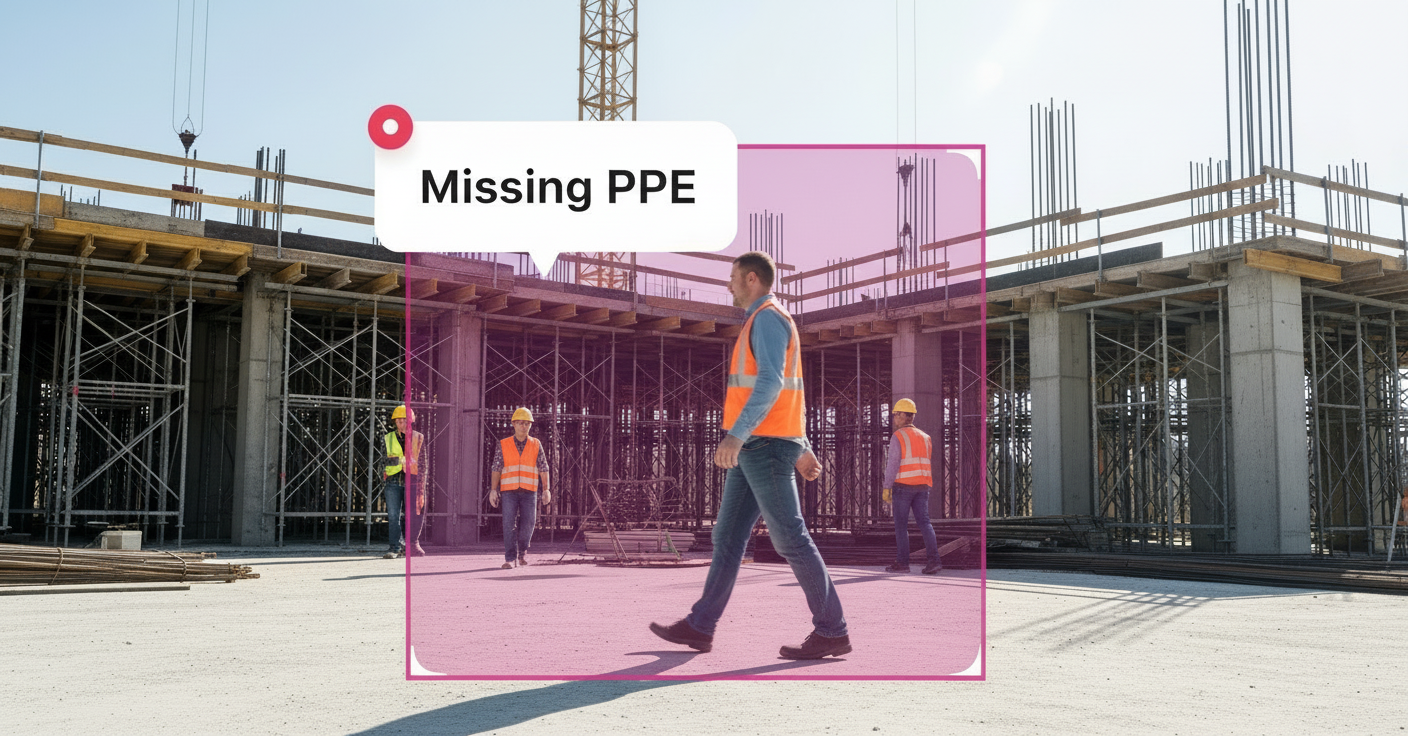
- PPE compliance: Continuous monitoring verifies the presence of hard hats, safety vests, and harnesses, identifying compliance gaps that manual spot checks often miss.
- Equipment proximity: AI detects when workers are dangerously close to operating machinery, enabling timely alerts to guard against struck-by incidents.
| Feature | Spot AI (Edge AI) | Cloud-Only Solutions | Manual Inspection |
|---|---|---|---|
| Detection Speed | Real-time (Minimal delay) | High Latency (Seconds/Minutes) | Reactive (Hours/Days) |
| Connectivity | Works Offline | Requires Constant Internet | N/A |
| Bandwidth Usage | Low (Process locally) | High (Stream everything) | N/A |
| Privacy | Local Anonymization | Raw Data to Cloud | N/A |
| Scalability | High | Limited by Bandwidth | Low |
Addressing privacy and field resistance
A major obstacle for innovation directors is overcoming field resistance. Superintendents and workers can be skeptical of new technology, viewing it as intrusive monitoring rather than a tool for safety. Edge AI architectures offer a technical solution to this cultural concern through privacy-by-design.
Because processing happens locally, sensitive video data does not need to leave the site to be analyzed. Edge AI systems can apply automated anonymization features, such as face blurring and person masking, before any data is transmitted to the cloud or viewed by off-site stakeholders. This capability helps organizations demonstrate to workers and unions that the technology is strictly for safety monitoring and hazard detection, not for monitoring individual productivity or breaks.
Privacy-focused deployment steps:
- Local redaction: Configure systems to blur faces on the edge device, ensuring identifying information never enters the cloud.
- Data governance: Establish clear policies that distinguish between safety analysis and individual performance tracking, supported by the technical limitations set within the system.
- Transparent communication: Use the privacy features of edge AI as a selling point during pilot rollouts to gain buy-in from field teams.
Integrating safety data with BIM and project workflows
Innovation leaders often deal with multiple disconnected tools and data silos. A standalone safety camera system adds little value if it doesn't communicate with existing platforms like Procore, Autodesk Construction Cloud, or BIM 360.
Edge AI systems can serve as a bridge between physical site conditions and digital project records. By integrating real-time safety data with Building Information Models (BIM), organizations can create context-aware alerts. For example, the system can reference BIM data to understand that a specific area is a designated fall hazard zone based on the project design, rather than just a generic location.
Integration opportunities include:
- Automated incident reporting: When a safety violation is detected, the system can automatically generate an incident record in the project management platform, complete with time-stamped video evidence.
- Schedule verification: Visual data can verify progress against the schedule, helping VDC teams correlate safety incidents with specific project phases or contractors.
- Resource planning: Data on work patterns and bottlenecks can flow into ERP systems to inform future resource allocation and cost estimation.
Driving ROI through operational efficiency
To secure budget approval from CFOs, innovation directors must demonstrate value beyond safety compliance. Edge AI turns video data into a source of operational intelligence that drives productivity and reduces waste.
Video analytics can track time allocation across project activities, identifying situations where crews are idle or where work handoffs create delays. Unlike manual time studies that require dedicated personnel and introduce observer bias, continuous video analysis captures actual work patterns across entire shifts.
Operational use cases for ROI justification:
- Bottleneck detection: Identify congestion points or inefficient material flow that slows down progress.
- Dispute resolution: Use objective, time-stamped video evidence to help resolve liability claims or subcontractor disputes faster than manual approaches.
- Equipment utilization: Track whether expensive machinery is being used effectively or sitting idle, allowing for better rental management.
The path forward for ConTech leaders
The adoption of edge AI on construction sites offers a pragmatic solution to the industry's most pressing safety and operational obstacles. By processing data locally, construction firms can overcome the limitations of site connectivity, reduce the latency of critical safety alerts, and address privacy concerns that hinder technology adoption. For innovation and ConTech leaders, edge AI provides a scalable path to modernize site safety without adding headcount or navigating complex IT roadblocks.
Transitioning from reactive responses to proactive risk reduction requires the right technology partner. Spot AI adds AI-powered analysis to your existing cameras, providing real-time insights to help standardize processes, reduce risk, and support workforce safety.
Want to experience Spot AI’s edge video AI in action? Request a demo to see how real-time safety insights work on your construction site.
Frequently asked questions
How can AI improve safety on construction sites?
AI improves safety by continuously monitoring the job site for hazards that human supervisors might miss. It automates the detection of missing PPE, unauthorized entry into dangerous zones, and unsafe proximity to heavy machinery. By providing real-time alerts, AI can help teams intervene sooner, shifting the focus from incident reporting to risk mitigation.
What are the benefits of using edge AI in construction?
Edge AI processes data locally on the device rather than sending it to the cloud. This offers three main benefits for construction: it works reliably even with poor or intermittent internet connectivity; it reduces latency for faster alerts; and it enhances privacy by keeping sensitive raw data on-site while only transmitting necessary insights.
How does real-time monitoring enhance construction safety?
Real-time monitoring helps teams address safety violations quickly after they happen. Instead of waiting for a safety audit or an accident report, supervisors receive on-the-spot notifications of hazards, such as a worker entering a fall zone without a harness. This rapid feedback loop reinforces safe behaviors and helps guard against minor errors escalating into serious injuries.
What technologies are best for hazard detection in construction?
Computer vision powered by edge AI is effective for hazard detection. It can identify specific objects (like hard hats and vests), and track movement patterns (such as vehicles moving too fast). Integrating these visual systems with BIM data can support coordinated safety workflows.
How can AI technologies support compliance?
AI technologies support compliance by providing objective, continuous verification of safety protocols. Automated systems can track PPE adherence rates across different teams and shifts, generating summaries that support OSHA reporting when configured. This data helps management identify trends, target training where it is needed most, and maintain a verified record of safety standards without the administrative overhead of manual logging.
About the author
Nate Lee is an AI Architect at Spot AI who designs the computer-vision models and edge-cloud pipelines that power the company’s Video AI Agents.

