






In the high-speed environment of metals packaging, balancing aggressive production targets with zero-harm safety standards is a constant operational pressure. For leaders overseeing these complex facilities, the risk of a safety incident is always present, with fall protection violations remaining the most cited OSHA violation for the fifteenth consecutive year (Source: Fall Protect). This persistent compliance gap highlights a fundamental roadblock: manual safety checks, especially for personal protective equipment (PPE) like safety harnesses, are often inefficient and inconsistent across multiple shifts. The inability to verify compliance 24/7 creates regulatory exposure and operational risks that can lead to costly downtime and, more importantly, severe worker injuries.
The high cost of manual safety checks in metals packaging
Ensuring every worker on every shift uses the correct PPE is a monumental task. The reality for many manufacturing facilities is that manual compliance verification is inefficient. It consumes valuable supervisor time with audits that still miss violations, creating both safety risks and regulatory exposure. This is particularly true in the metals packaging sector, where workers navigate heavy machinery and elevated work areas. Fabricated metal product manufacturing reported an injury rate of 3.2 cases per 100 full-time workers in a recent year, highlighting its inherent hazards (Source: U.S. Bureau of Labor Statistics).
The human element introduces further complexity. Safety inspectors experience fatigue and distractions, leading to inconsistent standards and missed violations. This reliance on manual observation is a major factor in why manufacturing faced 8,383 OSHA citations and $30 million in fines in 2023 alone. When an incident does occur, the consequences are severe. Beyond the direct costs of an average indemnity claim, which can be $38,538, facilities face operational disruption, production stoppages for investigations, and damage to team morale (Source: Kinetic Compliance).
Why harness compliance remains a persistent manufacturing safety obstacle
Falls are the leading cause of serious injuries in general industry, and the data shows a clear pattern of failure in this area. Four of OSHA's top ten violations in 2025 directly relate to fall protection, including general requirements, ladder safety, training, and scaffolding. Together, these categories accounted for 11,231 violations, or about 51% of all top ten violations. This concentration reveals that a substantial portion of compliance failures is tied to mitigating fall risks and ensuring the proper use of fall protection equipment like harnesses (Source: CCI Comply).
OSHA requires employers to protect workers from fall hazards at heights of four feet or more in general industry settings. This involves providing fall arrest systems, which include full-body harnesses designed to distribute impact forces. However, providing the equipment is only the first step. The bigger barrier is ensuring it's used correctly every time. When an incident occurs, determining whether protocols were followed often becomes a "he-said-she-said" situation. Without clear, time-stamped video evidence, it's tough to drive accountability and make fact-based improvements.
How video AI automates missing PPE harness detection
Instead of relying on periodic manual checks, organizations can leverage video AI to act as a digital force multiplier, turning existing cameras into AI teammates that monitor for missing PPE 24/7. This technology addresses the core frustration of reactive firefighting by enabling forward-looking management.
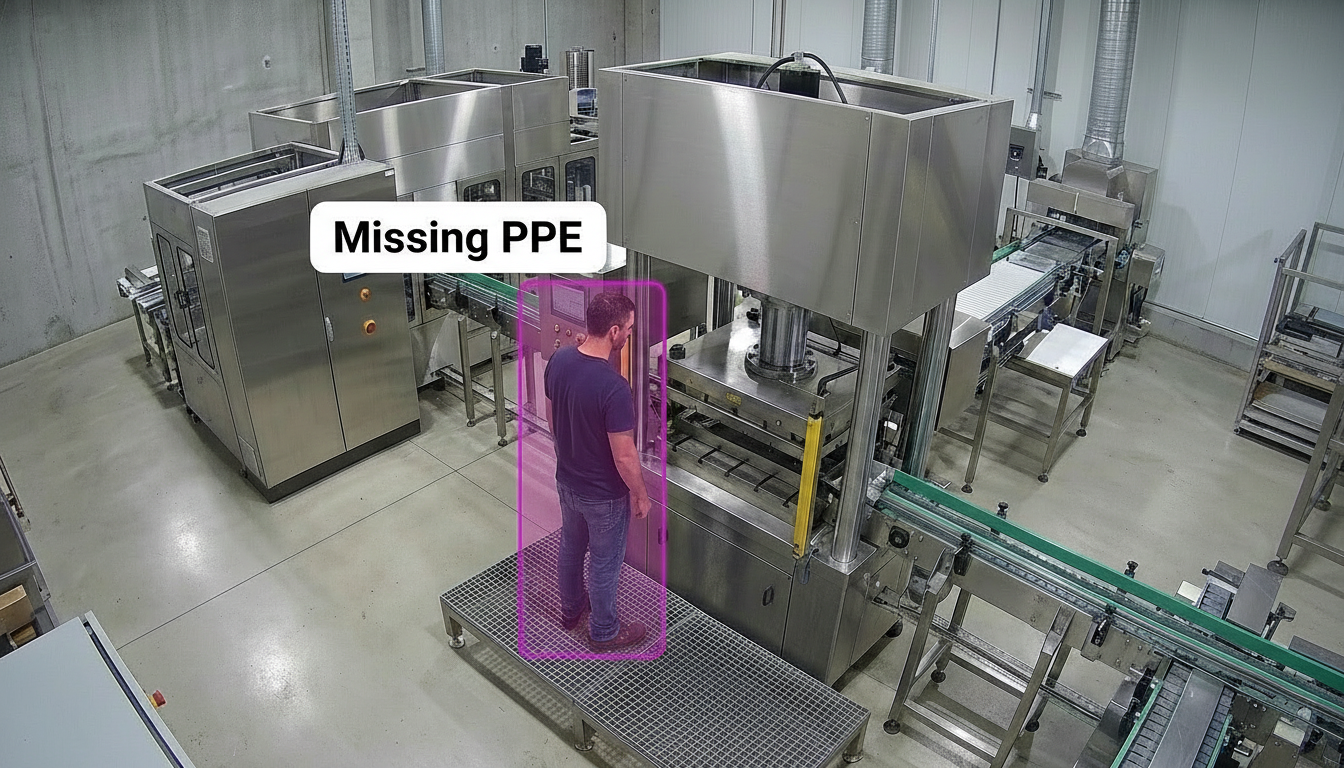
AI-powered systems for PPE detection use computer vision to identify required safety equipment in video feeds and flag infractions as they happen. These platforms analyze video to detect the presence or absence of specific items like hard hats, vests, and safety harnesses. When the system identifies a worker without the required harness in a designated high-risk zone, it can generate an alert for supervisors.
Spot AI’s platform includes a Missing PPE detection template that can be configured specifically for harnesses. Here is how the process works:
- Your existing IP cameras capture footage of work areas where harnesses are required.
- The video stream is analyzed by an AI agent trained to recognize workers and check for the presence of a safety harness.
- If a worker is detected without a harness in a pre-defined zone, the system can send an alert to supervisors, allowing them to intervene on the spot.
- The event is automatically logged with video evidence, creating an objective record for coaching or incident review.
This automated approach moves safety monitoring from a reactive, manual process to a proactive, data-driven one. Studies show that modern AI systems can reliably detect multiple PPE types, demonstrating the accuracy needed for practical deployment in industrial settings.
From alerts to insights: building a data-driven safety program
A video AI platform converts raw safety data into actionable insights, empowering you to build a stronger safety culture. By automatically tracking and logging PPE compliance, you can move beyond simply reacting to individual infractions and start identifying systemic patterns.
Key capabilities that support a data-driven program include:
- Compliance analytics: Dashboards can track compliance trends over time, by location, or by shift. If a specific production line consistently shows lower harness compliance, leaders can deploy targeted training or procedural changes.
- Objective documentation: Automated email alerts with violation snapshots provide timely notification and create a documented audit trail. This eliminates ambiguity during incident investigations and helps facilitate fact-based coaching conversations.
- Compliance scoring: Systems can quantify safety adherence by calculating compliance percentages. This provides an objective measure of performance, helping to benchmark progress and identify areas needing improvement.
- Faster investigations: In the event of an incident, intelligent search allows teams to find relevant footage in seconds rather than hours. Searching for "person without harness near Line 3" delivers the exact clip needed, accelerating root cause analysis.
| Capability | Manual Monitoring | AI-Powered Monitoring with Spot AI |
|---|---|---|
| Consistency | Periodic spot-checks, varies by shift and supervisor | Continuous 24/7 observation across all cameras |
| Objectivity | Subjective, depends on individual inspector's judgment | Data-driven, based on pre-defined AI models |
| Documentation | Manual logs, often incomplete or inconsistent | Automated, time-stamped video evidence |
| Scalability | Resource-intensive; requires more staff to cover more areas | Highly scalable; add more cameras to the platform without adding headcount |
| Foresight | Reactive; often identifies issues after they occur | Anticipatory; real-time alerts help reduce incidents |
A framework for implementing harness detection AI
Adopting AI-powered safety monitoring is a strategic initiative that enhances operational discipline. A phased approach ensures a smooth transition and builds buy-in from the ground up.
- Conduct a risk assessment and start with a pilot program. Begin by identifying the highest-risk areas in your facility where fall hazards are most prevalent. Deploy AI monitoring on a small scale, such as on a single production line or maintenance area. Define clear success metrics, like achieving 90% detection accuracy, to validate the technology in your specific environment before a wider rollout.
- Focus on system integration and change management. Involve safety supervisors, plant managers, and frontline workers from the start. Transparent communication about the system's purpose—to help keep teams safe through coaching and support—is crucial for building trust. Integrate the system's alerts into existing workflows to ensure they are actionable.
- Prioritize workforce communication and training. Teach teams how to interpret alerts and respond appropriately. Reinforce foundational safety knowledge about why harnesses are required and how to inspect them. When workers understand that the technology is a tool to help keep them safe, they are more likely to embrace it as a supportive AI teammate.
Take the next step toward a safer, more compliant facility
Manual safety checks are no longer sufficient to manage the complex risks in modern metals packaging facilities. The persistence of fall-related incidents and the high cost of compliance failures demand a more reliable and scalable approach. AI-powered harness detection offers a proven solution to improve safety, ensure regulatory compliance, and minimize the operational disruptions that impact your bottom line. By turning your existing cameras into an intelligent monitoring system, you can empower your teams to move from reactive firefighting to proactive risk mitigation.
See how Spot AI’s video AI platform can help your team mitigate fall-related risks and strengthen safety compliance. Book a demo to experience harness detection and compliance analytics in action.
Frequently asked questions
How does video analytics enhance workplace safety?
Video analytics enhances workplace safety by automating the monitoring of protocol compliance, like PPE usage. It uses video AI to analyze feeds in real time, detect issues such as a missing safety harness, and alert supervisors. This allows for timely intervention and provides objective data to identify risk trends and inform targeted safety improvements.
What are the best practices for ensuring PPE compliance?
Best practices include conducting thorough hazard assessments to identify where PPE is needed, providing comprehensive training on proper use, and performing regular equipment inspections. To overcome the limitations of manual checks, augmenting these practices with automated monitoring technology like video AI ensures 24/7 observation and creates an objective record of compliance.
How does harness detection AI work?
Harness detection AI uses computer vision algorithms to analyze video from standard IP cameras. The AI model is trained on large datasets to recognize people and determine if they are wearing a safety harness. If a person is detected in a designated zone without a harness, the system automatically triggers an alert and logs the event with corresponding video evidence.
About the author
Dunchadhn Lyons leads Spot AI’s AI Engineering team, building real-time video AI for operations, safety, and security—turning video data into alerts, insights, and workflows that cut incidents and boost productivity.

