




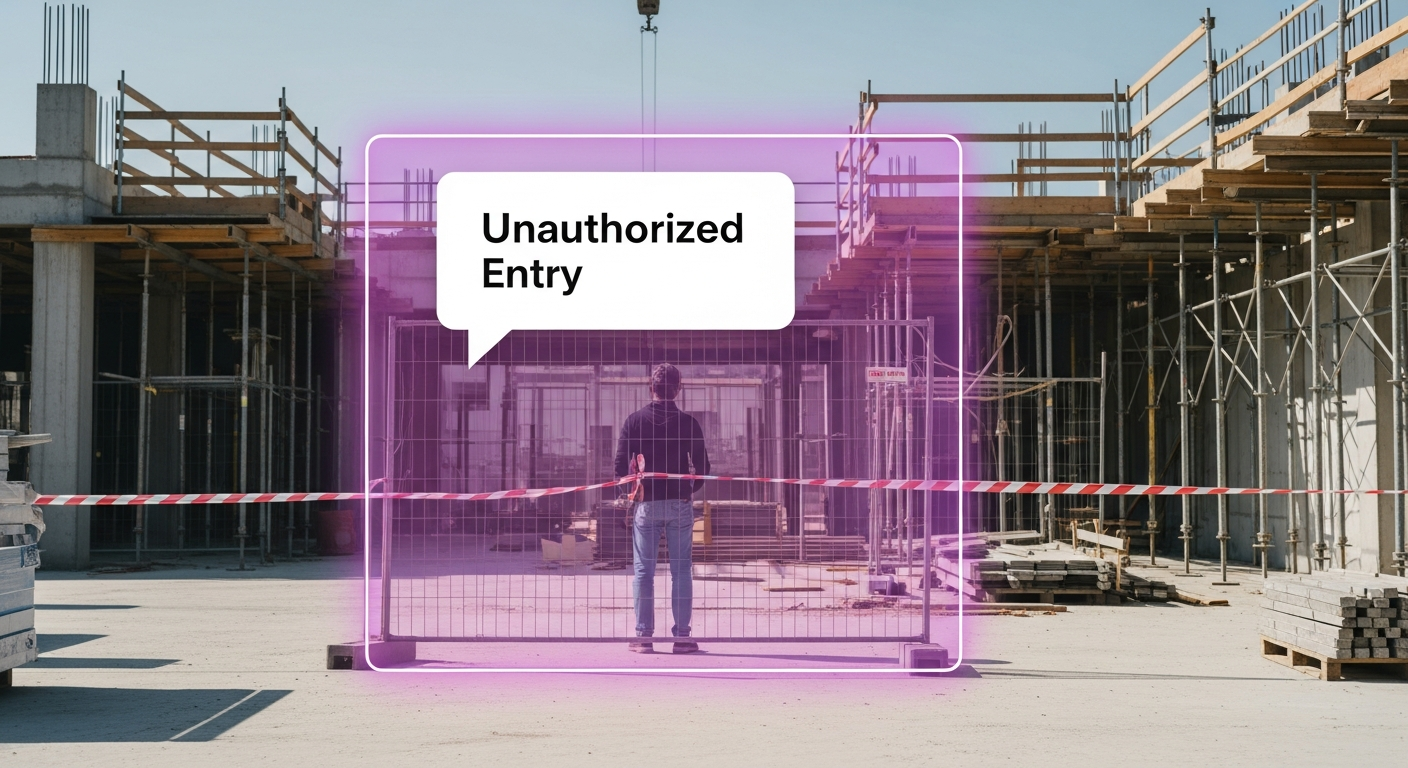


Every General Superintendent knows the sinking feeling of arriving at a job site on Monday morning to find a gate chain cut or a skid steer missing. The initial loss of the asset is painful, but the ripple effects are worse: schedule delays, insurance paperwork, potential liquidated damages, and the erosion of client trust.
For decades, construction security relied on two imperfect options: expensive human guards who cannot watch every corner at once, or passive camera systems that simply record the crime for later viewing. Neither solution reliably deters theft in the moment.
Today, video technology has evolved from passive recording into an active member of the site team. By combining computer vision with human-like voice responses, modern video systems can detect unauthorized access and intervene in real time. This approach, known as active deterrence, shifts the focus from investigating crimes to reducing the likelihood of incidents and interrupting them sooner.
This guide explores how AI-enabled active deterrence works, how it addresses the specific frustrations of site leaders, and how to implement it to protect your project’s schedule and budget.
The high cost of reactive security
The traditional "record and review" model of site security is failing construction teams. National data indicates that construction sites face annual theft losses ranging from $300 million to $1 billion, with recovery rates for stolen goods sitting below 25% (Source: Milesight).
For a Superintendent, the direct cost of a stolen generator or copper piping is just the tip of the iceberg. The hidden costs often do more damage to the project’s health:
- Schedule disruption: losing critical equipment halts work phases. If a specialized tool or machine is stolen, work stops until a replacement arrives, potentially triggering penalty clauses for delays.
- Insurance premiums: repeated claims reduce coverage flexibility and drive up premiums, impacting the profit margins on future bids.
- Operational friction: managing police reports and insurance claims pulls site leadership away from their core job—building the project.
- Rework costs: vandalism often requires completed work to be torn out and reinstalled, leading to significant labor and material costs for that segment.
Why traditional measures fall short
Physical barriers and reactive cameras leave gaps that sophisticated thieves exploit.
- Fencing: easily cut or climbed. It provides a boundary, not a defense.
- Locks: only effective until forced. They provide no notification when breached.
- Passive cameras: they document the theft but do not stop it. Reviewing footage after the fact is time-consuming and rarely leads to asset recovery.
- Security guards: while effective, they are expensive and have human limitations. A guard cannot monitor a 10-acre site simultaneously, and fatigue during overnight shifts (10 PM – 2 AM) creates vulnerability windows (Source: WCCTV).
Understanding active deterrence and human-like responses
Active deterrence uses video systems to detect activity and trigger warnings. Instead of waiting for a human to review footage, the system uses AI to flag potential intruders and automated tools to warn them away.
The most effective component of this technology is the "human-like response."
How it works
- AI detection: computer vision analyzes video feeds in real time to identify specific objects (people, vehicles) or behaviors (loitering, crossing a perimeter line).
- Verification: the system filters out nuisance alerts from things like stray animals or wind-blown debris, reducing false alarms by up to 70-80% (Source: WCCTV).
- Intervention: upon verifying an intruder, the system triggers a response. This can be a strobe light, a siren, or most effectively, a spoken warning.
The power of the voice-down
Research in deterrence theory suggests that the certainty of being caught is a stronger deterrent than the severity of the punishment.
A generic siren might be ignored as background noise. However, a human voice saying, "You are being monitored. Leave the area now," creates a psychological "spotlight effect." It confirms to the intruder that they have been seen by a person, not just a machine.
The mere presence of security cameras can be a powerful deterrent. When that is combined with voice communication that mimics human presence, deterrence can improve.
| Feature | Passive video systems | Active deterrence systems |
|---|---|---|
| Detection | Records motion (often false alarms) | AI detects people/vehicles in real time |
| Response | None (recording only) | Lights, sirens, and voice warnings |
| Timing | Forensic (hours/days later) | Real-time (seconds) |
| Outcome | Evidence for police report | Deters incidents |
Using AI for site safety and efficiency
While security is the primary driver for active deterrence, the same Video AI technology solves other critical pain points for Superintendents, such as safety compliance and subcontractor accountability.
1. Real-time safety monitoring
OSHA compliance is a daily battle. Traditional methods rely on site walks, which only capture a snapshot of activity. Video AI provides continuous safety visibility.
- PPE detection: systems can detect missing hard hats or high-visibility vests. If a worker enters a zone without proper gear, the system can log the event or issue an automated reminder.
- No-go zones: AI can monitor hazardous areas, such as active demolition zones or crane swing radiuses. If a person enters these "No-go zones," the system triggers an alert to help reduce the risk of accidents.
2. Managing subcontractors and disputes
Disputes over timeline delays or site damage are common. Without objective data, these become "he-said-she-said" arguments.
- Visual verification: high-definition, time-stamped video provides verified evidence of who was on site and when.
- Accountability: if damage occurs to finished work, video data can pinpoint exactly which trade was in the area at that time, resolving liability questions in minutes rather than days.
3. Reducing false alarms
Superintendents often disable alerts from traditional systems because they are bombarded by notifications every time a tarp flaps in the wind.
Advanced AI filtering distinguishes between actual intruders (a person climbing a fence) and environmental noise (shadows, animals). This reduces nuisance alarms by up to 80%, so alerts are more likely to be relevant (Source: OpenEye).
Implementing active deterrence on your job site
Deploying this technology requires a strategic approach to ensure coverage without disrupting operations.
1. Assess your site risks
Before installing hardware, map out your vulnerabilities.
- Perimeter weak points: where is fencing most likely to be breached?
- High-value targets: where are generators, copper rolls, and heavy equipment staged?
- Access points: are gates monitored for unauthorized vehicle entry?
2. Choose the right deployment model
Construction sites vary in infrastructure. Your security setup should match your power and connectivity reality.
- Solar-powered mobile units: ideal for early-phase projects or sites without reliable power. These trailers operate independently, use cellular connectivity, and can be relocated as the site evolves.
- Fixed systems: better for long-term projects (18+ months) with established utilities. These offer lower operating costs over time but require installation effort.
3. Define your response protocols
Technology needs a process. Decide how alerts should be handled.
- Automated voice: for perimeter breaches at night, a rapid automated voice warning is often sufficient.
- Live monitoring: for high-risk sites, verified alerts can be routed to a remote monitoring center where a live operator speaks directly to the intruder. This "man-in-the-loop" verification minimizes police dispatch fees for false alarms.
4. Integrate with your stack
Don't let video data sit in a silo. Modern video platforms integrate with project management tools like Procore. This allows security incidents or safety violations to be logged directly into your daily reports, keeping all project data in one place.
Comparison: video AI vs. traditional solutions
When evaluating solutions, it is vital to look at deployment speed, flexibility, and total cost of ownership.
| Feature | Spot AI | Traditional guard services | Legacy Camera Systems |
|---|---|---|---|
| Deployment speed | Fast (plug-and-play hardware) | Slow (staffing & scheduling) | Slow (complex wiring/servers) |
| Cost structure | Scalable SaaS model | High hourly rates | High upfront capital |
| Deterrence | Active (AI Agents + Voice) | Reactive/limited coverage | Passive (recording only) |
| False alarms | Low (AI filtering) | N/A | High (motion-based) |
| Searchability | Google-like search | None (manual logs) | Manual scrubbing |
| Site visibility | Unified Cloud Dashboard | Site-specific only | Local DVR access only |
Securing your schedule, budget, and team
For the Site Superintendent, the goal is clear: keep the project moving, keep the crew safe, and protect the budget. Reactive security measures that only tell you what was stolen yesterday are no longer sufficient.
Active deterrence with human-like responses offers a practical solution to the persistent problems of theft, vandalism, and liability. By turning cameras into intelligent teammates that can see, analyze, and speak, you help create a site that is better defended. This technology doesn't just secure the perimeter; it standardizes safety, helps resolve disputes, and ultimately protects the project's bottom line.
Want to see Spot AI in action on your job site? Request a demo to experience how video AI can help protect your team and assets.
Frequently asked questions
How effective are voice warnings compared to sirens?
Research indicates that intruder abandonment rates hit approximately 70% when human-like voice warnings are issued within 30 seconds of detection. Unlike sirens, which can be ignored as background noise, voice commands confirm active monitoring and escalate the perceived risk for the intruder (Source: WCCTV).
Can these systems work without site power or WiFi?
Yes. Mobile solar-powered units are designed specifically for construction environments. They utilize solar panels with battery backups for power and 4G/5G cellular connections for data transmission, supporting 24/7 operation even on greenfield sites.
Will AI security systems help lower insurance premiums?
Sometimes. Documented security measures, including 24/7 monitoring and perimeter access controls, can help when negotiating premiums; outcomes vary by insurer and policy and are not guaranteed (Source: Latium Technologies).
How does the system handle false alarms from weather or animals?
Modern Video AI uses deep learning to classify objects. It distinguishes between a "person" or "vehicle" and general motion like rain, shadows, or stray animals. This filtering reduces false alarms by 70-80%, mitigating alert fatigue for site supervisors (Source: WCCTV).
What happens if the internet goes down?
Robust systems use edge processing, meaning the AI analysis happens on the local device (the camera or appliance) rather than in the cloud. This helps detection and recording continue even during internet outages, uploading data once connectivity is restored.
About the author
Sud Bhatija is COO and Co-founder at Spot AI, where he scales operations and GTM strategy to deliver video AI that helps operations, safety, and security teams boost productivity and reduce incidents across industries.

