




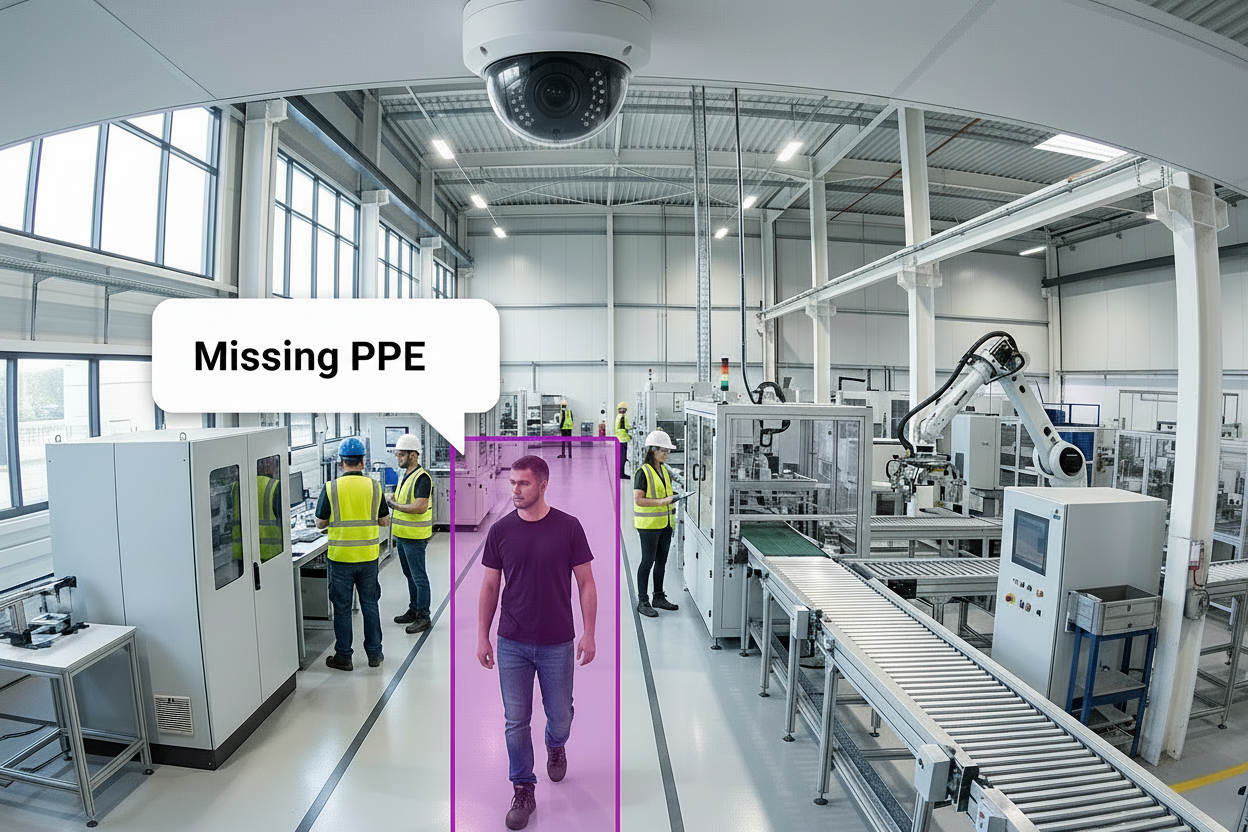


Video AI platforms can unlock far more value from the cameras across your facility—but not if your team is overwhelmed by a steady flow of low-value alerts.
Traditional video monitoring systems that trigger on simple motion lack the intelligence to distinguish between routine activity and a genuine operational issue, creating a cycle of alarm fatigue and reactive problem-solving. To make video data truly useful, you need a system that understands context.
This article provides a practical guide for how to manage and act on context-aware detections. We will explore how to move beyond simple motion alerts to a system that delivers meaningful, real-time insights, enabling your teams to standardize shifts, improve safety, and refine production workflows.
Understanding the basics: context-aware detection vs. motion alerts
Context-aware detection is a clear improvement over the motion-based alerts of traditional closed-circuit television (CCTV) systems. While older platforms can only detect movement, they cannot comprehend the meaning behind it, leaving staff to manually interpret hours of footage. This leads to a high volume of false alarms, training supervisors to ignore notifications that could signal real problems.
In contrast, context-aware detection uses video AI to interpret visual information within the specific operational setting of your facility. It learns to distinguish between routine work and unsafe behavior, or between normal equipment function and a potential malfunction.
For example, a context-aware system understands that a manager walking through a designated production zone is normal activity, but that same person entering a restricted, high-voltage area is a safety risk that requires a timely alert. This intelligence layer filters out the noise, ensuring that your team only receives alerts for events that truly matter.
The daily roadblocks of managing alerts in a manufacturing setting
Without context, video data can create more work than value. Operations and safety leaders in manufacturing environments often face a set of recurring frustrations that hinder them from moving from a reactive to a more proactive approach.
- Blind spots during off-shifts: It is tough to physically monitor all production areas at once, especially during second and third shifts. This creates anxiety about safety violations, equipment misuse, or production slowdowns happening without anyone knowing until it's too late.
- Reactive incident response: When an incident occurs, legacy video systems require supervisors to spend hours manually reviewing footage. This "too little, too late" approach makes it tough to intervene in real time to reduce the likelihood of accidents or catch safety violations as they happen.
- Excessive administrative load: The time spent searching for footage to investigate an incident, complete a safety audit, or generate a compliance report is time taken away from coaching teams and optimizing production. This administrative weight directly impacts productivity and morale.
- Inconsistent SOP adherence: When not directly supervised, workers may deviate from standard operating procedures (SOPs), leading to quality issues, safety risks, and efficiency losses. Without a reliable way to monitor adherence, it is difficult to enforce standards consistently across all shifts.
- Lack of data for root cause analysis: When production issues or safety incidents occur, a lack of clear, time-stamped visual evidence makes it difficult to identify the root cause. This leads to recurring problems and hampers continuous improvement efforts.
A framework for managing and acting on context-aware detections
To transform your video AI platform from a passive recording tool into an active operational assistant, you need a structured approach. The following framework helps you manage detections and turn them into decisive actions that improve safety, efficiency, and compliance.
1. Set up intelligent alerts that matter to your operations
The first step is to configure your video AI platform to monitor for the specific events that impact your bottom line. Instead of generic motion alerts, focus on context-aware detections that align with your operational goals. With Spot AI, you can deploy pre-trained AI Video Agents to monitor for specific activities, including:
- No-go zones: Receive an alert when a person or vehicle enters a restricted or hazardous area. This is essential for guarding against unauthorized access to areas with active machinery and reducing the likelihood of collisions.
- Missing PPE: Automatically detect if personnel are missing required personal protective equipment, such as hard hats or safety vests, in designated zones. This helps enforce safety compliance and reduce OSHA violation risks.
- SOP adherence: Monitor for behaviors that indicate a deviation from standard procedures, such as an unattended workstation or running in a pedestrian walkway. These detections provide visual evidence for coaching and process improvement.
By focusing on these context-rich events, you reduce the noise of false positives and help ensure your team receives alerts that require attention.
2. Establish a real-time response workflow
Once a meaningful event is detected, the alert must be delivered to the right person through a channel they actively use. Real-time monitoring enables teams to intervene while an issue is still unfolding, not hours or days later.
Spot AI’s unified platform delivers alerts directly to your team’s mobile devices or desktops. This allows supervisors to act in seconds, whether they are on the floor or off-site. With a single click, they can view the live footage, understand the context, and decide on the appropriate response. This capability transforms supervision from a reactive, after-the-fact process into a forward-looking one, giving leaders the power to troubleshoot issues before they impact production targets.
3. Streamline incident investigation and analysis
A major source of administrative overhead is the time spent manually searching through footage. A modern video AI platform can significantly speed up this process. Spot AI’s platform indexes video with AI-generated metadata, creating a searchable database of detected events.
Instead of scrubbing through hours of video, supervisors can use keyword search to find exactly what they need. For example, you can quickly find instances of a "person entering a no-go zone" between 2 a.m. and 4 a.m. or locate relevant "missing PPE" events from the previous week. This frees up valuable time for supervisors to focus on coaching and improvements rather than acting as investigators.
4. Use detections for coaching and continuous improvement
Context-aware detections are not just for incident response; they are a powerful tool for driving a culture of continuous improvement. Video evidence of SOP deviations or safety incidents provides concrete, objective data for coaching conversations.
With Spot AI, you can create and share time-stamped video clips of specific events. This allows supervisors to have fact-based discussions with team members, benchmark performance against a "gold standard" SOP, and track progress over time. By automatically capturing and categorizing events, the platform builds a rich dataset for root cause analysis, helping you identify trends and address systemic issues before they lead to bigger problems.
Comparing video AI platforms for context-aware detection
Not all video AI platforms are created equal. When evaluating solutions, it is important to consider factors beyond just the AI models themselves. Deployment speed, hardware compatibility, and user experience are all critical for long-term success.
| Feature | Spot AI | Traditional AI Systems |
|---|---|---|
| Camera Compatibility | Camera-agnostic; works with most existing IP cameras. | Often require proprietary cameras, leading to vendor lock-in. |
| Deployment Time | Go-live quickly with plug-and-play hardware. | Can take weeks or months, requiring complex integration projects. |
| User Interface | Unified dashboard with robust search and broad user access. | Multiple disparate systems for viewing, alerts, and investigations. |
| Alert Accuracy | Pre-trained models for manufacturing can reduce false alarms compared to basic motion detection. | Prone to high false alarm rates from generic motion detection. |
| Scalability | Cloud-native architecture scales across multiple sites. | On-premise systems are difficult and costly to scale. |
Turn your video detections into an operational advantage
Acting on context-aware detections is a proactive strategy rooted in building a system that continuously supports your operational improvement cycle. By filtering out noise and focusing on the events that directly affect your safety and productivity goals, you enable your frontline teams to be more insight-driven, efficient, and consistent. The right video AI platform helps your organization move from reactive firefighting to data-driven improvements, turning your existing cameras into a useful source of operational data.
See how Spot AI’s video AI platform can help you turn video data into actionable insights for your operations. Request a demo to experience context-aware detection in action.
Frequently asked questions
What is context-aware detection in manufacturing?
Context-aware detection in manufacturing is a type of video AI that understands the operational environment of a factory floor. It can distinguish between normal activities, like a worker walking in an approved area, and meaningful events, such as a person entering a restricted zone or a forklift operating unsafely. This intelligence helps minimize false alarms and allows teams to focus on events that impact safety and productivity.
What are the benefits of video analytics in factories?
Video analytics in factories offers numerous benefits, including automated quality control, real-time safety monitoring, and operational improvements. It enables facilities to minimize defect rates, improve SOP adherence, and enhance worker safety by detecting hazards promptly.
What strategies minimize false alarms in manufacturing?
The most effective strategy is to use a video AI platform with context-aware detection. These systems use advanced machine learning to distinguish between genuine issues and routine activities, which can minimize false alerts compared to basic motion sensors. Other strategies include calibrating detection thresholds based on production feedback. If your facility uses additional sensors (e.g., vibration), teams can manually correlate signals for cross-checking.
How can AI improve quality assurance?
AI improves quality assurance by automating visual inspection, which can be faster and more consistent than manual checks. Computer vision systems can identify surface defects, missing components, and incorrect assembly in real time, flagging issues before they move down the production line. This helps lower scrap and rework costs, and supports traceability with archived images for each tracked product.
How to implement AI for defect detection?
A successful implementation starts with a focused pilot project on a single, high-impact production line. Key steps include collecting clean, reliable image data of both good and defective products to train the AI model, integrating the system with existing production workflows, and establishing a feedback loop for continuous model refinement. Using platforms that require minimal custom model training can accelerate deployment.
How are top manufacturers using AI to minimize downtime and incidents?
Leading manufacturers use video AI to shift from reactive to more proactive operations. Instead of reviewing footage only after an incident, they use context-aware alerts for unsafe behaviors like missing PPE or entering hazardous zones to reduce the likelihood of accidents. They also monitor for deviations from standard operating procedures (SOPs) that can cause production bottlenecks, allowing supervisors to address issues as they arise and guard against minor slowdowns escalating into substantial downtime.
About the author
Dunchadhn Lyons leads Spot AI’s AI Engineering team, building real-time video AI for operations, safety, and security—turning video data into alerts, insights, and workflows that cut incidents and boost productivity.

