




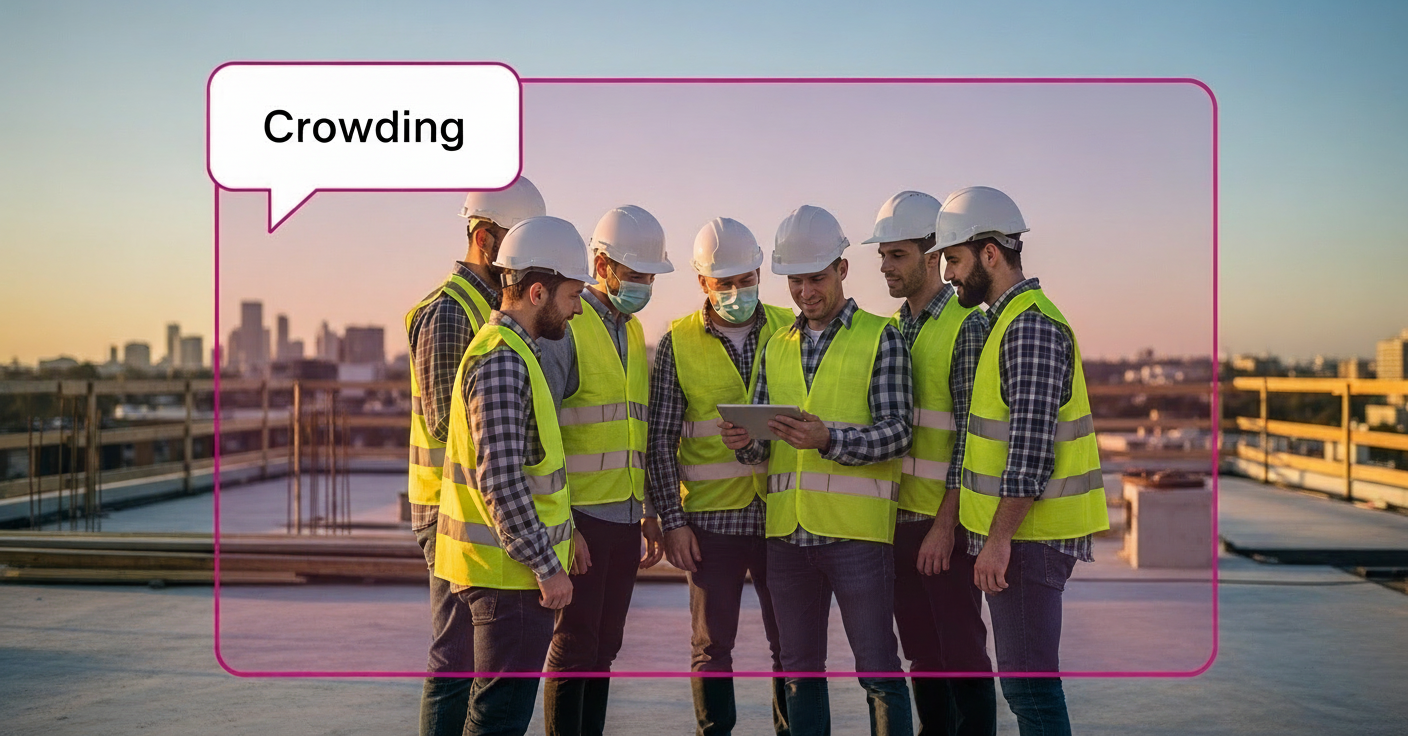


On a dynamic construction site, managing the flow of people is a core safety function. Worker density that exceeds safe thresholds, or crowding, directly elevates the risk of struck-by incidents, falls, and equipment-related accidents (Source: Spot AI). While the intense focus on social distancing from past health crises has evolved, the fundamental need to monitor and manage how people occupy a job site remains a critical hurdle for safety leaders. The constant flux of subcontractors, moving heavy equipment, and changing work zones makes manual oversight tough to manage, increasing the chance of missed issues and regulatory risk.
For safety professionals, this creates a familiar tension: the pressure to maintain project velocity against the non-negotiable mandate to keep every worker safe. The reality is that traditional methods of site walks and visual checks are insufficient for managing the complex, ever-changing patterns of a modern construction project. This article outlines how to move beyond reactive responses by using modern construction site safety technology to monitor for crowding, maintain safe work zones, and create a safety environment built on early detection.
The operational challenges of crowding on construction sites
Unlike a fixed facility, a construction site is a dynamic environment where crowding introduces specific risks. It's not just about having too many people in one place; it's about what happens when that density intersects with moving equipment, temporary structures, and multiple subcontractors working in confined areas.
This constant state of flux leads to several core frustrations for safety leaders:
- Reactive safety management: Responding to incidents after they happen is a reactive cycle of investigation and follow-up that fails to mitigate the initial harm. Crowding is often identified as a contributing factor only after an accident occurs.
- Multi-site compliance roadblocks: Maintaining consistent safety standards and real-time visibility across multiple job sites is a substantial roadblock. What constitutes a crowded zone can differ from one project to the next, making standardized manual monitoring difficult and increasing the risk of undetected violations.
- Coordinating multiple trades: A typical site may have numerous different subcontractors working simultaneously, each with its own safety culture and procedures. Ensuring every team adheres to site-specific density and zoning rules is a major roadblock, especially when you are ultimately liable for their actions.
- The complexity of documentation: Proving compliance to OSHA or an insurance auditor requires clear, reliable documentation. Manual logs and periodic photos are often insufficient to create the clear audit trail used to address citations or claims, pulling focus from ongoing safety work.
Crowding directly contributes to the second leading cause of construction fatalities: struck-by incidents (Source: Dave & Abels). When work zones become congested, equipment operators suffer from reduced visibility, and workers on the ground have limited evacuation pathways. This cognitive overload on everyone present increases error rates and slows response times when a hazard emerges (Source: Spot AI).
Technologies for monitoring crowding and worker density
Fortunately, technology offers a way to gain control over site density without adding headcount. By using existing camera infrastructure to generate useful site data, safety leaders can gain the visibility needed to manage crowding more effectively.
- Video AI for real-time crowding detection: Video AI is the core technology for real-time crowding monitoring. AI-powered video analytics process live camera feeds to identify people, measure their density in predefined zones, and trigger alerts when thresholds are exceeded. Unlike legacy motion detection, these advanced systems can distinguish between people and vehicles even in tough conditions like dust, rain, or low light, which is critical on a construction site. This supports a shift from after-the-fact incident investigation to earlier hazard identification and response.
- People counting and occupancy analytics: People counting solutions provide hard data on worker density by tracking the flow of people at entrances, zone boundaries, and common areas. This generates occupancy data that helps managers identify frequently crowded areas and peak density periods. With this information, you can implement staggered schedules or reconfigure work zones to improve traffic flow and mitigate risk.
- AI-powered pedestrian detection: Specialized AI models focus on the critical interaction between people and moving equipment. These systems can detect a person's location with high accuracy and trigger an alert only when they enter a true danger zone, such as an equipment blind spot. This precision is essential for mitigating "alarm fatigue," where operators begin to ignore frequent, irrelevant alerts, defeating the purpose of the system.
- Real-time alerting and automated response: The true power of these detection technologies is realized when they are connected to real-time alerting systems. When a zone becomes too crowded, the system can automatically send a push notification to a supervisor's phone, trigger an audible alarm, and log a video clip of the event. This helps notify the right people quickly so they can intervene when a risk is detected.
How a video AI platform addresses site crowding
A unified video AI platform like Spot AI brings these technologies together, adding AI tools that help you monitor and manage site density. It provides a practical solution to the core frustrations of manual, reactive safety management.
- Monitor crowding and no-go zones automatically: With Spot AI, you can define specific zones on a camera's view and set thresholds for crowding. When the number of people in a designated area exceeds your safety limit, the AI Agent automatically sends an alert with a video clip to supervisors. The same principle applies to Person Enters No-go Zones and Vehicle Enters No-go Zones analytics, which are crucial for keeping workers clear of heavy equipment paths and other hazardous areas. This automated monitoring frees your team from constant manual checks and enables intervention before issues escalate.
- Gain visibility across all your projects: For leaders overseeing multiple sites, the pain point of maintaining consistent standards is immense. Spot AI's cloud-based dashboard provides a single interface to view all your locations. You can monitor compliance, review alerts, and assess risks across your entire portfolio from anywhere, allowing you to deploy resources where they are needed most and address the "multi-site compliance oversight" roadblock head-on.
- Create a verified, time-stamped record for compliance: When a crowding or no-go zone violation occurs, Spot AI automatically creates a time-stamped video record. This documentation is useful for enforcing accountability with subcontractors and provides a clear audit trail for OSHA or insurance reviews. Instead of spending days searching for footage after an incident, you can find specific events faster, reducing investigation time and documenting your compliance efforts.
- Receive alerts that matter: Too many false alarms cause teams to tune out notifications. Spot AI's AI Agents are pre-trained to focus on safety-critical events involving people and vehicles, filtering out irrelevant motion from things like weather or debris. This intelligence reduces nuisance alerts and ensures that when your team receives a notification, it warrants their attention.
Best practices for implementing a crowding monitoring program
Deploying technology is only the first step. To achieve meaningful results, it must be integrated into your daily operations and safety culture.
- Establish site-specific occupancy standards: Define clear density thresholds for each work zone based on the tasks being performed, the equipment in use, and emergency egress paths. A concrete pour has different spatial needs than a framing crew. Document these standards in your site safety plan and communicate them during daily toolbox talks.
- Use engineering controls first: The most effective way to guard against crowding is to design it out of the workflow. Use physical barriers to create visible work zone boundaries, stagger schedules for different trades to lower peak density, and optimize material staging areas to keep pathways clear.
- Implement clear administrative controls: When engineering controls aren't enough, use standard operating procedures. Designate personnel responsible for monitoring density, establish protocols for temporary work stoppages when limits are exceeded, and make crowding management a key topic in safety meetings.
- Communicate visually and frequently: Use signs, color-coded floor markings, and loudspeaker announcements to keep everyone on site aware of crowding risks and current occupancy levels. Tying these communications to specific hazards, like reduced operator visibility, makes the rules more meaningful and improves compliance.
Measuring the ROI of automated crowding detection
Investing in a video AI platform for crowding detection can provide measurable benefits by improving safety and operational measures that teams track. Organizations using this technology cut safety incidents by 30-50%, with the largest impact on struck-by and equipment-related accidents (Source: Spot AI).
| Benefit Category | Description | Financial Impact |
|---|---|---|
| Incident Reduction | Alerts for crowding and no-go zone violations help mitigate the risk of accidents by enabling faster response, which can improve safety metrics such as TRIR and LTIF over time. | A single serious injury can cost over $42,000 in direct costs, with indirect costs often being significantly higher. Mitigating one incident can pay for the system. (Source: OSHA Education Center) |
| Insurance Savings | A lower Experience Modification Rate (EMR) and a documented history of forward-looking safety management can lead to considerable insurance premium savings. | A lower Experience Modification Rate (EMR) and a documented history of proactive safety management can lead to considerable insurance premium savings. |
| Compliance & Fines | An automated audit trail of alerts and responses provides clear evidence of due diligence, supporting OSHA reviews and responses to citations. | A single serious OSHA violation can result in penalties of over $16,000. Avoiding just one citation provides a substantial return. (Source: OSHA) |
| Operational Efficiency | Heatmaps and occupancy data reveal bottlenecks, enabling better scheduling and material flow. This helps avoid costly project delays and improves productivity. | Optimizing workflows can accelerate the work pace during peak periods, helping to avoid costly project delays. |
Improve your approach to site safety
Managing crowding on a construction site doesn’t have to rely on manual effort and guesswork. By leveraging a video AI platform, you can get real-time visibility and automation to help shift your safety program from reactive to more proactive. This technology helps you enforce occupancy limits and address a common contributor to serious site incidents.
Want to see how Spot AI’s video AI platform can help you cut incidents and simplify compliance across your job sites? Request a demo to experience the platform in action.
Frequently asked questions
What technologies are available for crowd monitoring in construction?
The primary technologies include video AI systems for real-time crowding detection, people counting sensors for occupancy analytics, AI-powered pedestrian detection for monitoring proximity to equipment, and real-time alerting systems that notify supervisors of violations. These are most effective when integrated into a unified platform.
How can AI improve safety on construction sites?
AI improves safety by automating the detection of hazards like crowding, people entering dangerous no-go zones, or missing PPE. It provides real-time alerts that enable faster intervention, helping teams move from reactive investigation to more proactive practices. It also creates an objective video record for incident analysis and training.
What are the best practices for managing crowding?
The best practices involve a layered approach. Start with engineering controls like physical barriers and staggered schedules. Add administrative controls like documented occupancy limits and designated monitors. Finally, use clear communication strategies, such as visual cues and daily reminders, to build a site-wide culture of awareness.
How do compliance regulations affect crowd management?
While OSHA may not have explicit density limits for all situations, its General Duty Clause requires employers to provide a workplace free from recognized hazards. Crowding is a recognized hazard that increases struck-by and fall risks. Documenting your efforts to monitor and manage crowding demonstrates due diligence and helps defend against citations.
What is the ROI of implementing crowd detection systems?
ROI can come from multiple areas: lowered costs from fewer safety incidents and workers' compensation claims, potential savings on insurance premiums, fewer regulatory fines, and improved operational efficiency from better workflow and fewer project delays. Many organizations see a full return on investment in 6-18 months (Source: Spot AI).
How can occupancy data improve project schedules and efficiency?
Beyond safety, occupancy data provides powerful operational intelligence. Heatmaps and historical people counting data reveal which areas are frequently congested and at what times of day. Project managers can use this information to validate trade stacking plans, adjust schedules to reduce crew overlap, and optimize material staging areas. This improves site flow, reduces bottlenecks, and helps keep the project on schedule.
About the author
Tomas Rencoret leads the Growth Marketing team at Spot AI, where he helps safety and operations teams use video AI to cut safety and security incidents as well as boost productivity.

