




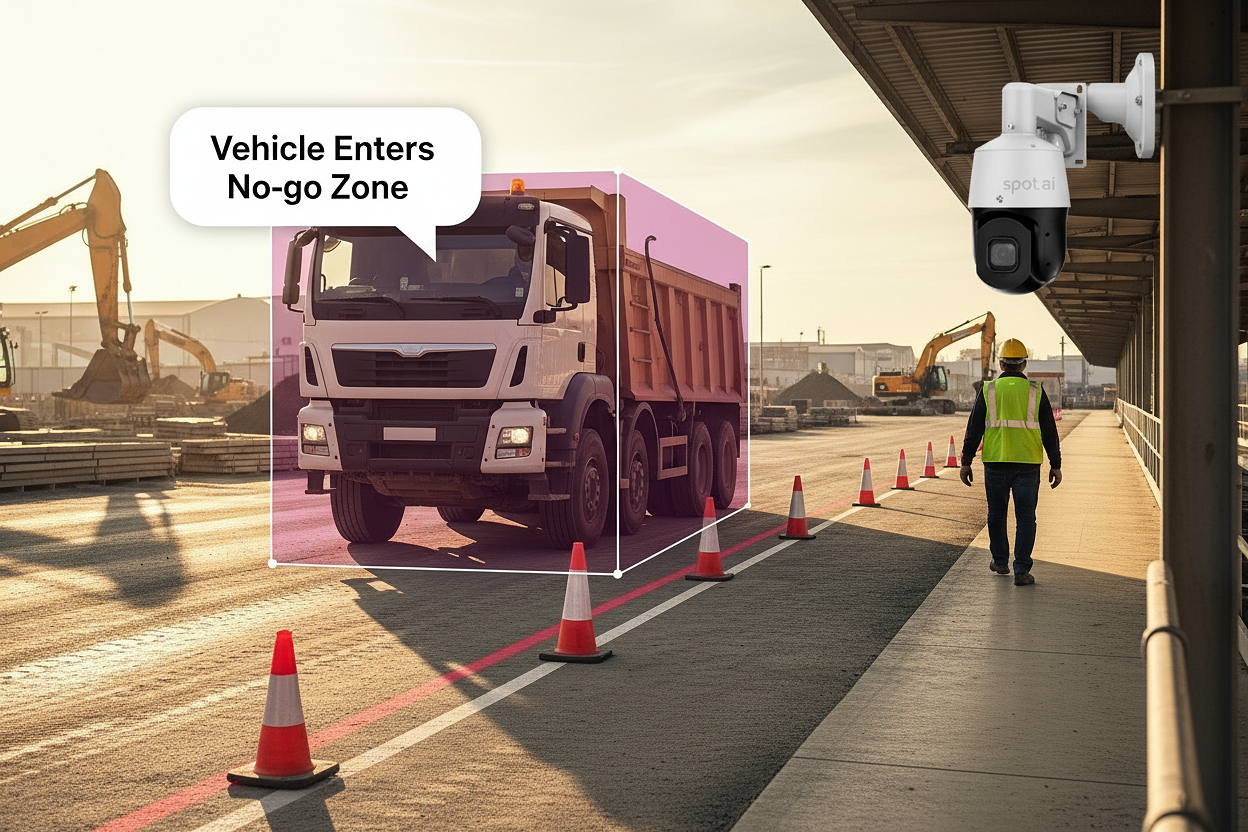


Construction sites are among the most dynamic work environments in the world. A safe access route at 7:00 AM might be blocked by a crane lift at 10:00 AM, and populated by a concrete crew by noon.
For safety directors, managing vehicle movement through these shifting zones is an ongoing challenge driven by visibility gaps and human error.
Struck-by incidents involving vehicles and equipment accounted for 8% of construction worker fatalities in 2023 (Source: U.S. Bureau of Labor Statistics). These incidents rarely happen because a driver intended to be unsafe; they happen because blind spots are large, site layouts change, and manual traffic management relies on fallible human attention.
Traditional methods like orange cones, signage, and spotters are essential, but they are passive. They cannot alert a supervisor when a dump truck takes a shortcut through a pedestrian laydown area. This is where "vehicle enters no-go zone" alerts can improve site safety. By moving from reactive accident investigation to clearer routing enforcement, safety leaders can reduce risk without slowing down operations.
Key terms to know
Before discussing implementation, it is helpful to clarify the specific technologies used in modern construction vehicle monitoring.
- No-Go Zones: Designated areas within a construction site where specific types of traffic (like heavy vehicles) are strictly prohibited to protect workers, infrastructure, or material storage.
- Geofencing: A technology that uses GPS, RFID, or video analytics to create a virtual geographic boundary, triggering an action when a mobile asset enters or leaves that area.
- Video AI: Artificial intelligence that processes live video feeds to identify specific objects (like forklifts or trucks) and behaviors (like entering a restricted zone) in real time.
- Traffic Control Plan (TCP): A dynamic document and operational strategy that specifies safe vehicle routes, pedestrian separation, and signage requirements for a specific project phase.
The limitation: why manual vehicle monitoring fails
Safety directors face a difficult reality: you cannot be on every site, watching every gate, all the time. The "Construction Safety Manager Persona Report" highlights a core frustration: the strain of manual compliance oversight. Spending hours walking a site to check protocols often means missing violations that occur the moment you leave the area.
The complexity of managing multiple subcontractors adds to this friction. When 10 to 15 different trades operate simultaneously, maintaining consistent adherence to vehicle routing plans is nearly impossible with manual supervision alone. A subcontractor delivering materials might not be familiar with the day's specific exclusion zones, and without real-time visibility, safety teams often only learn about a routing violation after an accident—has occurred.
Reactive safety management often leads to last-minute responses. Teams can spend days reviewing hours of footage to investigate incidents after the fact. To improve this, safety leaders need systems that detect hazards as they happen, not just record them for later.
How 'vehicle enters no-go zone' alerts work
Modern vehicle monitoring systems move beyond simple tracking. They utilize a combination of GPS telematics and computer vision to enforce site boundaries actively.
1. Establishing the digital perimeter
The process begins by mapping the physical site against a digital grid. Safety teams identify high-risk areas—such as active excavation sites, pedestrian walkways, or material staging grounds—and designate them as "no-go zones" for vehicles.
2. Detection and identification
When a vehicle approaches or enters these zones, the technology takes over.
- GPS Geofencing: Uses satellite data to track the vehicle's coordinates. If the coordinates overlap with a restricted zone, the system flags the event.
- Video AI Detection: Cameras equipped with AI agents visually recognize a vehicle. Unlike simple motion detection, Video AI can distinguish between a person, a pickup truck, and a heavy excavator. If a camera monitoring a "pedestrian only" walkway detects a vehicle, it triggers a specific "Vehicle Enters No-go Zone" alert.
3. Real-time notification
Once a breach is detected, the system transmits alerts promptly (subject to network and configuration). This can include notifying the site supervisor by radio or sending a push notification to the safety director’s mobile device. This speed allows for rapid intervention to mitigate risk—rather than a retroactive reprimand.
Practical implementation for safer routing
Deploying technology is only part of the solution. To improve vehicle routing safety on a construction site, safety directors should integrate these alerts into their broader traffic management strategy.
Mapping alerts to project phases
Construction sites change daily. A static geofence is useless if the work zone has moved.
- Review the Traffic Control Plan (TCP): Align your digital no-go zones with the current TCP.
- Update zones weekly: As project phases shift (e.g., from excavation to structural steel), update the alert parameters to reflect new pedestrian paths and material drops.
- Differentiate alerts: Set different alert priorities. A vehicle entering a "muddy area" might trigger a maintenance warning, while a vehicle entering a "trench work zone" triggers a critical safety alarm.
Improving routes with data
"Vehicle enters no-go zone" alerts do more than mitigate accidents; they reveal operational inefficiencies. If drivers frequently trigger alerts in a specific corner of the site, it suggests the designated route is blocked, unclear, or inefficient.
- Analyze breach patterns: Look for clusters of alerts. Are drivers cutting corners because the official route is too narrow?
- Adjust the flow: Use this data to redesign routes that are easier for drivers to follow, naturally improving compliance.
- Minimize reversing: Route optimization can identify patterns where vehicles are forced to back up frequently, a major cause of blind-spot incidents.
Comparing vehicle monitoring technologies
Safety directors often weigh the value of different oversight approaches. While GPS is common for fleet management, Video AI offers distinct advantages for site safety and context.
| Feature | Spot AI (Video AI) | Traditional GPS Telematics | Manual Spotters/Flaggers |
|---|---|---|---|
| Detection Type | Visual confirmation of vehicle type and context | Coordinate-based location tracking | Human observation |
| Deployment Speed | Plug-and-play with existing cameras | Requires hardware installation in every vehicle | Timely, but labor-intensive |
| Subcontractor Coverage | Monitors vehicles within camera coverage on site (no additional vehicle hardware needed) | Only monitors fleet vehicles with installed trackers | Limited by line-of-sight |
| Evidence Context | Provides video clip of the event | Provides data log (time/location) | Verbal report |
| Cost Model | Scalable software license | Hardware + subscription per vehicle | High hourly labor cost |
Spot AI excels in environments with diverse fleets. Since subcontractors often bring their own vehicles which may not have your company's GPS trackers installed, GPS geofencing leaves a visibility gap. Spot AI’s cameras monitor the zone itself, meaning they detect any vehicle that enters, regardless of who owns it or whether it has telematics hardware installed.
Addressing safety culture and compliance
Technology supports safety culture, but it does not replace it. The most effective safety programs use alerts as coaching opportunities, not just disciplinary measures.
Improving subcontractor accountability
A common pain point for safety directors is ensuring consistent safety compliance among the dozens of subcontractors that can be on a site at any one time.
- Objective evidence: When a "Vehicle Enters No-go Zone" alert is triggered, Spot AI provides a time-stamped video clip. This helps clarify disputes.
- Targeted coaching: Instead of holding a generic safety meeting, supervisors can show the specific clip to the subcontractor and discuss safe routing alternatives.
- Contract enforcement: Data on repeated zone violations can be used to enforce safety clauses in subcontractor agreements.
Minimizing alert fatigue
A common risk with any monitoring system is alert fatigue—when too many false alarms cause workers to ignore warnings.
- Precision matters: Using Video AI allows for specific filtering. You can set an alert for "Forklift" entering a zone while allowing "Person" to enter, minimizing false positives that might occur with simple motion detection.
- Tiered notifications: Configure the system so that minor deviations are logged for review, while critical safety breaches (like entering an active blast zone) trigger timely, high-priority notifications to leadership.
Best practices for deployment
To successfully use no-go zone alerts for safer routing, follow these evidence-based practices:
- Start with high-risk zones: Do not try to map the entire site right away. Focus first on areas with high pedestrian-vehicle interaction, such as break areas or site entrances.
- Integrate with orientation: During safety orientation, explicitly show new workers where the digital no-go zones are and explain that the site is actively monitored. Companies with in-depth orientation have Total Recordable Incident Rates (TRIR) 52% lower than those with basic orientation (Source: Associated Builders and Contractors).
- Maintain the system: Ensure cameras have clear lines of sight and that digital zones are updated as the physical site evolves.
- Review metrics regularly: Track the rate of zone breaches over time. A declining rate indicates that your routing plan is working and the safety culture is improving.
Enforcing safer routing with real-time visibility
The complexity of modern construction sites requires more than static signs and manual checks. By leveraging "vehicle enters no-go zone" alerts, safety directors can gain the real-time visibility to help reduce the likelihood of struck-by incidents. This technology supports managing subcontractors, enforcing routing plans, and reducing the administrative load of manual monitoring.
Spot AI helps construction firms use their existing camera infrastructure as a tool that helps teams act sooner. With capabilities like the Vehicle Enters No-go Zones and Forklift Enters No-go Zones templates, Spot AI provides real-time insights to support more consistent safety practices across shifts and sites.
Want to see how video AI can help you manage vehicle routing and safety? Book a demo to experience Spot AI in action.
Frequently asked questions
What are the best practices for vehicle safety on construction sites?
Best practices include establishing a comprehensive Traffic Control Plan (TCP), separating pedestrian and vehicle traffic via physical barriers, and using high-visibility signage. Implementing technology like Video AI to monitor compliance in real-time and holding daily toolbox talks on specific hazards can lower Total Recordable Incident Rates by as much as 78% (Source: Associated Builders and Contractors).
How can geofencing improve vehicle compliance?
Geofencing creates a virtual perimeter that triggers alerts when vehicles enter restricted areas. This improves compliance by providing on-the-spot feedback to operators and supervisors, allowing for rapid correction of unsafe behaviors. It also creates a data trail that helps identify recurring routing issues.
What technologies are available for real-time vehicle monitoring?
The primary technologies include GPS telematics (for location and speed tracking), RFID tags (for proximity detection), and Video AI (for visual context and behavioral analysis). Video AI is particularly effective for monitoring subcontractors who may not have GPS hardware installed in their vehicles.
How can construction companies guard against vehicle accidents?
Guarding against accidents requires a layered approach: engineering controls (designing safe routes), administrative controls (training and protocols), and technology (blind-spot monitoring and no-go zone alerts). Early hazard identification using data from reports of close calls is also critical for averting serious accidents.
What is the best OSHA-aware safety monitoring for construction sites?
While no system is officially 'OSHA-certified,' a Video AI system directly supports key OSHA principles. It helps enforce the separation of vehicles and pedestrians to mitigate struck-by hazards, a major focus for the administration. The system also creates an objective, time-stamped video record of violations, which is crucial for demonstrating a forward-thinking safety program and conducting effective incident investigations (Source: OSHA).
About the author
Sud Bhatija is COO and Co-founder at Spot AI, where he scales operations and GTM strategy to deliver video AI that helps operations, safety, and security teams boost productivity and reduce incidents across industries.

