




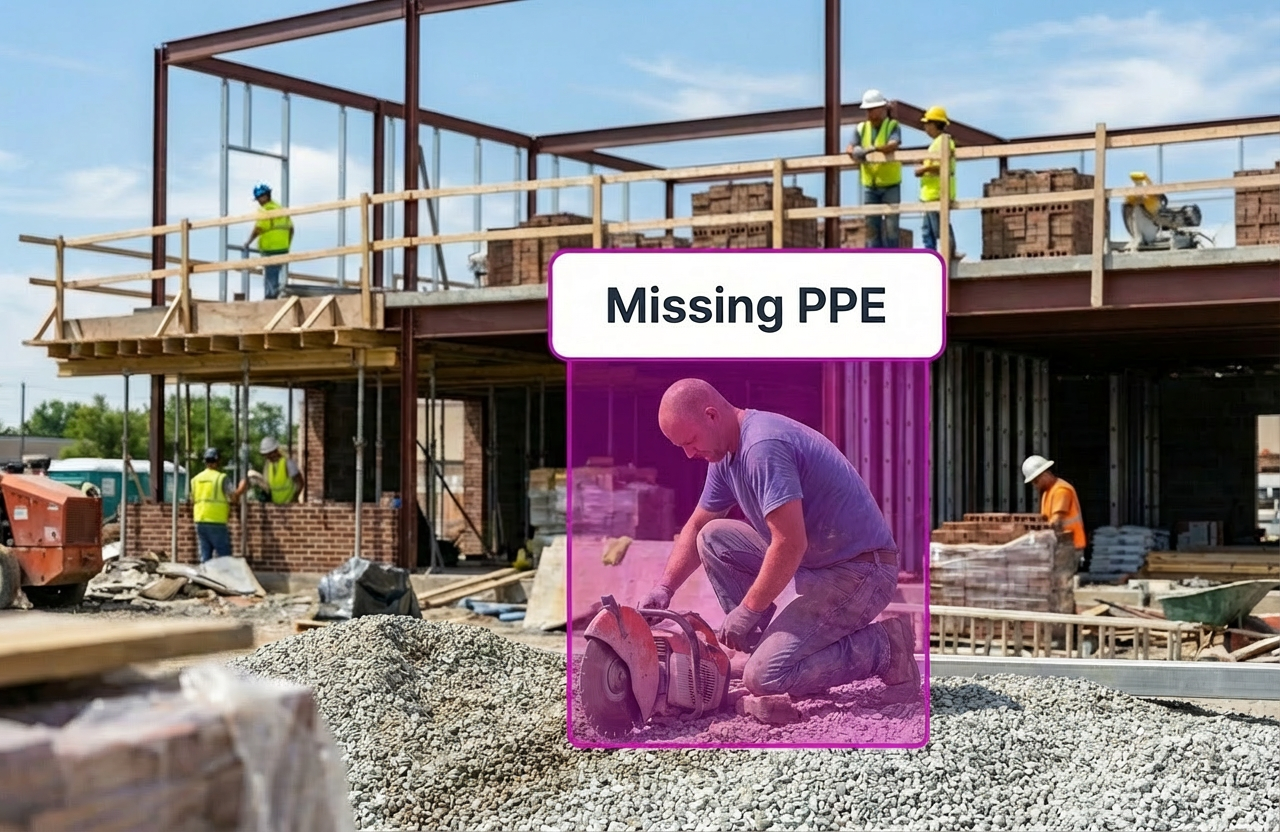


Managing safety across multiple construction sites often feels like fighting a losing battle against visibility. You are responsible for the lives of hundreds of workers, the compliance of dozens of subcontractors, and the protection of the company’s bottom line—yet you cannot physically be present on every floor of every project simultaneously. This visibility gap is where traditional safety management struggles, leading to reactive incident responses rather than forward-looking risk mitigation.
This guide explores how video AI can enhance site safety by adding analytics to your existing cameras to help you standardize safety, reduce risk, and support OSHA compliance without adding headcount.
Understanding the basics
Before examining how to implement this technology, it is helpful to define the core concepts that drive modern safety monitoring.
- Video AI: This refers to systems that use computer vision to analyze video feeds in real time. Unlike passive recording, video AI acts as an always-on observer that can identify specific objects (like hard hats) or behaviors (like entering a restricted zone).
- Digital force multiplier: In a safety context, this is a technology that dramatically increases the effectiveness of your existing team. It allows a single safety director to monitor hazardous zones across multiple sites simultaneously, effectively "multiplying" their presence.
- Computer vision: The field of artificial intelligence that enables computers to derive meaningful information from digital images and videos. It is the engine that allows a camera to distinguish between a forklift and a person.
- Insight-driven vs. reactive safety: Reactive safety involves investigating incidents after they occur. Insight-driven safety uses leading indicators—such as behavioral trends revealed by video analytics—to address hazards before they result in injury.
Ongoing challenges in construction safety
Despite rigorous training programs and established protocols, the construction industry faces stubborn safety statistics. Data indicates that safety compliance gaps are systemic rather than isolated incidents. For the 13th consecutive year, Fall Protection remained the most frequently cited OSHA violation in fiscal year 2023, with 7,271 citations recorded—more than double any other category (Source: OSHA).
For safety directors, the "Fatal Four" hazards—falls, struck-by incidents, electrocutions, and caught-in/between incidents—remain the primary focus. Falls alone accounted for 39.2% of all construction industry fatalities in 2023 (Source: Porter Law Group). These numbers underscore a critical limitation in traditional safety management: manual inspections are intermittent. A safety walk might catch a violation at 10:00 AM, but it misses the hazard that emerges at 10:15 AM.
Addressing the safety director's core frustrations
The daily reality for safety leadership involves managing complex hurdles that manual processes simply cannot scale to address.
- Limitations of manual compliance monitoring: You likely spend hours conducting site walks to check for PPE and protocol adherence. Yet, violations often occur the moment you leave the area.
- Subcontractor accountability: With 10-15 trades working simultaneously, ensuring consistent safety culture is difficult. When an incident occurs, determining liability without objective evidence is a time-consuming process.
- Reactive safety management: Most safety data comes from lagging indicators—incident reports and injury logs. This makes it difficult to mitigate risks proactively because the data arrives too late to intervene.
- Incident investigation time drain: Reviewing hours of footage to investigate a claim or incident pulls focus from strategic safety initiatives.
Video AI addresses these frustrations by automating the detection of hazards and providing real-time visibility into site conditions, helping you monitor high-risk zones around the clock where cameras are present.
How video AI acts as a digital force multiplier
Deploying video AI does not mean replacing safety professionals; it means equipping them with a tool that amplifies their impact. By integrating AI agents into your existing camera infrastructure, you turn passive recordings into active data sources.
1. Automating hazard detection in real time
The most direct impact of video AI is the ability to detect hazards as they happen. Instead of waiting for a site walk, the system monitors for specific unsafe conditions and alerts supervisors promptly.
Key capabilities include:
- Missing PPE detection: The system identifies workers entering active zones without required safety equipment, such as hard hats or high-visibility vests. This allows for on-the-spot coaching rather than retroactive consequences.
- Person enters no-go zones: AI agents monitor high-risk areas—such as excavation sites, electrical rooms, or active demolition zones—and alert site leadership if unauthorized personnel enter.
- Vehicle and forklift safety: By tracking "Vehicle Enters No-go Zones," the system helps enforce traffic management plans, mitigating the risk of struck-by incidents in crowded laydown areas.
This continuous monitoring capability addresses the "Fatal Four" directly—for instance, by monitoring fall protection compliance at elevations or identifying workers in the blind spots of moving equipment.
2. Streamlining subcontractor accountability
Managing subcontractor compliance is one of the toughest aspects of a safety director's role. Video AI provides an objective, timestamped record of site activities.
Benefits for subcontractor management:
- Objective evidence: If a subcontractor violates a safety protocol, you have timely video evidence with verified timestamps to support discussions or contract enforcement.
- Targeted training: Instead of generic safety blasts, you can use specific clips of unsafe behaviors or non-compliance to conduct toolbox talks relevant to specific crews.
- Dispute resolution: Video analytics create a clear audit trail, minimizing the time spent debating "he-said, she-said" scenarios regarding safety violations or damage claims.
3. Shifting from reactive to forward-looking safety
The ultimate goal of a digital force multiplier is to enable insight-driven safety management. By aggregating data on unsafe behaviors—such as frequent entries into a hazardous corridor or repeated PPE violations by a specific trade—you can identify risk patterns before an injury occurs.
By analyzing trends, you can identify patterns in unsafe behaviors that often precede serious injuries, enabling you to make targeted interventions. For example, if your dashboard shows a spike in "Person Enters No-go Zone" alerts near an unprotected edge, you can intervene to reinforce barricades or retrain the crew before an incident occurs.
Operational benefits and ROI
Implementing video AI is not just a safety decision; it is an operational strategy that can lead to measurable efficiencies. By providing objective data on site activities, you can better manage risk, which can influence insurance premiums and liability costs. While results vary by organization, the goal is to create a safer environment that protects both your people and your bottom line.
Potential areas of impact include:
| Metric | Impact |
|---|---|
| Incident Mitigation | Timely alerts for unsafe behaviors help teams intervene before incidents occur, contributing to a safer work environment. |
| Insurance & Liability | A documented history of proactive safety measures and objective incident data can support more favorable insurance terms and help resolve claims efficiently. |
| Investigation Efficiency | Intelligent search capabilities allow teams to find relevant footage in minutes, not hours, accelerating investigations. |
| Operational ROI | By minimizing downtime from incidents and streamlining compliance workflows, video AI contributes to overall project productivity and profitability. |
Strategic implementation for safety directors
To successfully deploy video AI as a digital force multiplier, safety directors should follow a strategic approach that prioritizes high-risk areas and integrates with existing workflows.
1. Identify high-risk zones
Do not attempt to monitor every square inch of a site right away. Focus on the areas with the highest potential for severe incidents.
Priority zones for deployment:
- Elevated work areas: Monitor for fall protection compliance and use "Person Enters No-go Zone" alerts for areas with unprotected edges.
- Traffic corridors: Monitor "Forklift Enters No-go Zones" to reduce the likelihood of vehicle-pedestrian collisions.
- Restricted access points: Use "Person Enters No-go Zones" for electrical rooms, chemical storage, or lift shafts.
- Site perimeters: Monitor for unauthorized entry to guard against theft and liability issues.
2. Integrate with existing workflows
For technology to be a force multiplier, it must fit into your daily operations. Spot AI’s unified video AI platform integrates with existing cameras and operational software, ensuring that safety data is accessible where you need it.
Integration best practices:
- Unified dashboard: View all sites from a single dashboard to spot trends across regions.
- Alert configuration: Set up alerts to go to the right people—site superintendents for time-sensitive hazards, and safety directors for aggregate trends.
- SOP adherence: Use video recaps to verify that standard operating procedures (SOPs) regarding site opening and closing are followed.
3. Foster a coaching culture
The most successful implementations position video AI as a tool for coaching, not just for compliance. When workers understand that the cameras are there to identify hazards—like a blind spot that needs a mirror or a walkway that needs better lighting—adoption improves.
Use video clips during safety meetings to highlight good behavior as well as areas for improvement. This reinforces a culture where safety is a shared responsibility, supported by technology.
Comparing safety monitoring approaches
When evaluating how to upgrade your site safety, it is helpful to compare traditional methods with modern AI-enabled approaches.
| Feature | Spot AI | Traditional video systems | Manual site walks |
|---|---|---|---|
| Deployment speed | Quick to deploy; often live the same day | Weeks of cabling and setup | N/A |
| Hazard detection | Real-time AI alerts (PPE, No-go zones) | Passive recording only | Dependent on inspector presence |
| Scalability | Unlimited users and cloud access | Limited by local hardware | Limited by personnel headcount |
| Search capability | Google-like search for events | Manual scrubbing of hours of footage | N/A |
| Hardware | Camera-agnostic (works with existing IP cameras) | Often requires proprietary cameras | N/A |
Spot AI stands out by allowing you to leverage your existing camera investment while adding the intelligence needed to improve monitoring.
Standardize Safety and Gain Real-Time Visibility
The construction industry is at a pivotal moment where the complexity of projects and the stringency of regulations demand more than manual oversight. Video AI offers a practical, scalable way to help monitor more areas simultaneously without adding headcount.
By enhancing your existing camera system, Spot AI helps you standardize safety across shifts, reduce risk through earlier hazard detection, and better protect your workforce from common dangers. The result can be improved compliance and a safer, more efficient job site.
See Spot AI’s video AI platform in action—book a demo and discover how you can standardize safety and gain real-time visibility across your sites.
Frequently asked questions
How can AI improve safety on construction sites?
AI can improve safety by providing continuous, 24/7 monitoring of high-risk areas where cameras are deployed. It can detect hazards such as workers missing PPE, unauthorized entry into dangerous zones, or vehicles moving in pedestrian walkways. This allows safety managers to intervene in real time rather than reacting after an incident occurs.
What are the benefits of using video analytics for construction safety?
The primary benefits can include mitigating incident rates, improving OSHA compliance, and creating potential cost savings on insurance and liability claims. Video analytics also streamline incident investigation, often cutting review time significantly, and provide objective data to improve safety training and subcontractor accountability.
What technologies are available for automated safety monitoring?
Technologies include AI-powered video analytics that overlay existing camera systems, wearable sensors that track environmental hazards and worker vitals, and integrated safety management software. Spot AI focuses on video AI, turning standard security cameras into intelligent sensors that detect unsafe behaviors and conditions.
How do AI cameras enhance construction site safety?
AI cameras enhance safety by acting as an always-on observer. They can identify specific risks—like a person standing too close to an excavator or a worker on a roof without a harness—and alert site supervisors quickly, enabling a timely response.
What are the common safety hazards in construction?
The most common hazards are known as the "Fatal Four": falls, struck-by incidents, electrocutions, and caught-in/between incidents. Falls consistently rank as the leading cause of fatalities and the most frequently cited OSHA violation.
About the author
Sud Bhatija is COO and Co-founder at Spot AI, where he scales operations and GTM strategy to deliver video AI that helps operations, safety, and security teams boost productivity and reduce incidents across industries.

