






Managing safety across a network of distribution centers and retail warehouses is a complex balancing act. You are responsible for protecting inventory, ensuring operational continuity, and, most importantly, keeping people safe. Yet, traditional methods often fail to keep pace with the dynamic nature of modern logistics.
Relying on reactive video systems means you typically only see an incident after the damage is done. A forklift collision or a recurring SOP violation is identified during a forensic review, hours or days later. By then, the injury has occurred, the inventory is damaged, and the operational downtime has already impacted the bottom line.
Video AI changes this dynamic by turning existing cameras into intelligent teammates. Instead of passively recording footage for later review, these systems analyze behavior in the moment. This shift enables real-time coaching—delivering on-the-spot feedback to associates when safety protocols are breached. From enforcing forklift exclusion zones to improving PPE adherence, applying video AI for real-time coaching on warehouse safety protocols helps organizations move from a reactive stance toward a more proactive safety culture and better day-to-day operations.
Understanding the basics
Before exploring specific applications, it is helpful to clarify the core technologies driving this shift in warehouse safety.
- Video AI: Artificial intelligence software that processes video feeds to detect specific objects (like forklifts or PPE), behaviors (like running), and environmental conditions without human intervention.
- Real-time coaching: The process of providing timely, automated, or supervisor-led feedback to employees at the moment a safety protocol is violated, reinforcing correct behaviors on the spot rather than during delayed performance reviews.
- Leading indicators: Early indicators—such as the frequency of high-risk behaviors—that highlight potential risks, enabling teams to intervene sooner.
The high cost of reactive safety management
The logistics and warehousing sector faces a major safety crisis. Warehouses and distribution centers have notably high injury rates compared to other private industries. In 2024 alone, the transportation and warehousing sector reported nearly 250,000 workplace injuries, ranking third among all industries (Source: ProgramBusiness).
For Asset Protection Directors and VPs, these numbers translate directly into operational friction. Every incident sets off a series of operational impacts:
- Operational downtime: Investigations often require shutting down specific aisles or docks.
- Financial impact: Workers' compensation claims and potential regulatory fines increase costs.
- Reputational risk: High injury rates can damage the brand and make recruiting difficult.
The core frustration for many leaders is the inability to be everywhere at once. Managing multi-location security operations with limited staff makes it tough to manually monitor every loading dock and aisle for safety violations. Traditional video systems contribute to this pain point by generating false alarm fatigue, where security staff become desensitized to constant, irrelevant alerts.
How video AI enables real-time coaching
Video AI addresses these issues by automating the observation process. Advanced algorithms, such as Convolutional Neural Networks (CNNs), analyze video frames to identify specific safety hazards with high accuracy. When a system detects a violation, it can trigger a rapid response, letting supervisors address the behavior while it is happening.
This capability directly supports the hierarchy of control—the gold standard for risk reduction. While eliminating hazards is ideal, behavioral reinforcement is often the most practical initial step.
Mapping Spot AI capabilities to safety pain points
| Challenge | Spot AI Solution | Operational Outcome |
|---|---|---|
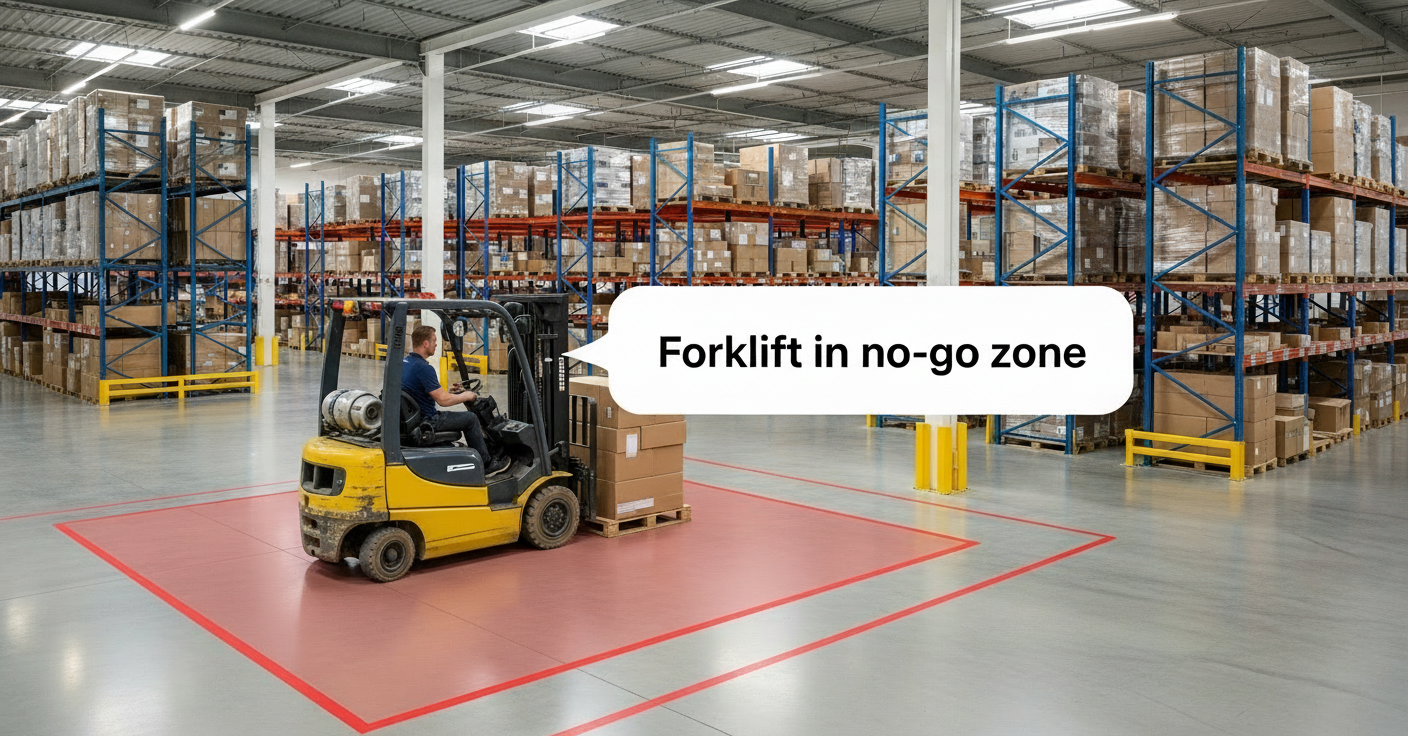
| Forklift Accidents | Forklift Enters No-go Zones | Reduces risk of vehicle/pedestrian collisions in restricted walkways. |
| Unauthorized Access | Person Enters No-go Zones | Keeps untrained staff out of dangerous areas with active machinery. |
| Slips and Trips | Running | Detects high-risk behaviors like running, which can be a precursor to dangerous incidents. |
| Compliance Gaps | Missing PPE | Helps drive consistent use of vests and hard hats without manual spot checks. |
| Internal Theft/Shrink | Loitering / Unattended Checkout | Identifies suspicious lingering in high-value zones or unsecured assets. |
Critical use cases for warehouse safety
Deploying video AI focuses on high-risk areas where human supervision is intermittent but the cost of error is high.
1. Mitigating forklift and machinery risks
Vehicle collisions are a major cause of warehouse fatalities. In the U.S., forklift accidents alone account for approximately 85 deaths and 34,900 serious injuries annually (Source: Conger). Blind spots and speed are frequent culprits.
- Zone enforcement: Video AI agents can monitor specific "No-go zones." If a pedestrian steps into a dedicated forklift lane, the system flags the event.
- Behavior correction: Rather than waiting for a collision, supervisors receive alerts about high-risk behaviors, like a pedestrian entering a forklift lane. This allows for real-time coaching: "We noticed you crossed the yellow line at 10:00 AM; let's review the safe walking paths."
- Competency verification: OSHA mandates refresher training every three years or after unsafe operation (Source: Conger). Video evidence provides the documentation needed to justify and target this retraining.
2. Automating PPE compliance
Ensuring every associate wears the correct Personal Protective Equipment (PPE) is a constant struggle. OSHA's recent rules emphasize that PPE must not only be worn but must fit properly.
- Continuous monitoring: AI models detect missing hard hats or high-visibility vests in real time.
- Targeted feedback: Instead of halting a shift for a general safety talk, managers can approach the specific individual who forgot their vest, maximizing efficiency.
- Audit readiness: Automated logs create a defensible record of compliance efforts, which is vital during regulatory audits.
3. Heat stress and environmental monitoring
With OSHA proposing new federal heat standards, warehouses must now actively monitor environmental risks.
- Integrated alerts: When temperatures rise, teams can review activity in relevant zones and use video analytics to spot safety-related behaviors and conditions that need attention.
- Protocol support: During high-heat trigger events (80°F+), teams can send reminders about required water breaks and document safety communications aligned with Heat Illness and Injury Prevention Plans (HIIPP) (Source: Perry Weather).
Strengthening asset protection and security
For the Asset Protection Director, safety and security are two sides of the same coin. The same camera that detects a safety violation can also identify a security breach.
Combating shrink and internal theft
Internal theft accounts for a substantial portion of retail shrink. Video AI provides visibility into behaviors that often precede theft.
- Loitering detection: AI agents identify individuals lingering in high-value storage areas or near loading docks during off-hours.
- Unattended assets: The "Unattended Checkout or Desk" capability monitors sensitive areas. If a secure dispatch station is left unmanned, an alert ensures it is re-secured quickly.
- Access control integration: By correlating badging events with video feeds, organizations can verify that the person using a credential matches the authorized user, guarding against tailgating into restricted inventory cages.
Streamlining investigations
Manual investigation is a major drain on resources. Spending 4-6 hours reviewing footage for a single incident is inefficient (Source: Spot AI).
- Natural language search: Operators can search for "person in red shirt near loading dock" or "forklift in aisle 4" to find relevant footage in minutes, not hours.
- Case resolution: Faster evidence retrieval improves case resolution rates, a critical KPI for Asset Protection teams aiming for closure rates of 75-85% (Source: Spot AI).
Implementation best practices
Deploying video AI for real-time coaching requires a strategic approach to ensure adoption and ROI.
1. Leverage existing infrastructure
A common misconception is that AI requires a complete hardware overhaul. Modern video AI platforms are often camera-agnostic, meaning they connect with existing IP cameras and infrastructure. This "plug-and-play" approach reduces deployment time and capital expenditure, allowing you to focus budget on software capabilities rather than cabling.
2. Focus on change management
Success depends on how the technology is introduced to the workforce. Employees may initially view monitoring as disciplinary.
- Position as safety: Communicate clearly that the goal is protecting people, not just assets.
- Manager support: Research shows that when managers actively support AI use, employees are 8.8 times more likely to see it as an opportunity to do their job better (Source: Gallup).
- Transparent governance: Establish clear policies on how data is used to address privacy concerns.
3. Move from lagging to leading indicators
Shift your measurement framework. Instead of only tracking DART rates (Days Away, Restricted, or Transferred), track leading indicators enabled by AI.
| Metric Type | Traditional Metric | AI-Enabled Leading Metric |
|---|---|---|
| Safety | Total Incident Rate (TCIR) | Frequency of high-risk behaviors |
| Compliance | Audit Failure Rate | PPE adherence % (Daily) |
| Operational | Downtime Hours | Zone blockage alerts |
| Response | Time to Discover Incident | Time to Resolve Incident |
The ROI of real-time safety coaching
Video AI can support a strong safety culture. Organizations that improve safety practices often report fewer accidents and may see lower insurance costs. Furthermore, companies adopting integrated warehouse models with video monitoring often see reductions in injury rates and improvements in space efficiency.
For the Asset Protection VP, this can translate to measurable benefits:
- Reduced claims: Fewer injuries mean lower workers' compensation costs.
- Operational efficiency: Less downtime from accidents and investigations.
- Asset preservation: Reduced shrink through proactive security monitoring.
By deploying video AI for real-time coaching on warehouse safety protocols, leaders can shift their camera networks from passive recording devices to active tools that support safety and day-to-day operations.
Empowering a Safer, More Efficient Warehouse
The transition from reactive video monitoring to real-time coaching marks a meaningful change in how warehouses operate. It empowers Asset Protection and Operations leaders to standardize safety protocols across shifts and sites, regardless of physical location. By detecting hazards like missing PPE or forklift violations as they occur, organizations can address issues sooner and reduce risk of costly injuries or claims.
This technology does not replace human judgment; it augments it. It gives supervisors the "eyes" they need to be effective coaches and provides the data executives need to make informed risk management decisions. As regulatory pressures mount and operational complexity increases, video AI offers a scalable path to a safer, more efficient warehouse environment.
See Spot AI in action for warehouse safety.
Request a demo to explore how video AI agents help reduce risk and streamline operations across your sites.
Frequently asked questions
How does real-time coaching improve warehouse safety?
Real-time coaching improves safety by providing timely feedback when a hazard is detected. Instead of waiting for a monthly report, a supervisor is notified in real time about unsafe behaviors like entering a no-go zone. This on-the-spot reinforcement helps correct habits quickly, reducing the likelihood of accidents.
Can video AI work with my existing warehouse cameras?
Yes. Modern video AI platforms, such as Spot AI, are designed to be camera-agnostic. They integrate with your existing IP camera infrastructure, allowing you to deploy advanced analytics and coaching capabilities without the expense and disruption of a "rip-and-replace" hardware project.
What are the privacy implications of using AI for employee monitoring?
Privacy is a valid concern. Best practices involve using AI to monitor processes and safety compliance rather than individual performance for consequence-focused measures. Clear governance policies, transparency about data retention, and focusing on safety outcomes help build trust. The goal is to identify unsafe behaviors, not to spy on individuals.
How does video AI help with OSHA compliance?
Video AI supports OSHA compliance by automating the detection of violations such as missing PPE, blocked exits, or unsafe forklift operations. It creates a verifiable audit trail of compliance and documents the organization's forward-looking efforts to enforce safety rules, which is critical during regulatory inspections.
What is the ROI of implementing video AI for safety?
Potential ROI comes from multiple channels: fewer workers' compensation claims, the possibility of lower insurance costs, minimized operational downtime following incidents, and decreased inventory shrink. Companies implementing these technologies often see injury reductions and improvements in operational efficiency.
About the author
Sud Bhatija is COO and Co-founder at Spot AI, where he scales operations and GTM strategy to deliver video AI that helps operations, safety, and security teams boost productivity and reduce incidents across industries.

