




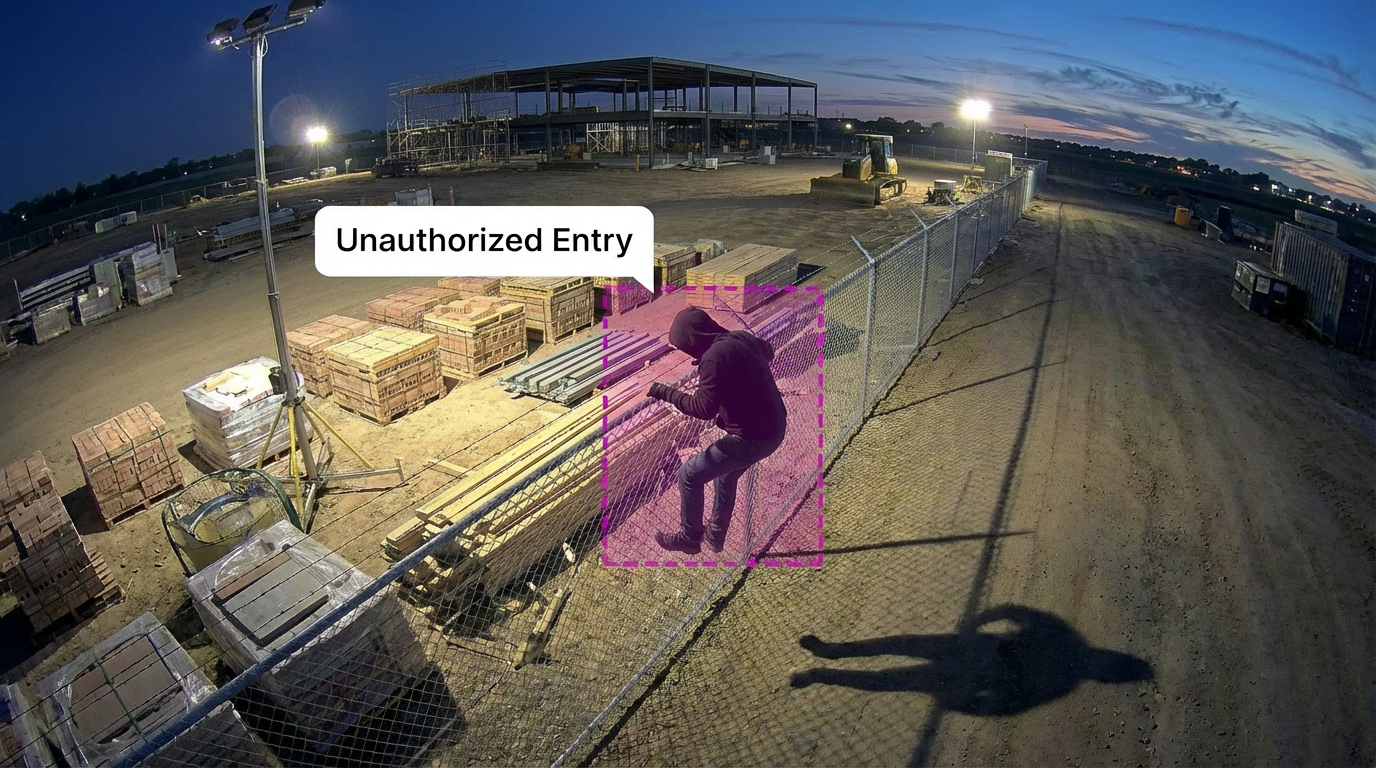


Construction sites are prime targets for theft and vandalism, with annual losses climbing as high as $1 billion in the United States (Source: National Equipment Register). For professionals managing multiple projects, the consequences go far beyond the direct cost of stolen equipment. Project delays, increased insurance premiums, and hours spent investigating incidents after the fact all erode profitability and strain client relationships. Traditional, reactive security systems that only provide footage after a loss has occurred are no longer sufficient.
The alternative is an anticipatory security posture built on active deterrence workflows. This approach uses integrated technology to detect, verify, and respond to potential incidents in real time, minimizing intrusions, damage, and loss. Setting up these workflows transforms your camera system from a simple recording device into an AI teammate that actively protects your perimeter.
Understanding the basics of active deterrence
Before building your workflow, it’s helpful to clarify a few key concepts that form the foundation of a modern construction security strategy:
- Active deterrence: This is a security strategy that shifts from passively recording events to actively intervening. It uses technology like AI-powered cameras, speakers, and lights to detect and deter intruders in real time.
- Perimeter protection: This refers to securing the outer boundary of a construction site. It involves a combination of physical barriers, like fencing, and technological monitoring to control access and detect unauthorized entry.
- Security workflow: This is a sequence of automated or manual steps—detection, verification, and response—that are triggered when a potential security event occurs. A well-defined workflow ensures that real incidents are handled swiftly and consistently while nuisance alarms are filtered out.
The high cost of reactive construction security
Overseeing multiple, multi-acre job sites is a complex balancing act. The last thing managers need is a security system that creates more work than it saves. Yet, many professionals find themselves burdened by the limitations of traditional security.
A core frustration is the lack of real-time visibility across dispersed sites, forcing managers to waste valuable time driving between locations for manual checks. When an incident does occur, these outdated systems offer only after-the-fact evidence, leaving teams to spend hours sifting through footage to investigate a theft that has already impacted the project timeline and budget. This is made worse by the constant stream of false alarms from wind, rain, or animals, which creates alarm fatigue and causes teams to miss genuine incidents. Without timestamped, searchable proof, resolving disputes or processing charge-backs for subcontractor damage becomes a significant sticking point.
Step 1: Establish a solid physical perimeter
An effective active deterrence workflow begins with a strong physical foundation. Before any technology is deployed, the site’s perimeter must be clearly defined and secured to restrict access and create an initial layer of visual deterrence.
- Assess the site: Begin with a comprehensive site assessment. Walk the perimeter to identify vulnerabilities, high-value asset locations like equipment storage areas, and all potential entry and exit points. Use this assessment to plan your physical barrier layout.
- Install construction fencing: Temporary construction fencing is the first line of defense. It restricts public access, contains job site hazards, and is often required by municipal regulations. Ensure panels are properly secured with a minimum of two couplers and clamps per panel to create a continuous barrier.
- Secure access points: Gates are a critical component of your perimeter. Whether you use swing, sliding, or barrier gates, they must be secured when the site is unattended. Integrating keycard or biometric access systems provides a digital log of all entries and exits, which is essential for accountability and incident investigation.
Step 2: Design the monitoring and detection layer
With physical barriers in place, the next step is to deploy a technology layer that provides comprehensive coverage and intelligent detection. This is where your cameras become AI teammates, extending your vision across every corner of the site.
Strategic camera placement is crucial for eliminating blind spots. Key locations include:
- Entrances and exits to monitor all personnel and vehicle traffic
- Perimeter fence lines to detect breach attempts
- Equipment and material storage areas
- Fuel tanks and generators
- Elevated points for a broad overview of the site
For construction environments, it's essential to choose rugged, weatherproof cameras with high-resolution, wide-angle lenses, and night vision. However, the real power comes from the video AI behind the cameras. Instead of motion detection that triggers excessive false alarms, a modern Video AI platform like Spot AI uses agentic AI to filter out irrelevant motion from environmental factors. It can be taught to specifically detect people, vehicles, and suspicious behaviors like loitering or fence jumping, ensuring your team only receives alerts that matter.
Step 3: Configure the active deterrence workflow
This is where detection, verification, and response come together in a coordinated sequence to reduce risk. An effective workflow moves from automated detection to human verification and finally to a calibrated, automated response.
- Automated detection: An AI-powered system, like Spot AI, monitors camera feeds 24/7. When it identifies a predefined event, such as a person entering a no-go zone after hours or loitering near a fence line, it automatically triggers an alert.
- Real-time verification: The alert is sent in real time to a monitoring center or designated team members. They can view the live video clip on a phone or computer to verify if the event is a genuine incident or a false alarm. This human-in-the-loop step is critical for avoiding unnecessary escalation.
- Automated response and escalation: If the incident is confirmed, the deterrence protocol begins. The first step is often a live, two-way audio "voice-down." A remote operator can speak through a speaker on the camera, informing the trespasser they are being monitored and must leave. This simple action is highly effective in compelling intruders to leave the premises. If the intruder remains, the workflow can automatically escalate to activating high-intensity strobe lights and audible sirens to disorient them and draw attention to the breach. If the intruder still does not leave, the final step is to dispatch local law enforcement or on-site security.
Step 4: Unify systems on a single platform
Managing multiple, disconnected security systems is a common roadblock for construction managers. A Video Management System (VMS) or a unified Video AI platform is essential for creating a seamless active deterrence workflow.
A platform like Spot AI brings all your cameras—regardless of brand—into a single cloud-based dashboard. This solves the pain point of managing disparate technologies and gives you real-time visibility across all your job sites from one screen. Instead of logging into multiple systems, you can view live feeds, search for incidents, and manage alerts from anywhere. This centralized approach is what makes scaling your security efforts possible, turning a complex collection of hardware into a cohesive and intelligent system.
| Feature | Traditional fragmented systems | Spot AI's unified platform |
|---|---|---|
| Deployment | Complex and slow; requires system integrators and custom configuration for each site. | Fast and simple; plug-and-play hardware goes live in minutes with no new cameras required. |
| Camera compatibility | Locked into a single manufacturer's ecosystem, forcing costly "rip-and-replace" projects. | Camera-agnostic; works with any existing IP camera, protecting your current hardware investments. |
| Site management | Requires logging into separate systems for each location, creating data silos and inefficiency. | A single, cloud-based dashboard unifies all sites, providing centralized visibility and control. |
| Alerts | Prone to excessive false alarms from motion detection, leading to alert fatigue. | AI-powered alerts intelligently filter out noise, focusing teams on verified, actionable events. |
| Scalability | Difficult and expensive to scale, with costs compounding for each new site or user. | Effortlessly scalable to thousands of sites and unlimited users with a predictable subscription model. |
Step 5: Document, analyze, and optimize
The final step in setting up your workflow is to establish protocols for documentation and continuous improvement. This not only strengthens your security posture but also provides crucial evidence for operational needs.
Active deterrence workflows, when managed through a Video AI platform, automatically create timestamped video evidence for every alert and incident. This solves the persistent frustration of inadequate proof for charge-backs or dispute resolution. If a subcontractor damages property or a delivery is disputed, you can search for the event and share a video clip to resolve the issue. This documentation is also invaluable for compliance with regulations from bodies like the Occupational Safety and Health Administration (OSHA) and for supporting insurance claims.
Finally, use the data from your system to optimize performance. Track key performance indicators (KPIs) like your incident detection rate, false alarm rate, and response times. Analyzing this data helps you identify trends, refine your detection rules, and continuously improve the effectiveness of your security program.
Transform your security from reactive to anticipatory
Shifting from a reactive security posture to one built on active deterrence fundamentally improves how you protect construction sites. By establishing a workflow that combines physical barriers, intelligent detection, and automated responses, you can mitigate theft and vandalism, keep project timelines on track, and arm your team with the evidence needed to protect your margins.
Want to see Spot AI’s unified video AI platform in action? Request a demo to explore how you can streamline security workflows across all your construction sites.
Frequently Asked Questions
What are the best practices for securing a construction site?
Effective construction site security relies on a multi-layered approach. This includes installing strong physical barriers like fencing, implementing strict access control for personnel and vehicles, deploying video AI for real-time monitoring and active deterrence, and ensuring all security protocols are documented to meet regulatory compliance.
How can technology improve construction site security?
Technology transforms construction security from a passive, after-the-fact process into an active one. Video AI can automatically detect intrusions and loitering, while integrated speakers and lights can deter trespassers in real time. Cloud-based platforms provide remote visibility across all sites, and digital records offer timestamped evidence for incident investigation and dispute resolution.
What are the most effective strategies to deter theft in construction?
The most effective strategies combine physical and technological security and clear processes. This includes securing the perimeter with fencing and controlled gates, using systems with cameras and audio warnings to deter thieves, tracking high-value assets with geofencing, and maintaining a visible security presence with mobile camera units or pole-mounted cameras.
How do I implement a perimeter security system for my construction site?
Implementation should be done in phases. Start with a site assessment to identify vulnerabilities. Next, install physical barriers like fencing. Then, deploy cameras at key points and connect them to a unified Video AI platform to configure detection rules and automated deterrence responses. Finally, test the system and train your staff on the new workflows.
What compliance regulations should I consider for construction site security?
Key regulations include OSHA requirements for controlled access zones and worker safety, municipal ordinances for site fencing, and standards from the National Fire Protection Association (NFPA) for fire safety. A robust security system helps document compliance with these rules through access logs and video records.
What is the best AI deterrence solution to replace overnight guards on jobsites?
An AI Security Guard on a unified Video AI platform is the most effective alternative. It offers consistent 24/7 coverage without the high cost of guard salaries. The system uses AI to detect intruders and deploys automated deterrents like two-way audio voice-downs to compel departure, while creating timestamped evidence for every incident.
About the author
Sud Bhatija is COO and Co-founder at Spot AI, where he scales operations and GTM strategy to deliver video AI that helps operations, safety, and security teams boost productivity and reduce incidents across industries.

