






Run-to-failure is a costly strategy. Yet, despite the flood of data available in modern facilities, many continuous improvement leaders find themselves trapped in a cycle of reactive firefighting. The average manufacturing facility experiences approximately 800 hours of downtime annually—more than two hours every single day (Source: Strain Labs).
Beyond the direct production loss, these unplanned stops create cascading costs. Emergency repairs average 3-9 times longer than planned maintenance and require expensive expedited parts (Source: Strain Labs). This inefficiency persists not because manufacturers lack data, but because they lack the intelligent systems necessary to see problems emerging, reason about their root causes in real time, and act on insights before they impact production.
Agentic AI represents a shift in this equation. By enabling systems to observe production conditions, analyze the "why" behind the "what," and recommend corrective actions, operations teams can move from reactive responses to more proactive, efficient workflows.
Understanding the basics
Before exploring the framework, it is helpful to clarify the core concepts driving this shift in manufacturing intelligence.
- Agentic AI: unlike traditional AI that waits for human prompts, agentic AI consists of autonomous systems that can perceive their environment, reason about goals, and take actions to achieve specific outcomes with minimal human intervention.
- Gemba walk: a fundamental Lean manufacturing practice where leaders go to the actual place where work is done ("Gemba") to observe processes and identify waste.
- OEE (Overall Equipment Effectiveness): the gold standard for measuring manufacturing productivity, calculated by multiplying Availability, Performance, and Quality.
- SMED (Single-Minute Exchange of Die): a Lean methodology for reducing waste in a manufacturing process, providing a rapid and efficient way of converting a manufacturing process from running the current product to running the next product.
- The "hidden factory": the undocumented rework, inspection, and waste that occurs when problems go undetected until it is too late to address them.
The cost of visibility gaps in manufacturing
For the Innovation and Continuous Improvement Lead, the "hidden factory" is the primary adversary. Inefficiencies often operate silently within complex, interconnected processes until they compound into major failures.
The limitations of manual observation
Traditional methods for identifying waste—such as manual Gemba walks and periodic audits—introduce an unacceptable lag between problem emergence and detection. By the time traditional analytics identify patterns, the opportunity to curtail waste has passed.
Common frustrations for improvement leaders include:
- Reactive problem-solving: teams are exhausted by constantly fighting fires—equipment failures and safety incidents—that could have been anticipated.
- Manual data collection: physical floor walks provide only snapshot views, missing critical events that occur between observations.
- Lack of evidence: root cause analysis takes weeks because there is no easy access to historical visual evidence of process variations.
- Inability to verify SOP compliance: without automated monitoring, ensuring consistent adherence to standard operating procedures across all shifts is tough to manage.
The financial impact of hidden waste
These visibility gaps translate directly to the bottom line. A facility operating at 80% OEE is losing one-fifth of its potential production capacity. Furthermore, the cost of poor quality (COPQ) can consume a significant portion of sales revenue, with some facilities losing substantial revenue to rework and waste.
Specific inefficiency patterns include:
- Changeover downtime: lengthy changeover processes can lead to significant losses in daily production capacity.
- Quality escapes: manual inspectors can experience fatigue, which leads to higher error rates and allows defects to pass through to customers.
- Unplanned downtime: human error, such as skipped checks or unauthorized settings, is a common cause of unplanned downtime incidents.
How to see, reason, and act on manufacturing inefficiencies with agentic AI
The "see, reason, act" framework addresses the gaps in current monitoring by building intelligence into each stage of the decision-making cycle.
Phase 1: see (continuous observation)
The "see" component requires capturing relevant data continuously and comprehensively. While sensors monitor temperature and vibration, video systems are a strong source of context for operational behavior.
From manual checks to computer vision
Computer vision systems provide consistent accuracy at high inspection volumes. For electronics manufacturers, some visual inspection systems have reported 99.8% accuracy at processing rates of 1,200 parts per minute in specific setups (Source: AI Innovate).
Real-time anomaly detection
Modern systems move beyond simple rule-based alerts to context-aware anomaly detection. Instead of just flagging a "high temperature," the system learns what normal operation looks like for a specific machine under specific loads. Manufacturing facilities deploying anomaly detection have reported a 40% reduction in unexpected downtime (Source: Applied Computing).
Phase 2: reason (intelligent analysis)
The "reason" component transforms raw observation into understanding. Where traditional monitoring reports what occurred, agentic AI explains why it occurred.
Automating root cause analysis
Agentic AI accelerates root cause analysis by automating data correlation. If a quality issue occurs, the system examines all sensor readings, personnel assignments, and video evidence leading up to the event. This aligns perfectly with Six Sigma methodologies, automating the "Analyze" phase of DMAIC (Define, Measure, Analyze, Improve, Control).
Moving from correlation to causation
Agentic systems use domain knowledge to understand relationships. For example, in chemical manufacturing, AI modeling can highlight patterns associated with quality deviations earlier than laboratory confirmation, enabling faster human review and adjustments (Source: Imubit).
Phase 3: act (autonomous execution)
The "act" component is where insights turn into value. This involves prescriptive guidance for operators or recommended next steps for teams to review and implement.
Condition-based maintenance workflows
Instead of time-based maintenance schedules that waste resources, teams can use condition indicators to schedule maintenance earlier. Organizations implementing condition-aware maintenance processes have reported reduced unexpected downtime by 40% and overall downtime by 15–30% in specific cases (Source: Strain Labs).
Real-time operator support
Activity-based training provides operators with moment-specific guidance. Providing operators with real-time feedback on the impact of their actions motivates engagement in continuous improvement.
Addressing continuous improvement hurdles with Spot AI
For the Innovation and Continuous Improvement Lead, Spot AI connects physical operations with digital insights. By using existing cameras with AI analytics, Spot AI addresses the core frustrations outlined in the persona report.
| Core pain point | Spot AI capability | Operational outcome |
|---|---|---|
| Manual Gemba walks | 24/7 process monitoring | Templates like "Vehicle Absent" and "Crowding" provide automated visibility into productivity and resource utilization without physical floor walks. |
| SOP compliance | Automated deviation detection | AI agents can flag events like "Forklift Enters No-go Zones" or "Running," helping teams reinforce safety and operational procedures across all shifts. |
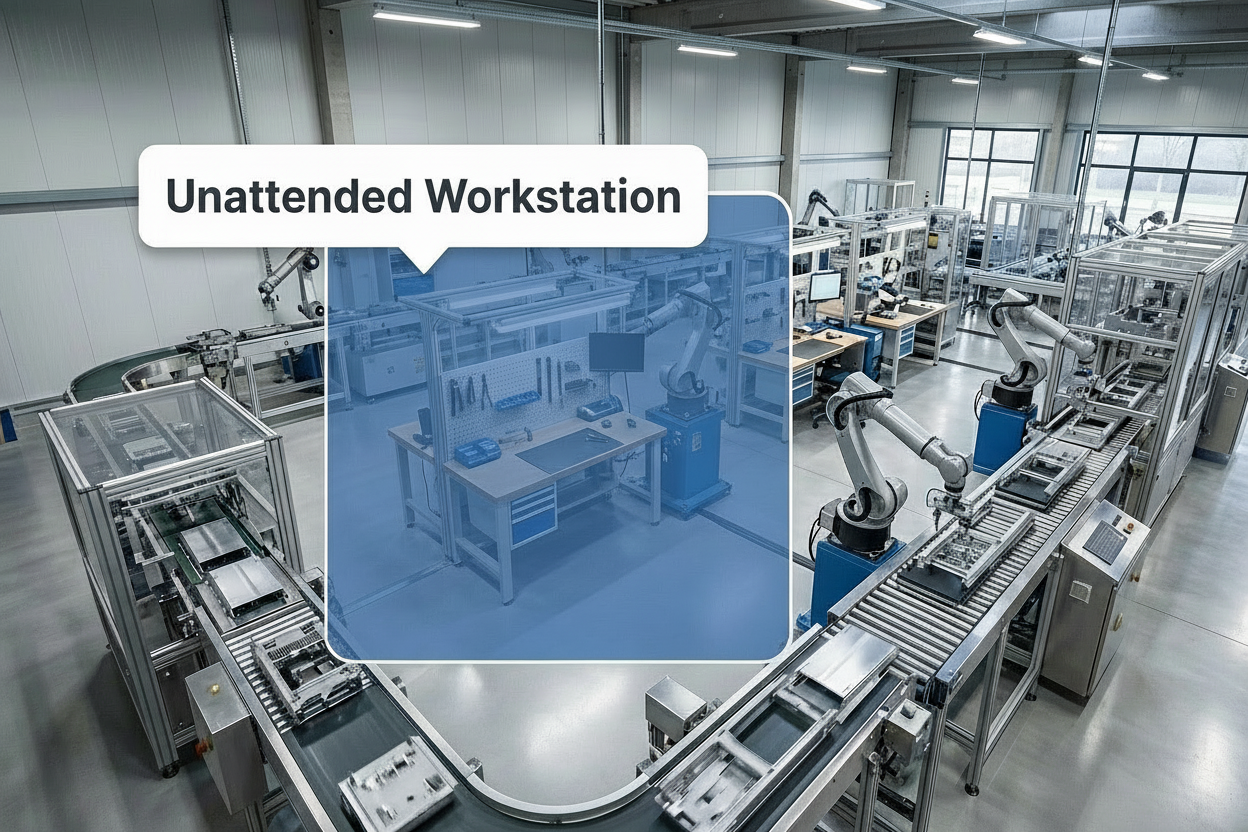
| Hidden process waste | Efficiency analytics | Computer vision reveals inefficient movement patterns and excessive waiting times ("Person Absent" or "Unattended Workstation") that are invisible to periodic observation. |
| Reactive firefighting | Real-time alerting | Real-time notifications for "Missing PPE" or "Person Enters No-go Zones" allow for intervention before an incident or bottleneck escalates. |
| Slow improvement cycles | Visual root cause analysis | Natural language search allows leaders to find specific events in historical footage in minutes, validating improvement initiatives with concrete evidence. |
By deploying these capabilities, leaders can move from reactive responses to more reliable, data-informed operations. Book a consultation to see how these tools work in your specific environment.
Industry use cases: AI in action
The following examples illustrate how "see, reason, act" principles translate into measurable business results across different manufacturing sectors.
1. Semiconductor: Ensuring SOP Compliance in Cleanrooms
In semiconductor fabrication, maintaining sterile environments is critical, as a single protocol violation can compromise an entire batch of wafers.
- Obstacle: Manual supervision is intermittent and cannot cover all zones 24/7, making it difficult to ensure every technician follows strict gowning procedures and movement protocols.
- Solution: A video intelligence platform is deployed using existing cleanroom cameras. AI agents are configured to monitor for SOP deviations, such as personnel entering restricted zones or failing to follow specific process steps.
- Result: The system provides real-time alerts for protocol violations, allowing supervisors to intervene immediately. It also creates a searchable visual record, helping teams identify patterns in non-compliance and refine training, leading to a measurable reduction in contamination events.
2. Automotive: reducing downtime with condition-based monitoring
An automotive facility faced frequent stoppages due to conveyor system failures.
- Hurdle: the facility experienced 800 hours of annual downtime from unexpected equipment failures (Source: Standard Bots).
- Solution: IoT-based condition monitoring was deployed to surface abnormal bearing conditions earlier for maintenance review.
- Result: unexpected downtime was reduced by 40%, averting approximately 320 hours of lost production annually (Source: Applied Computing).
3. Packaging: optimizing changeover times (SMED)
A corrugated box manufacturer struggled with lengthy product changeovers.
- Roadblock: frequent, time-consuming changeovers were a major source of lost production capacity.
- Solution: analysis using SMED principles and process mapping identified internal vs. external setup inefficiencies.
- Result: by redesigning the changeover process, the facility significantly reduced downtime and recovered substantial daily production capacity.
Comparing video intelligence solutions
When selecting a tool to implement agentic AI, choose a platform that integrates with existing infrastructure instead of requiring a full replacement.
| Feature | Spot AI | Traditional VMS | Manual observation |
|---|---|---|---|
| Deployment speed | Minutes (plug-and-play hardware) | Weeks/Months (complex server setup) | On-the-spot (but limited scope) |
| Hardware compatibility | Camera agnostic (works with existing IP cameras) | Proprietary (often requires specific brands) | N/A |
| Scalability | Supports many users and locations | Limited by server capacity/licenses | Non-scalable (requires more people) |
| Intelligence | Agentic AI (see, reason, act) | Passive recording (review after fact) | Human judgment (subjective, fatigued) |
| Cost model | Predictable (hardware + software) | High CapEx (servers, storage, licensing) | High OpEx (labor costs) |
Implementation strategies for continuous improvement leaders
Implementing agentic AI is as much about organizational change as it is about technology.
1. Start with a focused pilot
Begin with a comprehensive assessment of current operations to identify high-impact opportunities. Select a pilot project—such as monitoring a specific bottleneck or safety zone—where success is measurable within 6-12 months.
2. Integrate with existing methodologies
Do not view AI as a replacement for Lean or Six Sigma. Instead, use AI to automate the data collection required for these methodologies. AI accelerates value stream mapping by automatically identifying where material waits or where rework loops exist.
3. Focus on workforce engagement
Agentic AI amplifies expertise; it does not replace it. Involve operators in defining what the system should optimize. When workers see that data helps them hit targets rather than just monitoring them, engagement improves. Activity-based training can improve SOP compliance.
The Path to Intelligent Operations
Agentic AI can help coordinate monitoring and analysis across processes. By adopting the "see, reason, act" framework, continuous improvement leaders can better surface inefficiencies that affect margins and capacity.
The data confirms the value: up to a 40% reduction in unexpected downtime and over 99% accuracy in quality inspection are not theoretical—they are documented outcomes of intelligent operations.
For the Innovation Lead, the path forward is clear. It begins with leveraging the video data you already have to see what was previously invisible.
Ready to uncover inefficiencies in your facility?
Book a consultation with Spot AI to learn how to use your existing cameras for practical, data-driven improvements.
Frequently asked questions
What are the main pain points in manufacturing that AI solves?
AI addresses three primary issues: operational inefficiency (downtime, bottlenecks), quality control (defects, rework), and safety risks. By providing continuous monitoring and analysis, AI helps teams move from reactive responses to planned improvements.
How can AI improve manufacturing processes without disrupting production?
Solutions like Spot AI connect to existing camera infrastructure via a plug-and-play appliance. This allows for the deployment of AI analytics without stopping production lines or replacing expensive hardware.
What is the role of data-driven decision-making in manufacturing?
Data-driven decision-making moves operations from intuition ("we've always done it this way") to fact-based optimization. Real-time dashboards allow teams to see the direct impact of process adjustments, validating improvements in OEE and throughput.
How does condition-based maintenance reduce downtime?
Condition-based maintenance uses sensors and AI to monitor equipment condition (vibration, temperature) in real time. By detecting anomalies that may indicate developing issues, maintenance can be scheduled during planned gaps, helping reduce unexpected downtime in some deployments (Source: Applied Computing).
How can manufacturing inefficiencies be identified and solved using video?
Video analytics can identify inefficiencies such as excessive wait times, blocked aisles, and unauthorized motion. By quantifying these events (e.g., "forklift absent" duration), leaders can target specific areas for Lean improvement initiatives.
What is Agentic AI in the context of manufacturing?
Agentic AI refers to systems that can perceive their environment (See), analyze data to understand root causes (Reason), and recommend specific actions (Act), such as alerting a supervisor, to support operational goals.
About the author
Sud Bhatija is COO and Co-founder at Spot AI, where he scales operations and GTM strategy to deliver video AI that helps operations, safety, and security teams boost productivity and reduce incidents across industries.

