




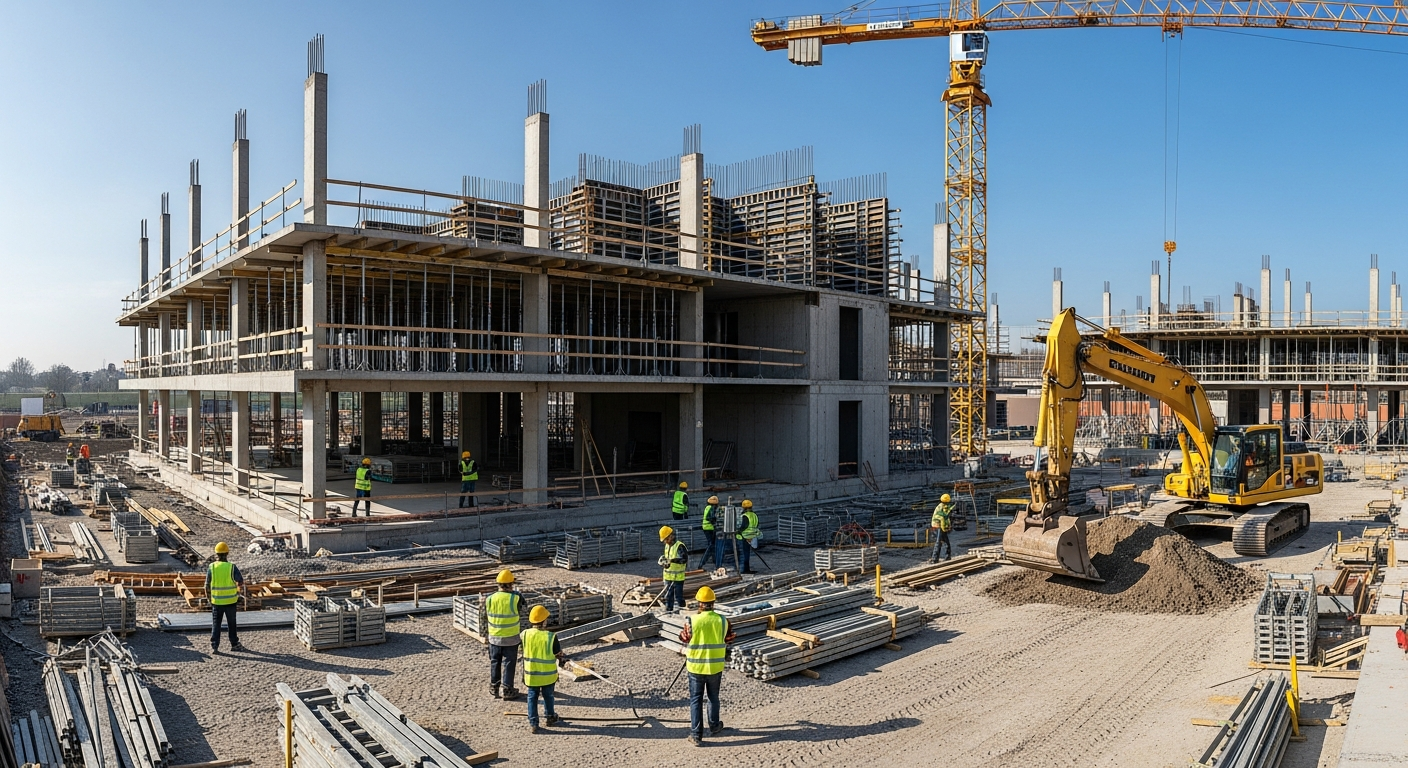


Managing a multi-site construction portfolio requires balancing thin margins against massive operational risks. For a VP of Operations or Project Executive, the daily reality involves overseeing 15 to 20 active jobsites, managing P&L performance, and ensuring schedule adherence—all while trying to control insurance premiums and guard costs. A major hurdle in achieving this operational excellence is the fragmented nature of site monitoring.
Different sites often inherit different video systems. One project might use legacy cameras from a previous phase, while another deploys mobile trailers, and a third requires specialized low-light units for equipment protection. This creates data silos where safety metrics, project progress, and security footage live in disconnected systems. This fragmentation leads to reactive incident response, where safety violations or theft are discovered days too late to mitigate loss.
A camera-agnostic platform offers a practical solution to these procurement and operational hurdles. By decoupling the software layer from the hardware, construction leaders can unify their video data into a single dashboard, regardless of the camera manufacturer. This approach helps turn video from a passive security expense into a useful tool for improving project margins, supporting subcontractor accountability, and helping cut investigation time significantly.
The hidden costs of fragmented video systems
Construction environments are inherently dynamic, with sites shifting and expanding through various project lifecycles. This complexity often forces firms into "vendor lock-in," where committing to a specific camera manufacturer restricts the ability to integrate equipment from other vendors without substantial technical hurdles (Source: Macnica).
For executives managing dozens of sites, this fragmentation creates tangible operational bottlenecks:
- Increased total cost of ownership: firms often maintain separate recording systems, monitoring software licenses, and support contracts for each vendor, essentially doubling or tripling infrastructure costs (Source: Macnica).
- Operational blind spots: supervisors cannot check all site cameras from a single dashboard but must navigate between manufacturer-specific interfaces, leading to delayed responses to safety violations and quality issues.
- Inconsistent data: Disconnected systems make it tough to generate unified compliance reports or analyze portfolio-wide trends, complicating efforts to lower Experience Modification Rates (EMR) and insurance premiums.
Understanding camera-agnostic platforms in construction
A camera-agnostic platform is a software-based system designed to ingest, manage, and analyze video feeds from any IP-connected camera, regardless of the manufacturer or age of the hardware. Unlike traditional video management systems (VMS) that optimize for proprietary equipment, these platforms employ a hardware-abstraction approach.
This interoperability is largely made possible by the ONVIF (Open Network Video Interface Forum) standard. Established to create a common language for IP video products, ONVIF allows cameras from different vendors to communicate across a unified network. Today, there are over 30,000 ONVIF-conformant products, allowing construction firms to select cameras based on performance and price rather than brand loyalty (Source: Macnica).
However, true camera-agnostic utility goes beyond basic connection. It involves normalizing video data processing so that a high-definition panoramic camera and a standard fixed camera feed into the same AI analytics pipeline. This aims to help detection algorithms for safety and security work reliably across supported equipment.
Strategic value for construction procurement
Adopting a camera-agnostic strategy directly addresses the "Critical Questions" regarding cost reduction and ROI that Project Executives face.
1. Procurement flexibility and cost optimization
Construction projects have varying monitoring needs. A remote laydown yard may only require cost-effective bullet cameras, while a critical active work zone needs advanced low-light imaging or PTZ (pan-tilt-zoom) units. A camera-agnostic approach allows procurement teams to source standard IP cameras at competitive rates—often $400-$800 per unit—while deploying a single unified platform license (Source: Spot AI).
This flexibility allows for a mixed hardware strategy:
- Standard IP cameras: ideal for general perimeter and gate monitoring.
- Panoramic/Fisheye cameras: provide 360-degree coverage for large open areas, lowering the total camera count required.
- Low-light cameras: essential for maintaining visibility in poorly lit conditions or monitoring heavy equipment overnight.
By avoiding vendor lock-in and optimizing hardware selection, firms may lower the total cost of ownership, with some reports citing 25–40% (Source: ASIS SystemsPro).
2. Scalability without headcount increases
One of the core frustrations for operations leaders is the pressure to take on more projects without adding proportional supervisory staff. A unified, camera-agnostic platform helps teams do more with the same staff. It enables a single Project Manager to effectively oversee multiple sites simultaneously through a centralized dashboard.
Instead of physically driving between sites to verify progress or safety compliance, executives can access real-time views and automated recaps. This capability directly supports the objective of scaling operations while maintaining lean project teams.
Mitigating risk and lowering insurance costs with unified intelligence
Safety incidents and insurance premiums are major variables in project margin optimization. Reactive incident response—finding out about an accident days later—erodes trust with owners and insurers.
Automating safety compliance
Camera-agnostic platforms leverage Video AI agents to help teams monitor safety more consistently using standard video feeds. By applying AI analytics across all connected cameras, organizations can standardize safety monitoring:
- PPE detection: the system can automatically identify missing personal protective equipment, such as hard hats or high-visibility vests, and alert supervisors in near real time.
- No-go zone enforcement: AI agents detect when personnel or vehicles enter restricted areas, such as active demolition zones or swing radiuses of heavy machinery.
- Audit trail generation: automated logging of safety compliance creates verified timestamped documentation to aid OSHA compliance and support insurance claims.
Organizations implementing comprehensive safety monitoring systems often report a marked decrease in incident frequency, which can lead to lower insurance premiums (Source: ASIS SystemsPro).
Mitigating theft and guard spend
On-site guard services represent a significant annual expense. A unified video platform strengthens security by providing intelligent deterrence and active response capabilities, often at a lower operational cost than human guards.
AI-driven alerts filter out false positives caused by weather or animals, surfacing only business-critical events like unauthorized vehicle entry or loitering. This minimizes "alert fatigue" and ensures that security resources are deployed only when necessary.
Operational efficiency: Beyond security
For the VP of Operations, the value of video extends into quality control and schedule adherence. Rework consumes an estimated 5-15% of construction project budgets annually (Source: Hoosier Security).
Real-time quality control
Video AI can assist in quality management by providing continuous visual verification of work against schedules.
- Work verification: High-resolution cameras provide a visual record of critical construction phases. Teams can quickly review footage to confirm that work was completed according to specifications, preventing costly rework discovered during later inspections.
- Subcontractor accountability: Timestamped video evidence helps resolve charge-back disputes by providing objective records of when damage occurred or when subcontractors were on site.
Progress tracking and schedule adherence
Automated visual documentation helps verify schedule alignment. AI analysis can compare current site conditions against planned milestones, providing executives with early warnings if a project is tracking behind schedule. This objective data replaces subjective estimation, enabling forward-looking resource allocation to get projects back on track.
Integration strategies for mixed-vendor environments
Successfully implementing a camera-agnostic platform requires a strategic approach to integration.
Key technical considerations
- Network infrastructure: high-definition cameras require robust bandwidth. IT teams should verify that cabling (Cat5e or Cat6) and network capacity can support the data load, particularly for 4K cameras.
- Protocol standardization: ensure all cameras are configured to stream via ONVIF interfaces where possible to standardize data pipelines.
- Cross-platform connectivity: the video platform should integrate with project management tools like Procore or Autodesk to connect visual data with project workflows.
Phased deployment approach
- Foundation: install network infrastructure and core servers during low-activity periods.
- Ingestion: connect existing cameras to the platform via ONVIF to establish rapid visibility without hardware replacement.
- Intelligence: enable AI analytics for high-priority use cases first, such as "Missing PPE" or "Vehicle Enters No-go Zones," before expanding to advanced quality monitoring.
Comparing Spot AI to traditional solutions
| Feature | Spot AI | Traditional VMS / Vendor-Locked Systems |
|---|---|---|
| Camera Compatibility | Broad compatibility: Works with most ONVIF-conformant IP cameras and integrates existing hardware. | Limited: Often restricted to proprietary cameras or requires complex encoders. |
| Deployment Speed | Rapid: Plug-and-play appliance connects in minutes; cloud dashboard available quickly. | Slow: Requires extensive server setup, configuration, and integration services. |
| AI Analytics | Built-in: Pre-trained AI agents for safety, security, and operations included. | Add-on: Analytics often require separate licenses or specialized hardware. |
| Search Capability | Intelligent: Google-like search for events, objects, and behaviors. | Manual: Time-consuming scrubbing through timelines to find incidents. |
| Scalability | Highly scalable: Cloud-native architecture scales across many sites and users. | Constrained: Server limitations often require hardware upgrades to scale. |
| Cost Structure | Simplified: Simple licensing model lowers total cost of ownership. | Complex: Per-camera fees, maintenance contracts, and hardware markups. |
The Strategic Advantage of a Camera-Agnostic Platform
For construction leadership, adopting a camera-agnostic platform is a strategic move that acts as a practical lever for protecting margins and improving scalability. By breaking free from vendor lock-in, organizations can optimize procurement spend, extend the life of existing assets, and deploy a centralized intelligence layer that works across many jobsites.
This approach addresses core frustrations of the Project Executive: it helps minimize blind spots, streamlines compliance documentation to address insurance increases, and provides verified timestamped evidence for subcontractor accountability. In an industry where schedule adherence and risk mitigation influence profitability, a flexible, intelligent video platform is a practical choice for modern construction procurement.
See how Spot AI can unify your jobsite monitoring and streamline operations. Request a demo to experience our video AI platform in action.
Frequently asked questions
What are the benefits of using a camera-agnostic platform in construction?
A camera-agnostic platform allows you to use any IP camera brand, giving you the flexibility to choose hardware that fits your budget and specific site needs. It unifies all video feeds into a single dashboard, lowering software licensing costs and simplifying multi-site management.
How can multiple camera types be integrated on a jobsite?
Through protocols like ONVIF, different camera types—such as low-light, PTZ, and standard bullet cameras—can connect to a central appliance or cloud platform. This allows diverse hardware to function within the same system, sharing the same analytics and storage capabilities.
What challenges arise with mixed camera systems in construction?
The main challenges include inconsistent user interfaces, separate login credentials for different systems, and fragmented data that makes reporting difficult. A camera-agnostic platform solves this by normalizing the data streams and providing a single interface for all cameras.
How do camera-agnostic solutions improve operational efficiency?
They centralize data, allowing for remote management of multiple sites without travel. Features like AI-powered search can significantly shorten incident investigation time, while automated alerts for safety violations or idle equipment help keep projects on schedule.
What are the best practices for managing multiple camera vendors?
Adopt a unified software platform that sits above the hardware layer. This allows you to maintain relationships with multiple hardware vendors to get the best pricing and technology while keeping your operational workflows consistent and centralized.
About the author
Sud Bhatija is COO and Co-founder at Spot AI, where he scales operations and GTM strategy to deliver video AI that helps operations, safety, and security teams boost productivity and improve outcomes across industries.

