






How to build a loss prevention dashboard that drives decisions across every store
U.S. retailers lose more than $112 billion annually to shrinkage, with the average shrink rate sitting at roughly 1.6% of sales across the sector (Source: National Retail Federation). For VPs of loss prevention managing dozens or hundreds of locations, the challenge is no longer just catching theft. It is consolidating POS exceptions, cash variance, inventory gaps, and video evidence into a single executive view that proves ROI to the CFO and directs resources where they matter most. This article walks through what an effective loss prevention dashboard should include, how to design it for rapid decision-making, and how video AI turns existing cameras into AI coworkers that surface incidents in real time, correlate them with transaction data, and build case-ready evidence.
Key takeaways
- A loss prevention dashboard should track five to 15 core KPIs, including shrink percentage by store and category, cash variance, refund rates, investigation cycle time, and SOP adherence scores.
- Dashboard views should be segmented by audience: executives see consolidated trends and ROI, regional directors see store-level outliers, and store managers see daily action items.
- Integrating POS exception data with time-stamped video evidence turns ambiguous alerts into verified, case-ready incidents and shortens investigation cycles.
- Self-checkout environments require dedicated metrics. Stores using self-checkout experience losses 33% to 147% higher than comparable stores without it (Source: Ecrloss).
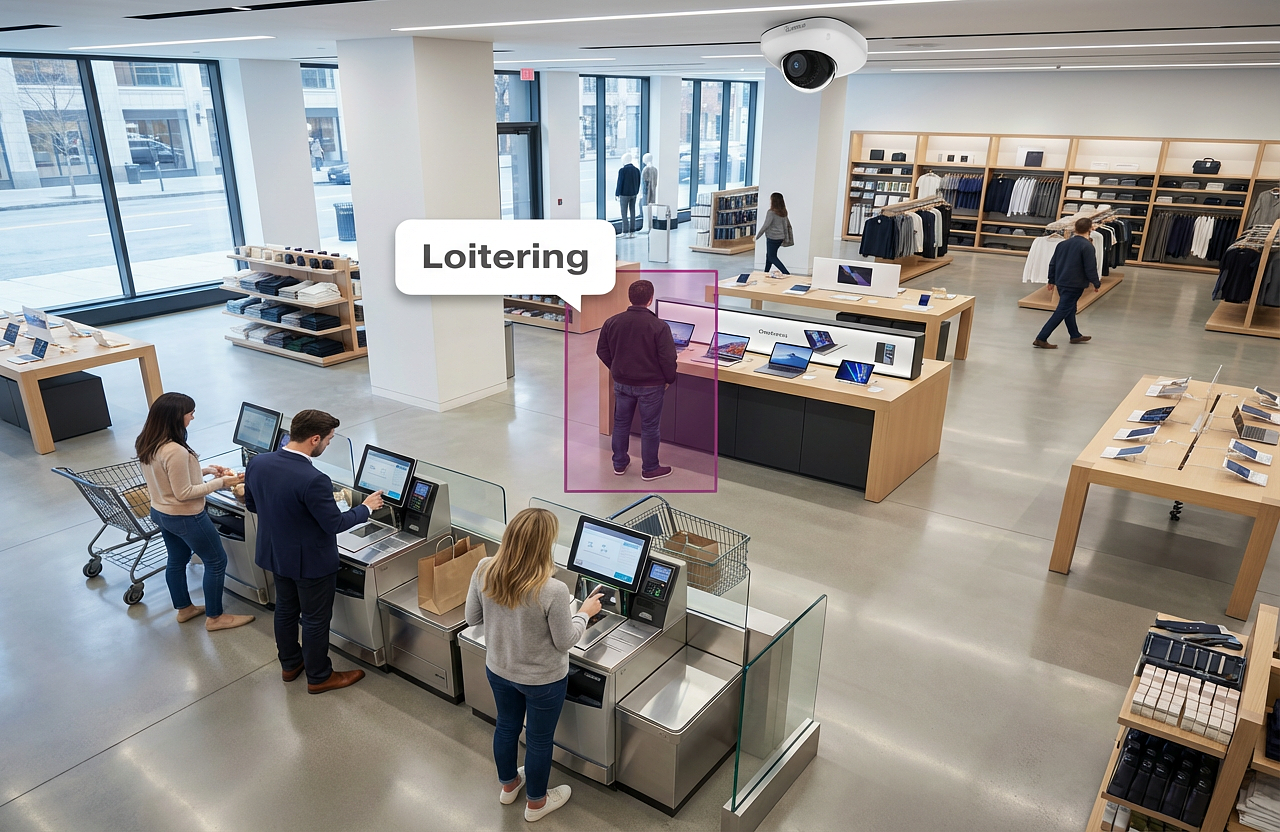
- Video AI Agents act as AI coworkers that detect context-aware behaviors (loitering, unauthorized zone entry, unattended registers) and feed those detections directly into the dashboard for triage and resolution.
Key terms
- Exception-based reporting (EBR): the process of flagging unusual POS transaction patterns, such as high refund rates, frequent voids, or price overrides, that often signal fraud or process errors. Learn more about exception-based reporting.
- Shrinkage: the gap between recorded inventory and actual inventory on hand. Common causes include external theft, internal fraud, administrative errors, and vendor discrepancies.
- Video AI Agents: intelligent software that analyzes camera feeds to detect specific behaviors, such as loitering or unauthorized entry, and alerts teams to act. Spot AI ships multiple pre-trained Video AI Agents across safety, operations, and security.
- Anomaly detection: statistical or machine-learning methods that identify deviations from expected patterns, alerting LP teams to potential risks before they escalate into confirmed losses.
Why loss prevention leaders need a different kind of dashboard
Traditional security setups record video and generate POS reports in separate silos. LP teams then spend hours manually cross-referencing footage with transaction logs, often weeks after an incident occurred. The result is a department that operates in a constant cycle of after-the-fact investigation rather than forward-looking risk mitigation.
The pressure is compounding. The National Retail Federation now frames organized retail crime as a national policy priority, while margin headwinds from swipe fees and tariffs make every basis point of shrink reduction more valuable to the P&L (Source: National Retail Federation). McKinsey's 2026 outlook on North American grocery reinforces this shift, finding that leading retailers are building integrated operating systems that unify data across merchandising, store operations, and digital channels to respond faster to changing conditions (Source: McKinsey).
A well-designed loss prevention dashboard addresses three specific frustrations that keep LP executives up at night.
Moving from after-the-fact recording to timely intervention
Most camera systems capture footage that sits unreviewed unless someone already knows what to look for. Executive dashboards change this dynamic by incorporating real-time data feeds from video AI, POS, and inventory systems. Instead of analyzing a theft two weeks after the merchandise is gone, LP teams can intervene while an event unfolds or within minutes of a flagged anomaly.
Deloitte's fraud-risk framework emphasizes "responsiveness measurement," evaluating whether controls detect and respond to suspicious activity quickly enough to minimize losses (Source: Deloitte). That concept translates directly to LP: a dashboard that surfaces a high-value void at register 7 alongside the corresponding video clip within seconds is fundamentally different from one that logs the same void in a weekly report.
Breaking down system silos
Retail environments frequently run cameras, POS systems, access controls, and inventory platforms on separate networks with no shared data layer. This forces LP analysts to toggle between applications and manually correlate events. An open API architecture connects these systems into a unified view, so a single dashboard can correlate a transaction anomaly with the associated video evidence and the inventory record for that SKU.
Deloitte's fraud-risk assessment calls for holistic data integration across internal transactions, customer information, employee activity, and external intelligence sources, providing a blueprint for LP leaders seeking dashboards that break down silos and support coordinated detection (Source: Deloitte).
Proving ROI to the CFO
Without clear metrics, loss prevention is often viewed as a cost center. Dashboards change the narrative by quantifying mitigated incidents, tracking investigation time reductions, and connecting shrink improvements to margin impact. In a slow-growth environment where NRF's Retail Monitor shows U.S. retail sales growing modestly month over month (Source: National Retail Federation), shrink reduction becomes one of the most direct levers for margin expansion. A dashboard that shows a region's shrink rate dropping from 2.1% to 1.4% over two quarters tells a story the CFO can act on.
Essential KPIs for a loss prevention dashboard
Overloading a dashboard with dozens of metrics creates noise, not clarity. The most effective approach focuses on five to 15 core KPIs that drive accountability and action. The table below organizes the metrics that matter most for an executive loss prevention dashboard, along with the strategic value each delivers.
| Metric category | Key performance indicator | Strategic value |
|---|---|---|
| Shrinkage | Shrink % by store, region, and category | The foundational KPI. NRF benchmarks average U.S. retail shrink at approximately 1.6% of sales (Source: National Retail Federation). Tracking by location and category reveals where losses concentrate. |
| Financial control | Cash variance, refund rate, and return-to-sale ratio | Surfaces cash handling errors, potential internal fraud, and return abuse. NRF PROTECT sessions now spotlight return fraud as one of retail's fastest-growing loss sources (Source: National Retail Federation). |
| Self-checkout | SCO shrink rate, SCO transaction share, and control-health score | ECR Retail Loss Group finds that turning off weight-scale controls in self-checkout lanes is associated with increased loss (Source: Ecrloss). Tracking control health by lane gives early warning. |
| Investigation efficiency | Average time from incident to detection, and detection to resolution | Measures whether tools like video AI are shortening investigation cycles. Faster resolution frees LP staff for higher-value work. |
| Compliance | SOP adherence score and audit pass rate | Confirms that safety and security procedures are consistently followed across locations. Variance here often predicts future shrink spikes. |
A useful rule of thumb: if a KPI does not change a resource allocation decision or trigger a specific follow-up action, it does not belong on the executive view. Focus your top-level dashboard on five to seven metrics that directly drive resource deployment and shrink reduction.
Designing the dashboard for rapid decision-making
A dashboard is only valuable if the people who open it can grasp status and identify variances within seconds. McKinsey's 2026 grocery report finds that retailers using well-designed analytics interfaces respond more quickly to demand and operational changes (Source: McKinsey). Three design principles keep LP dashboards focused.
Visual hierarchy that earns trust
- Traffic-light logic: apply consistent color coding (red for critical, yellow for elevated, green for stable) so executives can scan a 50-store fleet in seconds.
- Progressive disclosure: present five to seven summary KPIs at the top. Let users drill into region, store, and transaction-level detail only when they need it.
- Mobile access: regional directors traveling between sites need dashboards that load fast on a phone and surface the two or three data points that require immediate attention.
Audience-segmented views
McKinsey documents that high-performing retailers differentiate decision-support tools for corporate, regional, and store-level audiences (Source: McKinsey). The same principle applies to LP dashboards.
- Executive view (VP of LP, CFO): five to seven KPIs, year-to-date trends, variance from budget, and a high-risk store ranking. This view answers one question: where should we allocate resources next quarter?
- Regional director view: store-level performance comparisons, outlier flags, and incident heatmaps by geography. This view answers: which stores need intervention this week?
- Store manager view: daily operational metrics, open investigation tasks, and SOP adherence scores for their location. This view answers: what do I need to act on today?
Deloitte's fraud-risk framework reinforces this approach, calling for organizational alignment and shared risk taxonomy so that different audiences interpret metrics consistently even when their views differ (Source: Deloitte).
How video AI feeds the loss prevention dashboard
Video technology has evolved from a passive recording tool into a rich data source for LP analytics. When video analytics are unified with an executive dashboard, retailers can correlate visual evidence with transactional and operational data in a single workflow.
Context-aware incident detection
Spot AI's AI Security Guard acts as an AI coworker that identifies behaviors preceding loss in real time, then feeds those detections into the dashboard for triage. Key detections include:
- Loitering in high-risk zones: flagging individuals lingering near high-value merchandise or back-of-house areas.
- Unauthorized zone entry: alerting staff when someone enters a restricted area without credentials.
- Unattended checkout or kiosk: detecting when a register or self-checkout station is left unstaffed, which increases walkaway and shrink risk.
ECR Retail Loss Group's research confirms that interventions designed to increase a sense of control in self-checkout areas, such as AI-enabled monitoring and increased staff presence, are associated with reductions in loss (Source: Ecrloss). Video AI detections serve as the trigger for those interventions.
Faster investigations, fewer hours wasted
Manual video scrubbing remains one of the largest time drains in LP. When a dashboard flags a POS exception, an integrated video AI platform lets investigators search by behavior, time window, or keyword rather than scrolling through hours of footage. This approach shortens investigation cycles and frees staff to focus on higher-impact work like building ORC cases or coaching store teams on SOP adherence.
Correlating video with POS data
Integrating video with POS data creates a powerful anomaly detection capability. When the dashboard flags a high-value refund or a voided transaction, the system can surface the associated video clip alongside the transaction record. This correlation helps LP teams distinguish between an administrative error, a training gap, and confirmed internal fraud, all from a single screen.
Spot AI's POS integration connects transaction data with time-stamped video evidence so that every exception carries visual context. The result: fewer false positives, faster case building, and clearer documentation for law enforcement or HR follow-up.
Correlating POS exceptions with time-stamped video evidence is one of the highest-impact steps an LP team can take. It eliminates ambiguity around flagged transactions, reduces false positives, and produces case-ready documentation that accelerates resolution with law enforcement or HR.
Architecture for multi-store visibility
Managing loss prevention across a fleet of stores requires a centralized platform that does not sacrifice local detail. Two layers work together.
Centralized oversight for corporate LP
Corporate-level dashboards aggregate shrink, incident, and compliance metrics across the entire chain. Heat maps reveal geographic concentrations of shrinkage or organized retail crime activity, enabling strategic deployment of field investigators and guard resources. NRF's supply-chain resilience guidance stresses that central teams are increasingly expected to coordinate with procurement, logistics, compliance, and finance (Source: National Retail Federation). A well-built LP dashboard serves as the shared reference point for those cross-functional conversations.
Store-level accountability and coaching
NRF's National Retail Security Survey highlights that shrink is not evenly distributed across retailers or locations (Source: National Retail Federation). Store-level dashboards give managers visibility into their own cash handling, audit scores, and incident trends. Locations meeting targets can be recognized. Locations with elevated variance receive targeted coaching and support rather than punitive scrutiny.
ECR's self-checkout study reinforces this point: store-level design and control choices, including the number of self-checkout machines and how they are configured, directly affect shrink outcomes (Source: Ecrloss). Giving managers that visibility empowers them to adjust configurations before losses compound.
"Confidence, efficiency, and security."
Lee Kunkle, Director, Storage Asset Management, describing the impact of centralized video AI monitoring across approximately 50 virtually managed facilities (Source: Spot AI).
Implementation strategy for rolling out an LP dashboard
Deploying an executive dashboard is as much an organizational change project as a technical one. McKinsey reports that grocery retailers implementing integrated operating systems often follow phased rollouts, starting with pilots and gradually extending capabilities (Source: McKinsey). A similar approach works for LP dashboards.
- Define business objectives first. Clarify the specific outcomes desired: reducing shrink by a target percentage, cutting average investigation time, or improving SOP adherence scores across a region.
- Pilot in a controlled set of stores. Start with five to ten locations that represent different risk profiles. Refine alert thresholds, dashboard views, and escalation workflows before scaling.
- Establish data governance. Standardize definitions for metrics like "void," "refund," and "cash variance" across all locations so that comparisons are reliable.
- Map insights to actions. Define who investigates a flagged anomaly, the expected timeline for resolution, and how outcomes are documented. A dashboard that surfaces insights without a clear response workflow generates noise rather than results.
- Integrate with existing infrastructure. Spot AI is camera-agnostic and works with any IP camera, so most sites go live in days with no rip-and-replace. Open system architecture connects video, POS, and access control into a single data layer.
Evaluating dashboard and analytics platforms
When comparing solutions for loss prevention analytics, prioritize flexibility, deployment speed, and total cost of ownership. NRF's supply-chain disruption guidance underscores the value of technologies that provide end-to-end visibility and the ability to ingest data from multiple sources into coherent dashboards (Source: National Retail Federation). The table below outlines key evaluation criteria.
| Evaluation criterion | Spot AI | Traditional VMS | Closed cloud systems |
|---|---|---|---|
| Deployment speed | Live in days with existing cameras | Weeks to months | Varies; may require proprietary hardware |
| Hardware compatibility | Camera-agnostic (any IP camera, no vendor lock-in) | May require specific hardware brands | Often tied to proprietary cameras |
| AI capabilities | Unified platform with Video AI Agents for security, safety, and operations | Limited analytics; may require costly add-ons | Basic analytics included |
| Scalability | Cloud-native dashboard scales across sites and users | Constrained by on-prem server capacity | Scalable but often carries high per-camera licensing |
| POS and video correlation | Open API connects POS exceptions to time-stamped video clips | Manual cross-referencing required | Varies by vendor and integration availability |
| Investigation speed | Search and resolve incidents in minutes | Manual scrubbing can take hours | Depends on bandwidth and interface design |
From data to decisions: making the dashboard work
A loss prevention dashboard is not a reporting tool. It is a decision engine. The distinction matters. Reporting tells leadership what happened last quarter. A decision engine tells leadership where to deploy a field investigator tomorrow, which store's self-checkout controls need reconfiguration this week, and whether the refund-fraud trend in the Southeast region is accelerating or stabilizing.
Deloitte's fraud-risk framework recommends transitioning from static risk registers to real-time, data-driven dashboards that support continuous monitoring and cross-crime pattern detection (Source: Deloitte). For LP leaders, this means treating the dashboard as living infrastructure: tuning alert thresholds quarterly, adding new KPIs as threats evolve (return fraud, ORC tracking), and retiring metrics that no longer drive action.
Spot AI's AI Security Guard and video intelligence capabilities feed directly into this model. Existing cameras become AI coworkers that detect, deter, and document, while the dashboard gives LP leadership the single executive view they need to allocate resources, prove ROI, and reduce shrink across every location.
Ready to see how your existing cameras can power a loss prevention dashboard that drives outcomes? Book a demo to explore how Spot AI connects video AI, POS data, and incident management into a unified view for your LP team.
Frequently asked questions
What should be on a loss prevention dashboard?
An effective loss prevention dashboard tracks five to 15 core KPIs: shrink percentage by store and category, cash variance, refund and return rates, investigation cycle time, SOP adherence scores, and self-checkout control health. Each metric should trigger a specific follow-up action or resource allocation decision.
How do you integrate POS data with a loss prevention dashboard?
POS integration is typically achieved through open APIs that connect the transaction system with the dashboard platform. This enables exception-based reporting where anomalies like high refunds or frequent voids are automatically correlated with time-stamped video evidence and inventory records to verify whether an event represents fraud, error, or a training gap.
What are the best KPIs for retail loss prevention leaders?
NRF benchmarks average U.S. retail shrink at approximately 1.6% of sales, making shrink percentage by store, region, and category the foundational KPI (Source: National Retail Federation). Beyond shrink, track cash variance, refund rate, return-to-sale ratio, average investigation time, SOP adherence, and self-checkout shrink rate. Forward-looking risk indicators derived from anomaly detection add additional value.
How can video AI reduce shrink in retail stores?
Video AI Agents analyze camera feeds to detect context-aware behaviors such as loitering, unauthorized zone entry, and unattended registers. These detections feed into the LP dashboard for real-time triage, enabling staff to intervene during an event rather than investigating it days later. Correlating video with POS data also accelerates case building and reduces false positives.
How do you prove loss prevention ROI to executive leadership?
Dashboard-driven LP programs quantify outcomes that resonate with CFOs: shrink rate reduction over a defined period, investigation time savings, guard and staffing efficiency gains, and the dollar value of mitigated incidents. Presenting these metrics alongside margin impact in a board-ready format shifts the perception of LP from cost center to profit protector.
About the author
Sud Bhatija is COO and Co-founder at Spot AI, where he scales operations and GTM strategy to deliver video AI that helps operations, safety, and security teams boost productivity and reduce incidents across industries.

