






Running a production floor often feels like trying to be in ten places at once. You are responsible for OEE, safety compliance, and shift handovers, yet you physically cannot monitor every line, loading dock, and workstation simultaneously. This visibility gap creates a persistent obstacle: the "70-20-10" rule of operator adherence. Research indicates that while 70% of operators follow standard operating procedures (SOPs) consistently, 20% operate in a "gray zone" of partial compliance, and 10% deviate significantly (Source: Orcalean).
For a production supervisor, that 30% variation drives the majority of headaches—unplanned downtime, scrap, and safety incidents. Traditional methods like clipboard audits or reviewing footage after an accident are too slow to change these behaviors. By the time you see the report, the damage is done.
This is where how to use video-based recommendations for real-time operator coaching changes the dynamic. By leveraging video AI, you can transform cameras from passive recording devices into AI-assisted monitoring tools that detect process deviations as they happen. This allows you to provide feedback when it matters most—in the moment—rather than during a disciplinary meeting weeks later.
Key terms to know
Video AI (Video Artificial Intelligence): technology that uses computer vision algorithms to analyze video feeds in real-time, detecting specific behaviors, objects (like PPE), or anomalies without human intervention.
Real-Time Coaching: the practice of delivering timely, contextual feedback to operators during task execution, allowing them to correct performance before errors accumulate.
SOP Adherence: the degree to which operators follow documented Standard Operating Procedures, a critical metric for consistent quality and safety.
OEE (Overall Equipment Effectiveness): a gold-standard manufacturing metric that measures the percentage of manufacturing time that is truly productive.
The hidden cost of inconsistent operator performance
Every production supervisor knows the frustration of "blind spots" during off-shifts. You might leave the floor with the first shift running smoothly, only to return the next morning to find production targets missed or equipment damaged during the third shift.
The operational impact of this variation is measurable and severe. When operators interpret procedures differently or cut corners when unsupervised, it leads to:
Quality variability: inconsistent execution leads to defect rates that fluctuate between shifts. Organizations standardizing procedures through better adherence have reported cutting defect rates from 5% to 1% (Source: Spot.ai).
Changeover inefficiency: changeovers are a major source of lost capacity. When operators execute changeovers inconsistently, cycle times vary, directly hitting your OEE.
Safety risks: deviations from safety protocols, such as entering no-go zones or skipping PPE, significantly increase the Total Recordable Incident Rate (TRIR).
Manual compliance verification is no longer enough. You cannot improve what you cannot see, and you cannot coach effectively based on hunches. Video analytics provides the objective data needed to identify root causes and support your team effectively.
Moving from reactive supervision to real-time coaching
The traditional training model in manufacturing is episodic: new hires receive classroom training, followed by on-the-job shadowing. After that, feedback is often limited to annual reviews or reactive conversations after an incident. Real-time coaching changes this approach by integrating continuous feedback into daily operations.
This approach aligns with the "EMPATHY" framework for feedback, ensuring coaching is constructive and developmental rather than disciplinary. By using video data, you move the conversation from "I think you did this wrong" to "Let's look at the video and see how we can improve this step."
Feature | Traditional supervision | Video-based real-time coaching |
|---|---|---|
Feedback timing | Delayed (hours, days, or weeks) | On-the-spot or near real-time |
Data source | Subjective observation or manual logs | Objective, time-stamped video evidence |
Coverage | Limited to where the supervisor stands | Continuous monitoring within configured camera views |
Focus | Reactive (investigating accidents) | Proactive (addressing early signals) |
Outcome | disciplinary action | Skill development and process correction |
How video analytics drives real-time operator coaching
To implement how to use video-based recommendations for real-time operator coaching, you need to map specific video AI capabilities to your daily operational challenges. Spot AI’s platform simplifies this by offering pre-trained AI agents that detect specific scenarios relevant to manufacturing.
1. Standardizing shift changeovers and SOPs
Inconsistent SOP adherence is a primary driver of yield loss. Video AI can be configured to monitor critical process steps.
Time studies: automatically measure the duration of tasks like changeovers. If Shift A takes 45 minutes and Shift B takes 30, video analysis reveals the specific procedural differences, allowing you to coach Shift A on the more efficient method (Source: Spot.ai).
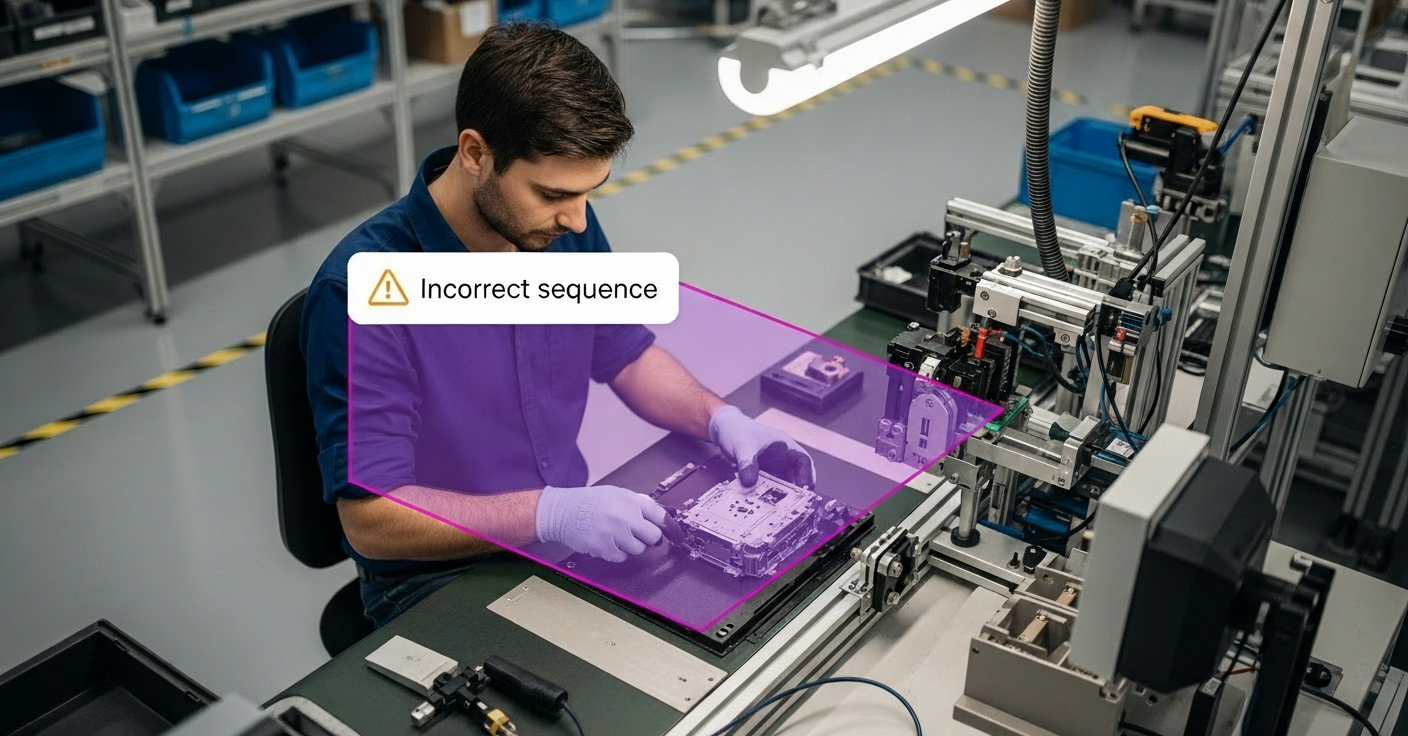
Workflow sequencing indicators: flag observable cues that suggest steps may be out of order (e.g., indications that a machine was engaged before pre-start tasks), for supervisor review.
Unattended workstations: receive alerts if a critical line position is left unattended for longer than a set threshold, allowing you to address bottlenecks as they arise.
2. Enhancing safety behaviors automatically
Safety is often the first area where coaching is needed. Instead of waiting for an OSHA recordable, use video AI to surface early observable signals.
PPE detection: automatically flag missing hard hats, vests, or safety glasses. This allows for a gentle reminder now, rather than an injury report later.
Forklift safety: monitor for "Forklift Enters No-go Zones" or interactions between pedestrians and machinery. This data helps you redesign traffic flows or coach specific drivers on safe routing.
Ergonomic coaching: identify "Running" or unsafe lifting behaviors that precede injuries. This is vital for minimizing long-term strain and workers' compensation claims.
3. Easing administrative burden
Supervisors often spend hours scrubbing through footage to find out why a line stopped.
Smart search: instead of watching hours of video, use keyword search to find "red forklift" or "person in Zone B" in seconds. This can significantly reduce investigation time, freeing you to focus on floor coaching.
Automated recaps: generate shift recaps that highlight anomalies, giving you a data-driven starting point for your morning stand-up meetings.
Implementing video-based recommendations on the floor
Deploying this technology requires a strategic approach to ensure operator buy-in. It must be positioned as a tool for support, not surveillance.
Phased implementation roadmap
Select a pilot area: choose a high-impact area, such as a bottleneck machine or a zone with frequent safety incidents. Focus on a clear metric, like shortening changeover time by 10% (Source: StandardBots).
Establish a baseline: use the video system to gather data on current performance levels (e.g., average changeover time is 32 minutes) before intervening. This objective data is crucial for measuring ROI.
Involve the operators: co-create the coaching protocols with your most experienced operators. When they help define what "good" looks like, they become champions for the technology.
Configure alerts: set up real-time alerts for supervisors. Ensure these are actionable—for example, an alert for "Unauthorized Entry" in a hazmat cage allows for rapid intervention.
Best practices for coaching conversations
When using video data to coach, follow the GROW model (Goal, Reality, Options, Wrap-Up) to facilitate learning.
Show, don't just tell: review the clip with the operator. Ask, "What do you see happening here?" This builds self-awareness and reduces defensiveness.
Focus on the process, not the person: frame the conversation around SOP adherence and safety standards rather than personal failure.
Reinforce the positive: use video to catch people doing things right. Highlight a perfectly executed changeover in your team meeting to set the standard.
Measuring the impact: KPIs that matter
To validate the investment in how to use video-based recommendations for real-time operator coaching, you must track specific KPIs. Organizations implementing these systems often see a rapid return on investment through productivity gains and fewer incidents.
KPI | Description | Expected impact with Video AI |
|---|---|---|
Overall equipment effectiveness (OEE) | Availability × performance × quality. | Improves OEE by reducing unplanned downtime and standardizing performance. |
First pass yield (FPY) | Percentage of defect-free products. | Increases the percentage of defect-free products by catching errors early in the process. |
Changeover time | Time to switch between products. | Shortens time by optimizing workflows (Source: Spot.ai). |
Safety incident rate | Frequency of injuries. | Lowers incident rates through earlier hazard detection (Source: Spot.ai). |
Training ramp time | Time for new hires to reach proficiency. | Shortens time for new hires to reach proficiency by using video examples of best practices. |
Real-world success stories
Shortening automotive changeovers: an automotive parts manufacturer used video analytics to analyze changeover procedures between shifts. They discovered one shift was consistently faster because they pre-staged materials. By using video to coach the other shift on this technique, they significantly lowered overall changeover times and lifted OEE.
Pharmaceutical quality control: a manufacturer struggling with assembly defects implemented video monitoring to verify steps in real-time. By catching errors during assembly rather than at final inspection, they improved First Pass Yield from 88% to 96% and reduced the cost of poor quality by $240,000 annually (Source: Spot.ai).
Heavy equipment safety: a facility facing high injury rates deployed AI to monitor PPE compliance and no-go zones. The team reported a 42% year-over-year drop in recordable incidents; they attributed the improvement to better coaching and traffic-flow adjustments (Source: Spot.ai).
From Reactive Firefighting to Proactive Coaching
For the production supervisor, the goal is not to watch every move an operator makes, but to create a system where excellence is the standard and safety is prioritized. How to use video-based recommendations for real-time operator coaching is about bridging the gap between what should happen and what actually happens on the floor.
By turning video footage into actionable data, you gain the visibility needed to reduce blind spots, standardize best practices across shifts, and help protect your team from hazards. This changes your role from a reactive firefighter to a forward-looking coach, driving continuous improvement that shows up in OEE metrics and, more importantly, in the safety of your workforce.
See how Spot AI’s video AI platform can help you standardize shifts and improve safety. Request a demo to experience the technology in action.
Frequently asked questions
What are the benefits of real-time coaching in manufacturing?
Real-time coaching provides on-the-spot feedback, which accelerates learning and helps mitigate errors from becoming habits. It can minimize scrap, improve safety compliance, and support consistent SOP adherence across all shifts.
How can video analytics improve operator training?
Video analytics captures real-world examples of both correct and incorrect procedures. This creates a library of "game tape" that can be used to train new hires faster and shorten their time-to-proficiency.
What strategies can minimize operator errors?
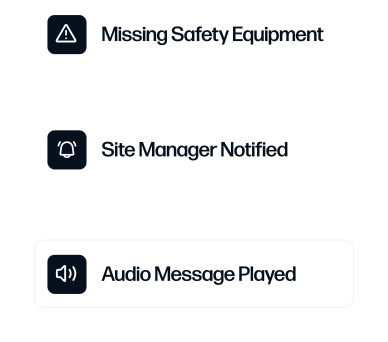
Implementing automated detection for process deviations (like skipped steps) and providing visual or audio alerts allows operators to self-correct in the moment. Combining this with data-driven coaching sessions helps address the root cause of errors (Source: Spot.ai).
How do AI cameras enhance operator coaching?
AI cameras act as a consistent observer, collecting objective data on performance within configured camera coverage. They identify patterns—such as a specific shift consistently struggling with a changeover—that a human supervisor might miss due to limited visibility (Source: Spot.ai).
Is video-based coaching considered spying on employees?
No, when implemented correctly. The focus should be on process improvement and safety, not individual punishment. Successful organizations communicate transparently that the system is designed to protect workers and reduce frustrating bottlenecks (Source: Orcalean).
About the author
Sud Bhatija is COO and Co-founder at Spot AI, where he scales operations and GTM strategy to deliver video AI that helps operations, safety, and security teams boost productivity and reduce incidents across industries.






.png)
.png)
.png)