






Every plant manager knows the sinking feeling of a 2 a.m. call reporting a line stoppage or a safety event. The crisis at hand is just the beginning; what follows is often a frustrating, hours-long process of scrubbing through video footage, trying to piece together grainy evidence to understand why it happened. In an industry where unplanned downtime can cost $260,000 per hour and safety violations trigger costly OSHA audits, spending days on incident review is a luxury no operation can afford (Source: MachineMetrics).
Traditional video systems force leaders to react slowly, relying on manual searches that are prone to human error and fatigue. However, the shift toward intelligent search is improving this workflow. By leveraging video AI, manufacturing leaders can cut incident review time, turning video data into timely, actionable information. This capability allows teams to move from reactive responses to proactive coaching, helping teams meet safety standards and OEE targets more consistently across shifts.
Understanding the basics: key terms in modern incident review
- Incident review: the systematic process of analyzing a safety, quality, or operational event to determine its root cause and minimize recurrence.
- Intelligent search: a capability within video AI platforms that allows users to search video footage using natural language or specific filters (e.g., "forklift in Zone A" or "person missing PPE") rather than manually scrubbing timelines.
- Root cause analysis (RCA): a method of problem-solving used to identify the underlying cause of faults or problems, often utilizing frameworks like the "5 Whys" or Fishbone diagrams.
- Video AI agents: automated software capabilities that monitor video feeds in real-time to detect specific behaviors, anomalies, or hazards and assist human reviewers.
The high cost of slow incident response in manufacturing
For a Director of Operations, the speed of incident review is directly tied to profitability and risk exposure. When an event occurs—whether it is a forklift collision, a machine failure, or a quality defect—the clock starts ticking.
The financial impact of investigation delays
Extended investigation timelines create a "compliance trap" where organizations struggle to meet reporting deadlines while conducting thorough analyses. The operational costs are severe:
- Production disruption: if a line is halted pending investigation, every hour of delay directly impacts throughput and revenue.
- Labor waste: skilled supervisors and safety managers spend significant time manually gathering data and analyzing footage for each serious occurrence, diverting them from high-value floor management.
- Recurrence risk: every hour an underlying issue remains unidentified is an hour where the event can happen again, potentially leading to further injury or equipment damage.
Why traditional video systems fail the plant floor
Most facilities still rely on passive camera systems that act merely as recording devices. These systems present significant limitations for the modern plant manager:
- Manual scrubbing: finding a specific event requires watching hours of footage at high speed, a process where human attention degrades rapidly, leading to missed evidence (Source: KPA).
- Data silos: critical context sits in disconnected systems. The video is in one server, the maintenance log in the CMMS, and the production data in the MES, making correlation nearly impossible.
- Blind spots: without remote access or intelligent alerts, managers are blind to third-shift operations, relying on hearsay or incomplete shift logs to understand overnight occurrences.
How intelligent search transforms incident review
Intelligent search significantly improves how operations teams interact with video data. Instead of passively watching hours of video, investigators can query the system to find what they need in less time.
From hours of scrubbing to seconds of clarity
Modern video AI platforms index video metadata, making physical actions searchable just like text on the web. This capability allows a safety manager to type "person entering no-go zone" or "forklift near Line 4" and swiftly see every relevant clip.
| Feature | Traditional video systems | Intelligent video search |
|---|---|---|
| Search method | Manual rewind and fast-forward | Natural language query / Filters |
| Time to locate evidence | 4–8 hours per incident | 15–30 minutes per incident |
| Data correlation | Manual cross-referencing | Time-stamped, synchronized views |
| Accessibility | On-premise control room only | Secure cloud dashboard (remote) |
| Outcome | Reactive documentation | Insight-driven root cause analysis |
(Source: Wavestore)
By compressing the timeline, intelligent search can significantly shorten investigation time, allowing teams to focus on fixing the problem rather than finding the footage.
Addressing the "he-said-she-said" accountability gap
One of the most persistent frustrations for plant managers is the lack of objective truth when events occur. Without clear evidence, safety violations or quality slips often devolve into subjective disputes.
Intelligent search provides verified, time-stamped visual evidence. This minimizes finger-pointing and encourages fact-based accountability. When a team can see exactly what happened—whether it was a skipped step in a changeover SOP or a legitimate equipment malfunction—the conversation moves efficiently to solution and coaching.
Solving core operational challenges with Video AI
For the Plant Manager balancing efficiency with safety, intelligent search is a key operational asset. Here is how it addresses specific frustrations found on the factory floor.
1. Reducing blind spots on third shift
Managing consistent execution across shifts is a constant struggle. Third-shift operations often suffer from lower visibility, leading to inconsistent SOP adherence.
- Remote visibility: managers can book a consultation to see how cloud-native dashboards allow them to assess third-shift performance from anywhere, without needing to be on-site at 3 a.m.
- Automated alerts: instead of analyzing a whole shift, the platform sends alerts for specific anomalies, such as unauthorized entry into restricted areas or extended idle time.
- Shift recaps: automated summaries highlight key events, allowing managers to assess the previous night's performance in minutes over morning coffee.
2. Reducing reactive firefighting
Spending too much of the day reacting to problems prevents leaders from focusing on continuous improvement. Intelligent search helps shift this balance.
- Pattern recognition: by searching for high-risk events like “forklifts braking suddenly,” managers can identify hazardous intersections and address risks before they escalate.
- Condition-based checks: integrating video with CMMS allows teams to visually verify equipment behavior and move from breakdown maintenance to condition-based monitoring.
- Trend analysis: aggregating data on recurring issues—like frequent stoppages on a specific line—reveals systemic bottlenecks that isolated event reports miss.
3. Streamlining compliance and OSHA audits
Manual compliance verification is inefficient and error-prone. Walking the floor to check for PPE usage captures only a fraction of the workday.
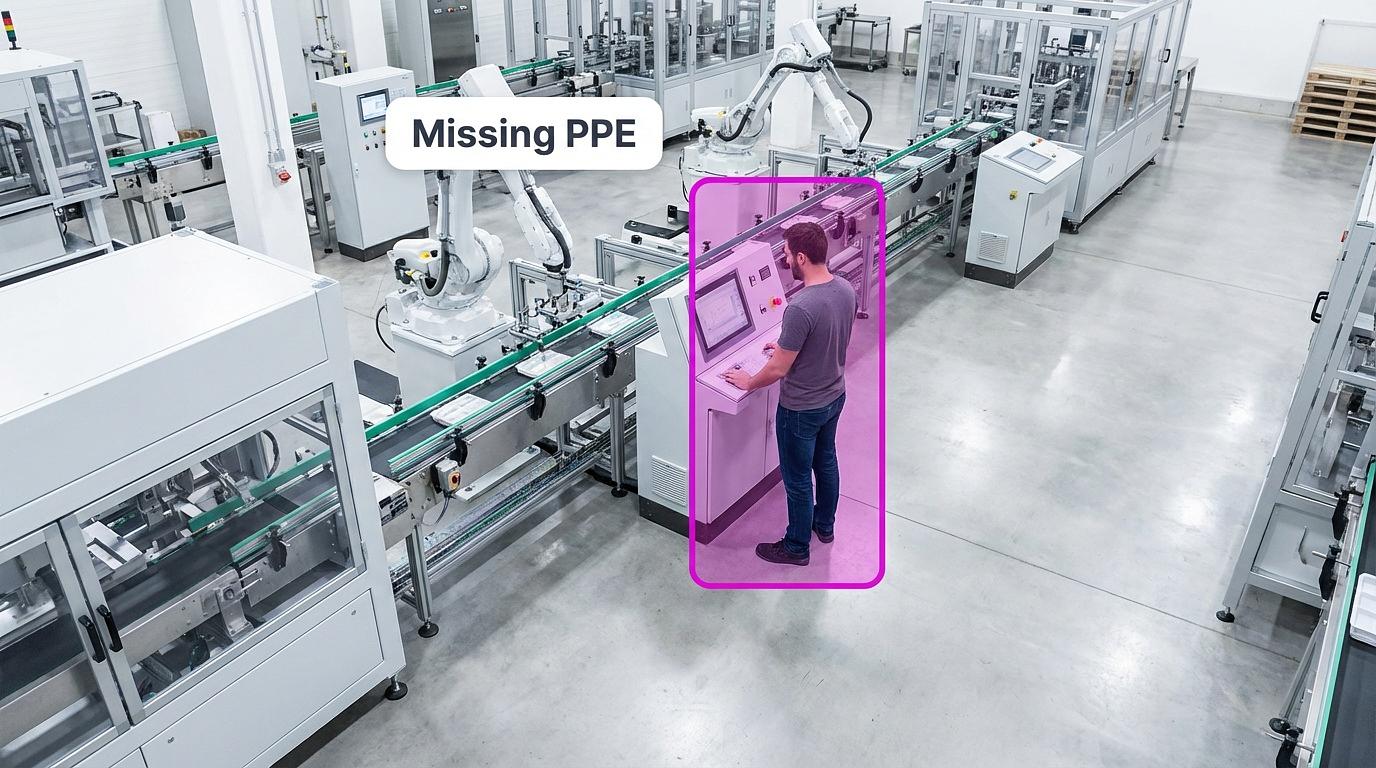
- Automated detection: Video AI agents can detect missing PPE (vests, hard hats) automatically, logging violations for assessment without constant human supervision.
- Audit readiness: when regulators request event history, intelligent search allows for the rapid compilation of a complete digital evidence package, helping teams meet documentation requirements.
- No-go zone enforcement: platforms automatically flag when personnel enter dangerous areas, supporting adherence to safety protocols around heavy machinery.
Best practices for implementing intelligent incident review
Adopting this technology requires more than just installing hardware; it requires a shift in operational processes.
1. Establish a structured investigation protocol
Speed is valuable only if the analysis is rigorous. Organizations should use standardized templates (like DMAIC or 5 Whys) to guide the investigation once the footage is found.
- Define: use intelligent search to isolate the incident clip and surrounding context.
- Measure: gather data on frequency (e.g., "How often does this machine jam?").
- Analyze: use the visual evidence to determine if the root cause was mechanical, environmental, or behavioral.
- Improve: implement a remedial step (e.g., update the SOP or repair the belt).
- Control: set a video alert to monitor for recurrence.
2. Integrate video data with operational systems
To fully eliminate data silos, video insights should not live in a vacuum. Integrating video data with MES and CMMS platforms provides a holistic view of the plant.
- Unified dashboards: view video feeds alongside production metrics to see if a drop in OEE correlates with specific visual anomalies.
- Automated work orders: configure the platform so that a visual detection of a hazard automatically triggers a maintenance ticket.
- Cross-functional access: ensure safety, quality, and operations teams all have access to the same "single source of truth" to facilitate collaboration.
3. Prioritize high-impact use cases first
Do not try to boil the ocean. Start by applying intelligent search to the areas that cause the most pain.
- High-risk zones: focus on forklift traffic areas and heavy machinery no-go zones.
- Bottleneck areas: monitor changeover stations to identify inefficiencies and coach teams on SOP adherence.
- Compliance hotspots: target areas with strict PPE requirements to demonstrate rapid safety ROI.
Top Video AI solutions for manufacturing: a comparison
When selecting a solution to shorten incident review time, Plant Managers should prioritize speed of deployment, ease of use, and the ability to work with existing infrastructure.
| Feature | Spot AI | Traditional VMS | Cloud-only cameras |
|---|---|---|---|
| Deployment speed | Plug-and-play (minutes) | Weeks (requires servers) | Days (requires new cabling) |
| Hardware flexibility | Camera Agnostic (Uses existing cameras) | Proprietary lock-in | Proprietary cameras only |
| Search speed | Real-time (Intelligent Search) | Slow (manual scrubbing) | Variable (Bandwidth dependent) |
| Scalability | Unlimited locations/users | Expensive to scale | Bandwidth constraints |
| AI capabilities | Edge-Cloud Hybrid (Low latency) | Server-heavy | Cloud-latency issues |
Why Spot AI stands out:
Spot AI is designed to turn existing camera infrastructure into a useful operational tool. Its hybrid architecture allows for swift deployment without ripping and replacing hardware. By making video data easier to access, it helps plant managers conduct searches like "show me all motion in the packaging zone between 2 a.m. and 4 a.m." and get results quickly, helping cut investigation time from hours to minutes in many cases.
Gaining a Proactive Edge with Intelligent Video
The difference between a profitable, safe plant and one managing frequent downtime often relates to the speed of information. Manufacturing leaders can no longer afford the operational drag of manual incident review. By adopting intelligent search and Video AI, plants can help shorten investigation timelines, support higher SOP adherence, and foster a culture of forward-looking safety.
Transforming your camera system from a passive recorder into an active teammate does not require a massive overhaul. It starts with unlocking the data you already have.
See how intelligent search can streamline your incident review process.
Request a Spot AI demo to experience video AI in action.
Frequently asked questions
What are the best practices for incident review in manufacturing?
Effective incident review relies on speed, objective evidence, and structured analysis. Best practices include using intelligent search to locate footage quickly, utilizing frameworks like the "5 Whys" for root cause analysis, and integrating video data with maintenance logs to ensure a complete picture of the event.
How can AI improve event analysis?
AI improves analysis by reducing human bias and fatigue. It automates the detection of anomalies, correlates patterns across different shifts (e.g., identifying that a specific error only happens at night), and provides real-time query capabilities that highlight relevant events without manual scrubbing.
How to ensure compliance in incident reporting?
To ensure compliance, organizations should use automated tools that create time-stamped, unalterable audit trails. Intelligent video platforms can automatically package video evidence with incident reports, ensuring that all regulatory documentation requirements for bodies like OSHA are met fully and accurately.
What tools are available for event management?
Modern tools include unified Video AI platforms like Spot AI, which combine video security with operational analytics. These integrate with traditional Manufacturing Execution Systems (MES) and Environmental, Health, and Safety (EHS) software to provide a centralized hub for detecting, investigating, and resolving events.
How does intelligent search help lower downtime?
By identifying the root cause of a stoppage in minutes rather than hours, maintenance teams can implement the correct fix quickly. Furthermore, analyzing trends in high-risk event data allows teams to take anticipatory action on equipment issues before they cause a full breakdown.
About the author
Dunchadhn Lyons leads Spot AI’s AI Engineering team, building real-time video AI for operations, safety, and security—turning video data into alerts, insights, and workflows that cut incidents and boost productivity.

