






Overseeing multiple construction sites means you can’t be everywhere at once. This creates blind spots, leaving you to discover theft, safety violations, or damage days after the fact when it’s too late to guard against losses. The constant pressure to scale operations without a proportional increase in headcount, coupled with rising insurance premiums and the high cost of physical guards, puts project margins at risk. Traditional security methods are reactive, time-consuming, and create a flood of irrelevant alerts, pulling your project managers and superintendents away from productive work.
This article provides a framework for how operations and project executives can use video AI to multiply site coverage and augment their existing teams. We will explore how to shift from a reactive security posture to an anticipatory one, enabling you to protect assets, improve safety compliance, and enhance operational efficiency across your entire project portfolio.
The roadblocks to scaling construction operations profitably
Managing a portfolio of construction projects involves navigating a complex landscape of risks that directly threaten profitability and timelines. For many leaders, the core frustrations are not isolated incidents but systemic issues rooted in outdated monitoring and security practices.
- Reactive incident response: finding out about a safety violation, theft, or act of vandalism days or even weeks after it occurs is a common roadblock. This reactive stance means the damage is already done, eroding project margins and straining relationships with clients and insurers.
- Manual investigation time drain: when an incident does occur, the investigation process can consume many hours of valuable time from project managers and superintendents, pulling them away from managing schedules and subcontractors. Sifting through hours of footage to find a single event is an inefficient use of highly skilled resources.
- Blind spots across multiple sites: maintaining real-time visibility across 10 to 20 active jobsites simultaneously is a considerable hurdle. This lack of a unified view creates constant uncertainty about what is happening when you are not physically present, making it difficult to allocate resources to the highest-risk sites.
- Rising insurance premiums: many organizations see their insurance premiums increase annually despite investing in safety programs. Without a reliable way to prove forward-looking risk management to carriers, leaders feel powerless to control this escalating operational cost.
- Subcontractor accountability gaps: the inability to prove when a subcontractor causes damage, violates a safety protocol, or contributes to a delay leads to costly disputes and eroded margins. Without verifiable, time-stamped evidence, holding third parties accountable is hard.
- False alert fatigue: traditional motion-detection systems often generate dozens of irrelevant alerts triggered by animals, weather, or shadows. This creates "alert fatigue," causing teams to ignore notifications and miss the real incidents that require timely attention.
- Disconnected data systems: critical information is often siloed. Safety metrics exist in one system, project management data in another, and security footage in a third. This lack of integration makes it impossible to get a unified view of site performance for strategic decision-making.
These roadblocks create a cycle of reactive firefighting that limits scalability and directly impacts key performance indicators like project margin, schedule adherence, and your company’s Experience Modification Rate (EMR).
The shift from reactive security to anticipatory risk management
The fundamental limitation of traditional security—physical guards, fences, and standard monitoring systems—is its reactive nature. These methods document what has already happened rather than helping you intervene before losses occur. Thieves understand this vulnerability and strategically target sites during periods of minimal supervision, such as overnight or on weekends. By the time a theft is discovered, the stolen equipment, which can be valued at $40,000 to $60,000 per machine, is often gone for good (Source: Latiumtech).
Video AI helps teams move from post-incident review to real-time monitoring and response.
Instead of relying on personnel to manually watch video feeds, AI-powered platforms help analyze footage from your sites. These systems can be configured to identify specific, business‑relevant events and reduce irrelevant alerts.
With an AI teammate, your team is alerted to potential incidents as they unfold, not after the fact. This allows you to move from documenting losses to actively mitigating them, transforming your security function from a cost center into a strategic asset that protects your bottom line.
How video AI multiplies site coverage and visibility
For executives managing a growing portfolio of projects, improving site coverage without a linear increase in cost is a primary objective. Video AI breaks the traditional scaling model, allowing you to see more and manage more effectively with your existing resources.
- Achieve more with fewer resources
AI-powered analytics extract more intelligence from every camera, enabling fewer cameras to provide superior coverage. For example, a single camera with AI can detect an intruder from hundreds of meters away with minimal false alarms, effectively doing the work of multiple standard cameras. When a potential threat is detected, AI-enabled pan-tilt-zoom (PTZ) systems can automatically track the subject, keeping it in frame without manual intervention. This reduces the number of cameras needed for perimeter coverage by an estimated 50% (Source: SightLogix). - A unified dashboard for multi-site operations
Instead of juggling multiple systems or relying on second-hand reports, a unified video AI platform like Spot AI gives you a central place to view and manage information. From one cloud-based dashboard, you can gain real-time visibility into all your jobsites. This helps reduce the blind spots associated with managing 10–20 sites at once. You can quickly assess activity levels, review active alerts, and determine which sites need rapid attention, enabling more strategic resource allocation. - Strategic camera deployment for maximum impact
Effective coverage starts with a risk assessment to identify high-value asset locations, likely points of unauthorized access, and critical safety zones. Based on this, you can deploy a mix of technologies for optimal results.- Mobile monitoring units at primary entrances can observe vehicle and personnel traffic and can be repositioned as project phases evolve.
- Elevated long-range cameras can secure vast perimeters in various lighting conditions, detecting intruders before they reach valuable assets.
- 360-degree panoramic cameras can cover large laydown yards or storage areas with a single device.
With a platform like Spot AI, you can integrate any IP camera—existing or new—into a unified system. This camera-agnostic approach protects your current hardware investments while giving you the flexibility to deploy the right technology for each unique site hurdle.
Augmenting your team with an AI teammate
Video AI doesn't replace your security and operations teams; it augments them, making them more efficient and effective. By automating routine monitoring and analysis, AI acts as an intelligent teammate that allows your personnel to focus on high-value tasks.
- Automating incident detection to minimize false alarms
A major source of inefficiency is the constant stream of false alarms from traditional motion sensors. AI-powered systems are trained to understand context, distinguishing between an animal crossing the site and a person attempting to breach a fence. This intelligence can significantly reduce false alarms compared to many legacy systems (Source: Patrolsense). With Spot AI, your team only receives alerts for business-critical events like loitering, unauthorized entry, or fence jumping, allowing them to respond with confidence. - Accelerating investigations from days to minutes
When an incident occurs, your team no longer needs to spend hours manually scrubbing through footage. With intelligent search capabilities, they can quickly find specific events. For example, a supervisor can search for "person in equipment storage area between 2 AM and 4 AM" and get results in seconds. This capability, available in the Spot AI platform, can reduce investigation time substantially, helping project managers and superintendents refocus on core work. - Proving subcontractor accountability with time-stamped evidence
Disputes over damages or work quality can quickly erode project margins. Video AI provides a verifiable record of site activities. With Spot AI, you can use time-stamped video evidence tagged with AI detections to verify when subcontractors were on-site, confirm work was completed to specification, or prove liability for damages. This reduces back‑and‑forth and helps protect your bottom line.
Integrating video AI into your operational workflows
The greatest value of video AI is realized when it is integrated into your core operational systems. By connecting video intelligence with project management and safety platforms, you can unlock new levels of efficiency and control.
- Connecting video intelligence to project management systems
Modern construction projects run on platforms like Procore. With an open API, a video AI platform like Spot AI can integrate with these systems to create a single, unified source of truth. You can automatically document project progress with time-lapse video, compare actual work against BIM models, and verify that subcontractors are adhering to the schedule. This allows you to identify and address schedule variance earlier, when corrective actions are less costly. - Streamlining safety compliance and insurance reporting
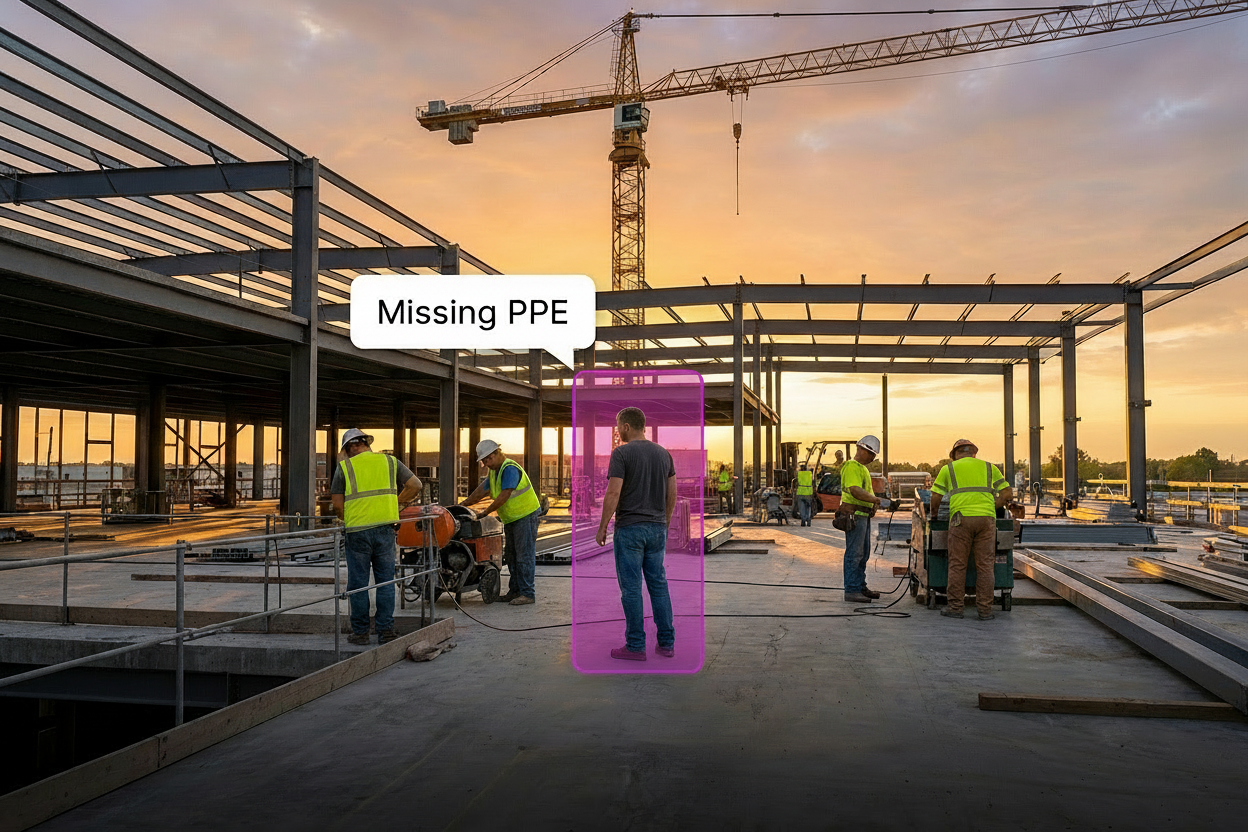
Maintaining documentation for OSHA and insurance is a substantial administrative burden. An AI platform can automate much of this work. Spot AI can automatically detect and log safety events like missing PPE or entries into no-go zones, creating a continuous, time-stamped record of compliance. This automated documentation proves forward-looking safety management to insurance carriers, helping to control premium increases. It also strengthens your position during OSHA audits by demonstrating a consistent, system-wide approach to safety.
A comparison of construction site security solutions
| Feature | Spot AI Video AI Platform | Traditional Guards | Basic Monitoring Systems |
|---|---|---|---|
| Deployment Speed | Days; plug-and-play hardware | Weeks | Weeks to months; requires extensive cabling |
| Scalability | High; unified cloud dashboard that supports many sites and users | Low; linear cost | Low; requires on-prem hardware at each site |
| Real-Time Alerts | Yes; AI-powered alerts for specific events (theft, safety) | Limited by vision | No; requires manual monitoring |
| Investigation Time | Minutes; intelligent search for events, people, and vehicles | Hours to days | Hours to days; requires manual footage review |
| False Alarm Rate | Lower; AI helps filter out irrelevant motion | N/A | Very High; standard motion detection |
| Total Cost of Ownership | Lower; cuts guard spend and leverages existing cameras | High | Moderate; substantial hidden costs in monitoring |
Unlock measurable ROI with a unified video AI platform
Transitioning to an AI‑supported security strategy can deliver measurable benefits across your organization. By improving site coverage and supporting your team, you can address core challenges that impact project profitability. The ability to deter theft, reduce safety incidents, and accelerate investigations can contribute to lower insurance costs, reduced labor spend, and healthier project margins. With a unified platform, you gain visibility and control to scale operations more efficiently.
Curious how video AI can help you protect assets and streamline construction operations? Book a demo to see Spot AI in action and explore how our platform supports safety, security, and efficiency across your sites.
Frequently asked questions
How can AI improve construction site safety?
AI improves construction site safety by actively monitoring for hazards in real time. It can automatically detect when workers are missing personal protective equipment (PPE) or enter restricted hazardous areas. By providing real-time alerts, AI helps supervisors respond faster to potential hazards, which may help mitigate risk and improve safety metrics like TRIR (Source: Cyberwave).
How does video analytics enhance security in construction?
Video analytics enhances security by turning camera feeds into actionable intelligence. AI algorithms can monitor video feeds to detect specific events like unauthorized access, loitering after hours, fence jumping, and vehicle break-ins. This allows for a much faster response than traditional manual monitoring and helps deter theft and vandalism, which globally costs the industry over $1 billion annually (Source: Young Douglas Insurance).
How can construction companies minimize theft and unauthorized access?
Construction companies can minimize theft and unauthorized access by deploying a layered security approach centered on video AI. This includes using AI-powered cameras to monitor perimeters, equipment storage areas, and access points. The system can create virtual boundaries and send real-time alerts when they are crossed by unauthorized individuals or vehicles. This real-time detection, often paired with automated deterrents like lights and audio alarms, can be effective in helping minimize losses (Source: Latiumtech).
How does video AI minimize false alarms?
Video AI helps minimize false alarms by using algorithms that can differentiate between genuine security events and irrelevant motion. Unlike traditional systems that trigger on any movement, AI can be trained to recognize specific objects and behaviors. It can distinguish between a person and an animal, or a swaying tree and someone climbing a fence. This approach can substantially cut the number of nuisance alerts, allowing your team to focus on what matters.
How can video AI help deter copper and tool theft?
Video AI directly addresses the theft of high-value materials like copper and tools by creating intelligent monitoring zones. With a platform like Spot AI, you can define virtual perimeters around tool containers and material laydown areas. The system sends real-time alerts if human activity is detected in these zones after hours, enabling a rapid response. This shifts security from reactive review toward earlier intervention and provides time‑stamped evidence to help accelerate investigations.
About the author
Sud Bhatija is COO and Co-founder at Spot AI, where he scales operations and GTM strategy to deliver video AI that helps operations, safety, and security teams boost productivity and reduce incidents across industries.

