






Fisheye vs PTZ vs 4K cameras: how to choose the right camera for video AI in 2026
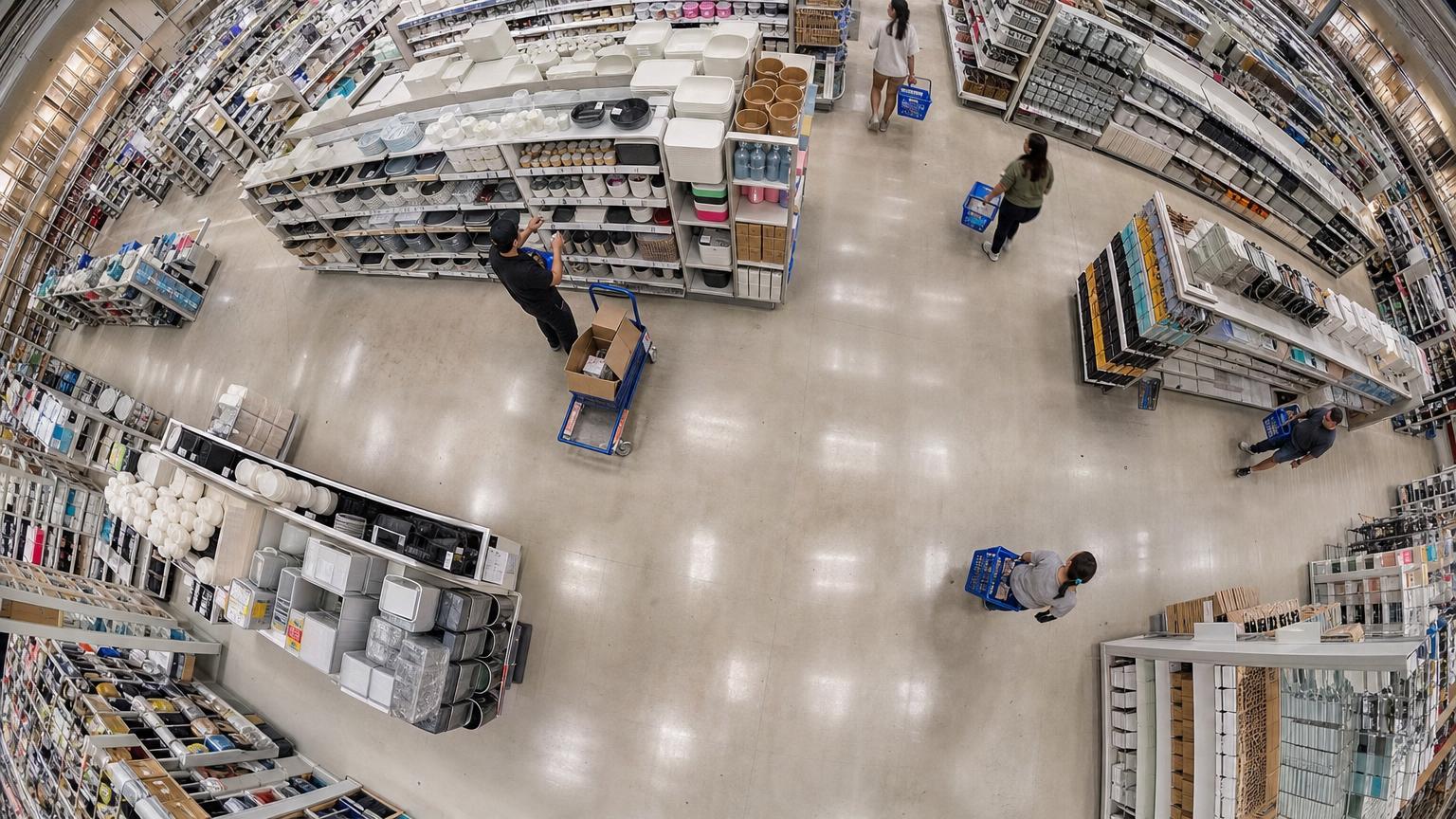
Fisheye vs PTZ vs 4K cameras is a choice about the scene, because each type solves a different coverage problem: a 360° fisheye watches one open room from a single ceiling mount, a PTZ camera trades constant coverage for zoom on demand, and a fixed 4K camera puts enough pixels on a distant target to read it. The geometry gap is wide, since a standard rectilinear lens covers 60 to 100 degrees while an overhead fisheye covers 360 degrees around its mount and 165 to 200 degrees across (Source: Frontiers in Imaging).
Spot AI is camera-agnostic: its video AI connects to the IP cameras a site already owns, or picks next, over RTSP and ONVIF, so the camera decision can follow the scene instead of the platform. This guide covers what each type does well, where it trips up video AI, the bandwidth math behind 4K, and a six-step plan for matching camera to task.
Key takeaways
- Spot AI runs on fisheye, PTZ, and 4K IP cameras alike, connecting over RTSP and ONVIF, so camera type is a decision about the scene, not the platform.
- A 360° fisheye covers a whole open room from one mount, but detail falls off toward the rim, and detectors built for standard lenses lose accuracy on its geometry.
- A PTZ camera sees only where it points, so fixed views should carry anything an AI agent must catch around the clock, with the PTZ kept for follow-up.
- A fixed 4K camera carries four times the pixels of 1080p, which pays off for reading plates and markings at a distance and costs bandwidth and storage everywhere else.
- Spot AI's IVR keeps full-resolution video on site and sends metadata to the cloud, so recording a 4K or fisheye stream around the clock stays off the internet uplink.
Key terms
- Dewarping: converting a fisheye's circular image into flat views, such as a panorama or four quad views. It can run in the camera, in the recording or management software, or in the viewing client.
- PTZ preset: a saved pan, tilt, and zoom position. The home preset is the one a PTZ camera returns to when nobody is steering it.
- Pixels on target: how many pixels cover the person, vehicle, or object of interest. Resolution, lens, and distance set it, and it decides what a person or a model can make out.
- ONVIF and RTSP: open standards that IP cameras use to describe themselves and to stream video. Spot AI connects to cameras over both, whatever the brand.
Fisheye vs PTZ vs 4K cameras at a glance
The table compares the three types on what matters when software, not a person, does most of the watching:
Criterion | 360° fisheye | PTZ | Fixed 4K |
|---|---|---|---|
Field of view | 360° around the mount, 165 to 200° across | Wide when pulled back, narrow when zoomed, one direction at a time | Fixed by the lens, typically 60 to 100° for a standard lens |
Best scenes | Open rooms: sales floors, dock staging areas, lobbies, break rooms | Large outdoor areas an operator follows: truck yards, parking lots, fence lines | Chokepoints where detail matters: gate lanes, dock doors, entrances, cash wraps |
Strength for video AI | Continuous coverage of a whole room, seen from above with fewer people hiding each other | Optical zoom to verify what a detection flagged | The most pixels on a target at a fixed distance, and a stable frame for zones and lines |
Watch out for | Distortion and small subjects near the rim; standard-lens detectors underperform | An unwatched area whenever it turns or zooms away; zones drift as it moves; motors wear | Four times the pixels of 1080p means more bitrate and storage; night quality comes from sensor and lens, not pixel count |
Pair it with | A fixed camera at the door or register for detail | Fixed cameras on the same ground for around-the-clock detection | A wider camera for context around the chokepoint |
The three types work best as a team. A fisheye answers who went where across a room, a fixed high-resolution camera at the door supplies the detail the rim of the circle cannot, and a PTZ gives an operator a closer look after an alert.
For dome, bullet, and the other common camera types, see Spot AI's guide to selecting the best cameras for each location.
Start with what the AI has to see
Before comparing lenses, write down the question each camera has to answer. A public-safety video quality guide hosted by NIST sorts that question into four discrimination levels, notes that not every video system needs positive identification, and ties identification, license plates, and small objects to high-resolution cameras whose extra data raises bandwidth and storage needs (Source: NIST). The four levels, from least to most detail:
- General elements of the action: is anyone in the zone, and is a vehicle at the gate?
- Target class recognition: a car versus a van, or a person versus a forklift.
- Target characteristics: markings and smaller actions, such as what a hand is holding.
- Target positive identification: the specific item, such as the characters on a license plate.
The level sets the camera. Presence and class questions work with a wide view and modest resolution, which is fisheye territory indoors. Characteristics and identification need pixels on target, which means a fixed high-resolution camera close to a chokepoint, or a PTZ zoomed in for a person to verify. Several detections in Spot AI's library of 15+ pre-trained Video AI Agents, such as loitering, unauthorized entry, and no-go zones, ask whether a person or vehicle is inside a defined area. Spotting missing PPE or a license plate of interest needs more pixels on the subject.
360° fisheye cameras: one mount for a whole room
A fisheye camera puts a single ultra-wide lens on the ceiling and records the room as a circle. Mounted overhead, it sees people from above, where they block each other less than in a side view, and it has no moving parts. In a distribution center, one fisheye over the dock staging area can follow forklifts, pallets, and people across every lane at once.
The catch is uneven detail. Fisheye distortion is strongest at the edges: straight lines bend most in the periphery, while the center of the image stays relatively undistorted (Source: Frontiers in Physics). A person directly under the camera is large and clear, and the same person near the rim is small and stretched, so the outer ring of the circle is the weakest place to read anything.
That geometry matters more to software than to people. A 2024 review in Frontiers in Imaging explains that detection algorithms built for standard lenses perform poorly on overhead fisheye footage, because people under the camera are seen from above and people farther out are seen from the side, and it reports a fisheye-specific model reaching 72.0% AP50 on a real-world benchmark against 59.8% for earlier methods (Source: Frontiers in Imaging).
Dewarping and what it means for detection
Dewarping turns the circle into flat views, and it can happen in the camera, in the recording or management software, or in the viewing client. For video AI, the useful question is which picture the model analyzes: the raw circle, a dewarped view, or both. Ask it of any vendor, and check the answer on a clip recorded at your own ceiling height, since a fisheye at 12 feet and one at 30 feet put very different pixel counts on the same person.
Where a fisheye fits, and where it does not
Room shape decides most fisheye placements:
- Fits: square, open rooms with a clear ceiling, such as sales floors, dock staging areas, lobbies, and break rooms.
- Fits: occupancy and flow questions, such as how many people are in an area or whether a station is unattended.
- Struggles: long, narrow aisles and high-racked storage that blocks the overhead view.
- Struggles: anything that needs detail near the rim, such as reading a label or a plate at the edge of the circle.
What a PTZ camera does well, and where it trips up video AI
A PTZ camera pans, tilts, and optically zooms on command, so one unit on a pole can cover a truck yard or a parking lot and still get close enough to see a trailer door or a person at the fence. It is the right tool when a person needs to look closer after something happens, and it can save running cable to a dozen fixed positions across a large lot.
The tradeoff is optics. The NIST-hosted guide puts it plainly: the more a lens is zoomed in, the less field of view the camera captures (Source: NIST). While a PTZ is zoomed on one corner of the yard, the rest of the yard is unwatched, by the AI as well as by people.
Why moving views are hard for video AI
Detection zones, tripwires, and no-go areas are drawn on the picture. When the camera moves, the picture moves under the zone, and the zone no longer sits on the same ground. Keeping a drawn zone aligned on a moving PTZ is still a research problem. A 2025 construction-safety study indexed on ScienceDirect used homography, visual place recognition, and a deraining model to hold hazard zones in place through camera movement and bad weather, and it reached an overlap score (IoU) of 0.9555 in simulation and 0.8876 on real sites (Source: ScienceDirect).
The practical pattern follows from that. Let fixed views, or a PTZ parked at its home preset, carry uninterrupted detection, and use the zoom to verify and follow up. Set an automatic return to the home preset, so the camera does not stay pointed wherever the last operator left it. For fence lines and yards, see how video AI handles perimeter intrusion detection on industrial sites.
Questions to settle before adding a PTZ
Four answers decide whether a PTZ earns its place:
- Which fixed camera covers the same ground while the PTZ is zoomed somewhere else?
- What is the home preset, and how long after an operator lets go does the camera return to it?
- Does the network switch have the power budget for an outdoor PTZ with a heater and infrared, which draws more than a fixed camera?
- Who maintains the motors? Moving parts wear in a way that fixed lenses do not.
4K cameras: detail at a distance, at a price in bits
A 4K UHD frame is 3840 by 2160 pixels, about 8.3 million, against about 2.1 million for 1080p, so a fixed 4K camera puts four times the pixels on the same scene. That density pays off where the target is small or far away: a plate in the gate lane, markings on a trailer, or what a hand is holding at a cash wrap.
Identification work is where that resolution earns its keep, and the bill arrives as bandwidth and storage, because every extra pixel is recorded around the clock whether or not anything happens in front of it. Codec choice moves that cost more than most spec-sheet lines do. H.265 (HEVC) cuts the bit rate by about 50% compared with H.264 at the same video quality (Source: PubMed). Confirm that every camera, the recorder, and the analytics software handle H.265 before counting on the saving.
The storage math for one camera
Storage in gigabytes equals bitrate in Mbps × 86,400 × days ÷ 8,000. The bitrates below are planning assumptions, not measurements, so replace them with the numbers from your own camera settings:
Stream | Assumed bitrate | 30 days of continuous recording |
|---|---|---|
4K in H.264 | 8 Mbps | 2,592 GB (about 2.6 TB) |
4K in H.265 | 4 Mbps | 1,296 GB (about 1.3 TB) |
1080p in H.265 | 2 Mbps | 648 GB (about 0.65 TB) |
Multiply by camera count and retention, and the gap becomes a recorder sizing decision. A 4K camera aimed at a wide, empty view spends that storage on pixels nobody needs; the same camera at a chokepoint spends it on the plate. Pixel count is not night performance either: low-light quality comes from the sensor and the lens, so compare night clips, not spec sheets.
Where Spot AI fits, whichever cameras you choose
Spot AI does not manufacture cameras. Spot AI's video AI turns the IP cameras a site already owns, or picks next, into AI coworkers, connecting over RTSP and ONVIF to mixed brands such as Avigilon, Pelco, Axis, and Hanwha, while legacy analog cameras reach it through the Intelligent Video Recorder (IVR). A site can keep the fisheye over the dock, the PTZ on the yard pole, and the 4K camera at the gate, and run one platform across all of them. That flexibility is the core of a camera-agnostic approach to procurement.
Spot AI's IVR is the on-site appliance that connects those cameras and runs the AI locally on NVIDIA GPUs. Full-resolution video stays in the facility and only metadata travels to the cloud, so recording a 4K or fisheye stream around the clock adds load to the local network and the recorder, not to the internet uplink. The tradeoffs behind that design are laid out in edge vs cloud processing for video analytics.
On top of whichever cameras a site runs, the platform adds three things:
- Spot AI's cloud dashboard gives live view of every location, AI-powered search across sites, and health monitoring that shows when a camera drops offline.
- Spot AI's 15+ pre-trained Video AI Agents cover security, safety, and operations, and Iris builds custom detections from a plain-language description.
- Spot AI's AI Security Guard detects in context, deters with strobes, horns, and natural-conversation talkdown, and assembles case-ready evidence.
Spot AI is NDAA-compliant and SOC 2 Type II, and most sites go live in days without a rip-and-replace.
What it looks like at unstaffed sites
Storage Asset Management runs about 50 storage facilities with no traditional on-site staff, and it connected Spot AI to the camera infrastructure it already had rather than replacing it. At one location that had been hit by break-ins, Spot AI detected intruders at 1 AM and alerted police, who arrived while the crime was still in progress. After the arrest was publicized, break-ins at that facility stopped, according to the Storage Asset Management customer story.
"The Spot AI notification went out around one in the morning, and police were able to arrive on-site while the incident was still in progress."
Lee Kunkel, Director of Virtual Operations, Storage Asset Management
Inventory the cameras already installed before buying any new ones. Spot AI connects to existing IP cameras over RTSP and ONVIF, so a new camera purchase only has to fill the gaps the inventory exposes.
A six-step camera plan for video AI
The steps below turn the comparison into a site plan:
- List what is already on the wall: each camera's make, resolution, lens, mount height, and whether it streams over RTSP or ONVIF.
- Map every zone and write the question the AI must answer there: presence, class, characteristics, or identification.
- Match the camera to the question. Open rooms with presence and flow questions get a fisheye; chokepoints with characteristics or identification questions get a fixed high-resolution camera; large outdoor areas get fixed coverage first and a PTZ for follow-up.
- Check pixels on target at the far edge of each zone, not the middle. For a fisheye that is the rim of the circle; for a fixed 4K camera it is the farthest plate or marking it must read.
- Run the storage formula for every camera at its real bitrate and retention, and confirm H.265 support from camera to recorder.
- Test on footage from the actual mounts. Record a short clip from each candidate camera at the height and angle it will live at, and judge the detections on that clip before ordering at scale.
The quickest way to settle fisheye vs PTZ vs 4K for a site is to watch video AI work on that site's own footage. Book a demo with Spot AI and bring a clip from each camera type under consideration. For more deployments, browse Spot AI customer stories.
Frequently asked questions
What is the difference between a fisheye and a PTZ camera?
A fisheye camera uses one fixed ultra-wide lens to record a full circle around its mount, with no moving parts, and operators zoom into the recording digitally. A PTZ camera physically pans, tilts, and zooms, so it gets optically close to a distant subject but sees only one direction at a time. That makes the fisheye a coverage camera for open rooms and the PTZ a verification camera for large outdoor areas.
Do you need 4K cameras for video AI?
Spot AI does not need 4K, because it works with standard IP cameras, and asking whether a person or vehicle is in a zone takes far fewer pixels than reading a plate. 4K earns its extra storage at chokepoints where the target is small or far away, such as a gate lane or a dock door. Elsewhere, a lower resolution with a well-chosen lens usually gives video AI what it needs at a fraction of the bitrate.
Can video AI work with fisheye cameras?
Yes, though fisheye geometry asks more of a model than a standard lens does: people under the camera appear from above, and people near the rim appear small and stretched from the side. Models trained for fisheye images close much of that gap, and dewarping into flat views is the other common route. Spot AI connects to fisheye IP cameras over RTSP and ONVIF like any other camera, so the deciding check is a detection test on a clip from the real mount.
Do PTZ cameras work with AI detection?
Spot AI connects to PTZ cameras over RTSP like any IP camera, and the open question is where the camera points when something happens. Zones and tripwires are drawn on the picture, so a PTZ that pans or zooms away leaves its zones unwatched until it returns to its home preset. Around-the-clock detection belongs on fixed views, with the PTZ saved for a closer look.
Will Spot AI work with the cameras a business already has?
Spot AI works with the IP cameras a business already owns, from mixed brands, over RTSP and ONVIF, and legacy analog cameras connect through the IVR. Fisheye, PTZ, and 4K IP models connect the same way, so the existing estate is the starting point rather than a write-off. Most sites go live in days, without a rip-and-replace.
About the author
Amrish Kapoor is VP of Engineering at Spot AI, leading platform and product engineering teams that build the scalable edge-cloud and AI infrastructure behind Spot AI’s video AI, powering operations, safety, and security use cases.

