




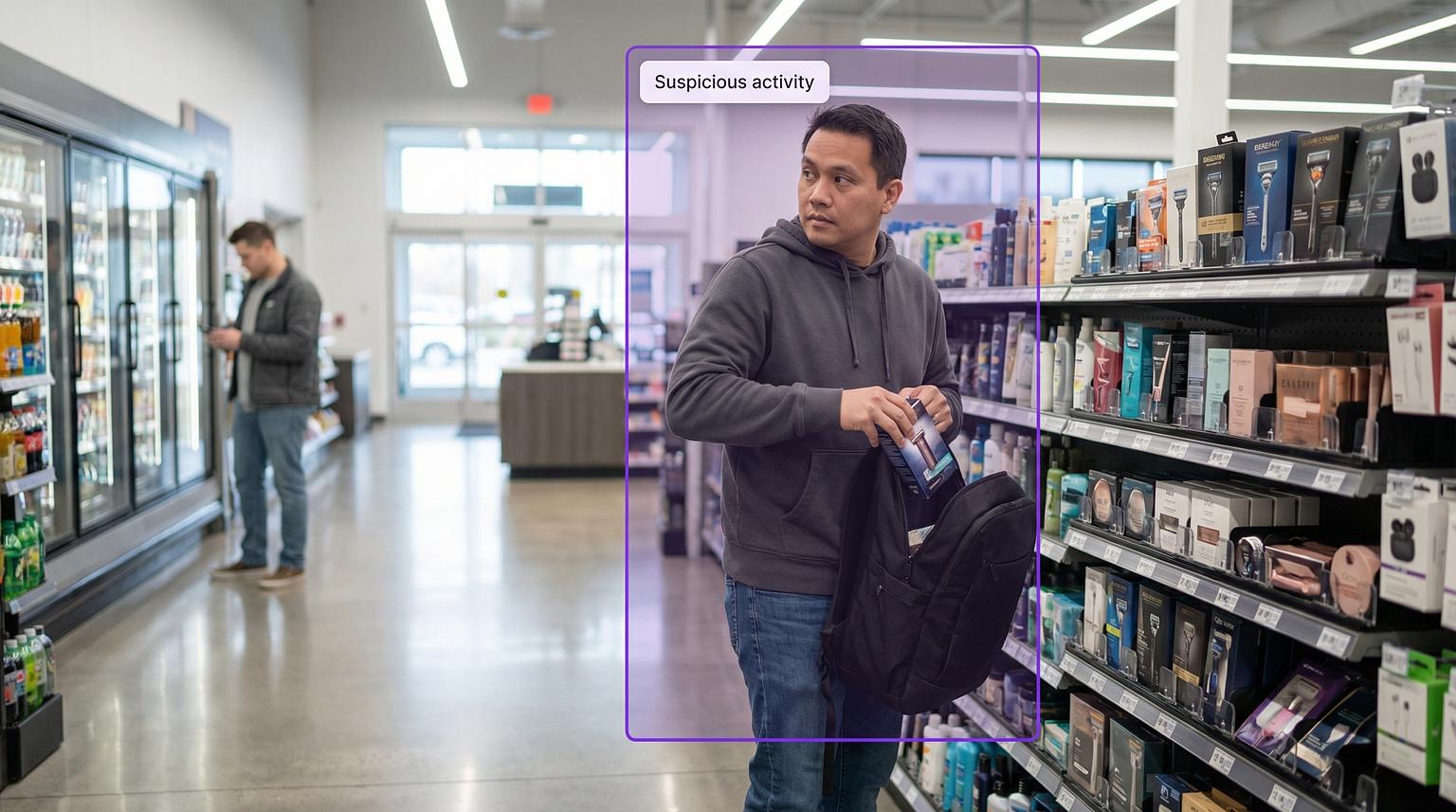


Retail shrinkage cost the industry an estimated $90 billion in inventory losses alone during 2025, according to the Appriss Retail Total Retail Loss Benchmark Report (Source: Just Style). For organizations running on 2% net margins, that level of loss doesn't just compress profits—it can erase them entirely. And the standard response—hire more guards, add more headcount, stretch LP teams thinner—has reached its ceiling.
The question facing enterprise retail leaders is no longer "how do we staff our way out of shrink?" It's "how do we stop more incidents at more stores without growing the payroll?" The answer lies in treating cameras not as passive recording devices, but as active AI teammates that detect, deter, and document around the clock. This article maps the financial case, the platform approach, and the implementation path for cutting retail shrink with existing infrastructure and zero new hires.
Key terms to know
Before examining specific strategies, a few definitions ground the discussion:
Term | Definition |
|---|---|
Shrinkage (shrink) | The gap between recorded inventory and actual inventory on hand, caused by theft, fraud, administrative errors, or operational loss |
Exception-based reporting (EBR) | A data analysis method that flags statistically unusual transactions—such as excessive voids, refunds without receipts, or no-sale drawer opens—for targeted review |
Organized retail crime (ORC) | Coordinated, multi-location theft operations carried out by organized groups who resell stolen merchandise through secondary channels |
Camera-agnostic | A platform's ability to work with any existing IP camera brand or model, eliminating the need for full hardware replacement |
Video AI Agents | AI-powered teammates that analyze live video feeds, detect specific events, and trigger automated responses such as strobes, voice-downs, or alerts |
Why adding headcount no longer scales
Enterprise LP teams already cover dozens—sometimes hundreds—of locations. Regional managers travel between stores, investigations stack up, and guard contracts consume budget that could fund technology with broader reach.
The math tells the story. A single on-site security guard typically costs upward of $20,000 per month when factoring in wages, benefits, scheduling overhead, and turnover. That guard covers one location, one shift, and one vantage point. Meanwhile, organized retail crime incidents surged 57% between 2022 and 2023 (Source: Hansa Jekalavya), and shoplifting incidents climbed 18% year-over-year according to the National Retail Federation's 2025 report (Source: Building Security). The threat surface is expanding faster than any hiring plan can match.
Three structural barriers make headcount-based loss prevention unsustainable at enterprise scale:
Guard quality varies widely. Off-duty officers and contract guards deliver uneven deterrence. Some locations get attentive coverage; others get a warm body in a chair. Standardizing performance across 50 or 100 stores is nearly impossible through labor alone.
Investigation backlogs drain LP capacity. When a regional LP manager spends hours scrubbing through video to build a single case, that's time not spent on strategy, training, or high-risk store visits. The bottleneck isn't detection—it's review.
Perimeter threats go unmanaged. Parking lots, receiving docks, and building exteriors sit outside the reach of most staffed security models. ORC crews exploit this gap, staging operations in lots before entering stores.
The alternative is an AI teammate that multiplies existing team capacity—covering every location, every shift, and every blind spot without a single new W-2.
The shrink composition that shapes your strategy
Effective shrink reduction starts with understanding where losses originate. The breakdown across the industry follows a consistent pattern:
Shrink source | Approximate share | Primary detection method |
|---|---|---|
External theft (including ORC) | 36% | Video analytics, license plate recognition, loitering detection |
Internal/employee theft | 29% | POS exception reporting linked to video verification |
Administrative and inventory errors | 21% | RFID inventory tracking, receiving verification |
Operational and logistics loss | 14% | Receiving dock monitoring, back door motion alerts |
(Source: Building Security) (Source: Hansa Jekalavya)
Each category demands a different intervention. Throwing guards at an administrative error problem wastes money. Running video analytics without POS integration misses internal fraud. The most effective approach layers multiple detection methods across all four categories—without requiring separate teams for each.
How video AI turns existing cameras into a force multiplier
Most large retailers operate camera systems installed over the past 5 to 15 years, often from multiple manufacturers. Ripping and replacing that infrastructure is neither practical nor necessary. Camera-agnostic video AI platforms connect to existing hardware through standard protocols like ONVIF and RTSP, adding an intelligence layer on top of cameras already in place (Source: MyTotalRetail).
The shift from passive recording to active response starts with exception-based alerting. Rather than requiring a human to watch 200 camera feeds, the system monitors every frame and generates alerts only when specific conditions are met. A properly configured deployment might watch hundreds of cameras yet notify LP staff only when:
A person lingers in a restricted zone for more than 60 seconds after hours.
An unauthorized individual enters the receiving dock during closed hours.
A vehicle flagged through license plate recognition appears at multiple locations within a short timeframe.
Crowding or unusual activity patterns develop near high-value merchandise areas.
This exception-based model means a single LP analyst can manage alerts from 100+ cameras because only genuinely concerning behaviors surface for review (Source: APS Security). Investigation time drops from hours of manual scrubbing to minutes of targeted clip review.
Spot AI's platform exemplifies this approach. Its Intelligent Video Recorder (IVR) connects to any IP camera and applies detection models at the edge, while a cloud dashboard gives LP teams centralized visibility across every store. Attribute search lets analysts type "red truck" or "person with backpack" and pull the right clip immediately. Camera health alerts flag offline devices before blind spots develop. And the system can be live in under a week—no new wiring, no parking spaces lost to camera towers.
How All Star Elite cut cash shrink by 83%
All Star Elite, a multi-location sports apparel retailer operating 80 stores across U.S. shopping centers, deployed Spot AI's unified video AI platform for loss prevention and operations. The results were measurable and rapid: cash shrink dropped from approximately 6% to 1%—an 83% reduction. Merchandise shrink fell from 10–15% to roughly 6%. Investigation efficiency improved by more than 50%, with incident resolution time compressed from hours to minutes using centralized case management and AI-powered search. Beyond LP, the analytics drove 5–15% sales increases through optimized product placement and enabled the company to proactively close three underperforming stores before absorbing another year of losses (Source: Spot AI customer story).
POS exception reporting: catching what cameras alone miss
External theft gets the headlines, but internal shrinkage and process errors account for roughly half of all losses. Many of these occur at the point of sale—through manipulated transactions, not physical concealment—making them invisible to video alone.
POS exception reporting analyzes transactional data to surface statistical outliers that warrant investigation. Common flags include:
Exception type | What it signals | Verification method |
|---|---|---|
No-sale drawer opens clustered around shift changes | Potential cash skimming | Video review of register area during flagged times |
Excessive refunds without receipts from the same customer | Returns fraud or sweethearting | Video confirmation of return transaction |
Void rates 3–5x the store average for a specific cashier | Possible internal theft scheme | Side-by-side POS data and video playback |
Discounts concentrated during specific hours or for specific employees | Unauthorized discounting or sweethearting | Transaction-linked video clips |
The highest-impact implementations link POS exceptions directly to video verification. When a suspicious transaction is flagged, the system retrieves the exact footage from that moment. An LP analyst can confirm whether a refund was legitimate or fraudulent in seconds rather than hours (Source: PaysPOS).
Spot AI's platform supports this workflow through POS integration that correlates transaction data with time-stamped video. When an exception fires—a no-sale drawer open, an unusual void pattern, an excessive refund—the corresponding video clip is already queued for review. This eliminates the manual search that traditionally consumes LP hours and delays case closure.
Deterrence at the perimeter: stopping shrink before it starts
Most retail shrink strategies focus on what happens inside the store. But organized retail crime, after-hours trespass, and parking lot incidents all begin at the perimeter—the zone where traditional staffed security is least present and most expensive to maintain.
Video AI Agents extend the security perimeter by detecting and responding to threats in parking lots, loading docks, and building exteriors. The escalation sequence mirrors what a trained guard would do, but operates 24/7 across every location:
Detection: The system identifies loitering, fence jumping, unauthorized vehicle presence, or after-hours activity using context-aware models—not simple motion triggers.
Deterrence: Automated responses activate in sequence: lights turn on, a strobe fires, and a contextual voice-down delivers a situation-appropriate verbal warning.
Escalation: If the behavior continues, the system escalates—from a firm verbal warning to law enforcement notification with time-stamped evidence ready for handoff.
Documentation: Every event is logged with video, timestamps, and response actions, creating a case-ready evidence trail.
This layered approach—detect, deter, escalate, document—replaces the need for manned guard posts at every location. Spot AI's AI Security Guard delivers this capability through outdoor units and mobile trailer systems that deploy without disrupting parking operations or requiring new infrastructure.
For LP leaders managing 30, 50, or 100 stores, the economics shift dramatically. Instead of rotating guard contracts across high-risk locations, a consistent deterrence presence covers every site. The cost per location drops from the range of a full guard contract to a fraction of that amount, while coverage extends to hours and zones that guards never reached.
Scaling the math across your footprint
How do you justify this investment to the CFO? Start with the guard spend comparison, then layer in shrink reduction.
Metric | Traditional guard model (per store) | Video AI Agent model (per store) |
|---|---|---|
Monthly cost | ~$15,000–$25,000 | A fraction of guard cost |
Hours of coverage | 8–16 hours/day (one or two shifts) | 24/7 |
Locations covered per contract | 1 | All stores on the platform |
Perimeter coverage | Limited to guard's position | Full parking lot + dock + exterior |
Investigation support | Manual video review | AI-powered search + time-stamped clips |
Consistency across locations | Variable by guard quality | Standardized detection and response |
Now multiply across a portfolio. For a 50-store chain spending $20,000 per month on guard services at just 20 high-risk locations, the annual guard budget is $4.8 million—covering less than half the footprint. Redirecting even a portion of that spend toward a unified video AI platform covers every location, every hour, with standardized deterrence and faster investigations.
The shrink reduction compounds the savings. If a retailer's average store generates $5 million in annual revenue with 1.6% shrink, that's $80,000 in losses per location. A 20% reduction—consistent with documented outcomes from integrated video analytics and POS exception reporting—recovers $16,000 per store annually. Across 50 stores, that's $800,000 in recovered margin before accounting for guard cost offsets or operational efficiency gains.
Considerations before deployment
Every rollout has trade-offs. LP leaders evaluating video AI platforms should account for several factors:
Camera infrastructure quality matters. Video AI works with existing cameras, but image quality affects detection accuracy. Aging analog cameras with poor resolution may need selective upgrades in high-priority zones.
Alert tuning requires operational discipline. Systems configured too aggressively generate noise that erodes team trust. Start with conservative thresholds and tighten over time as teams build confidence in the workflow.
Cross-functional alignment accelerates results. Shrink reduction touches LP, operations, IT, and store management. The most effective deployments involve all four groups from the pilot stage.
Measurement baselines must precede deployment. Without clear pre-implementation shrink data by location and category, proving ROI becomes subjective. Establish baselines during a 60–90 day measurement window before activating new detection rules.
Phased rollout outperforms big-bang deployment. Start with 5–10 representative stores, refine detection rules and workflows, document results, then expand in quarterly waves of 15–20% of the footprint.
From pilot to portfolio: a 180-day roadmap
For organizations ready to move from evaluation to execution, the implementation path follows a clear sequence:
Phase | Timeline | Focus |
|---|---|---|
1. Baseline | Days 1–60 | Measure current shrink by location, category, and root cause. Audit camera infrastructure. Document guard spend and investigation hours. |
2. Pilot | Days 60–120 | Deploy video AI and POS integration at 5–10 representative stores. Configure detection rules conservatively. Train LP and store teams on alert workflows. |
3. Optimize | Days 120–150 | Tighten detection thresholds based on pilot learnings. Measure shrink reduction against baseline. Calculate ROI per store. |
4. Scale decision | Days 150–180 | Present pilot results to executive leadership. Build rollout plan with quarterly deployment waves. Standardize workflows across regions. |
Spot AI's plug-and-play architecture compresses the pilot timeline. Because the IVR connects to existing cameras without new wiring or infrastructure changes, stores can go live in under a week. That speed matters when LP leaders need to show measurable progress within a single budget cycle.
Shrink reduction is a visibility decision, not a staffing decision
The retail industry lost $90 billion to inventory shrinkage in 2025. The organizations that recover the largest share of those losses won't be the ones that hire the most guards. They'll be the ones that turn their existing camera infrastructure into an always-on detection and deterrence network—covering every store, every shift, and every blind spot without adding a single person to the payroll.
This is deployable today. Camera-agnostic platforms, AI-powered exception reporting, automated perimeter deterrence, and centralized investigation tools give LP teams the reach of a much larger organization at a fraction of the labor cost.
"Video AI Agents are my second and third shift safety personnel on-site. They're my extra eyes and hands when I can't be there - like weekend shifts and overnight operations. They're my employees that I don't have to do employee reviews on. But they're consistently there, watching and helping us maintain safety standards 24/7."
Kevin, Unique Industries (Source: Spot AI customer story)
If you're evaluating video AI to reduce shrink across a multi-store footprint, schedule a Spot AI demo to see how AI Security Guard can detect, deter, and document parking lot and perimeter activity using your existing cameras. For a real-world benchmark, read how All Star Elite reduced cash shrink by 83% across 80 locations.
Frequently asked questions
What are the most effective strategies to reduce retail shrink without adding staff?
The highest-impact strategies combine video AI analytics with POS exception reporting and operational workflow changes. Video AI detects external threats and suspicious behavior across all cameras without requiring dedicated monitoring staff. POS integration surfaces internal fraud patterns—like excessive voids or no-sale drawer opens—and links them to time-stamped video for rapid verification. Together, these layers address external theft, internal dishonesty, and administrative errors, which account for the vast majority of shrink.
How can retailers justify the ROI of loss prevention technologies?
Start with guard spend comparison: document current monthly costs for contract guards, off-duty officers, and overtime, then model the coverage a video AI platform delivers at a fraction of that cost. Layer in shrink reduction by establishing baseline shrink rates at pilot locations and measuring the change over 90–120 days. Retailers operating on 2% net margins find that even a modest reduction in shrink rate translates to a significant increase in net profitability. Walmart's documented 0.05% shrink rate reduction yielded $167 million in savings (Source: Pygmalios).
What percentage of retail shrink is due to internal theft?
Internal and employee-related theft accounts for approximately 29% of total retail shrinkage (Source: Building Security). This category includes cash skimming, sweethearting (passing merchandise to friends without scanning), unauthorized discounts, and fraudulent refunds. POS exception reporting is the primary detection tool for these losses because they occur through transaction manipulation rather than physical concealment.
How can existing cameras support video analytics for loss prevention?
Camera-agnostic video AI platforms connect to existing IP cameras through industry-standard protocols like ONVIF and RTSP. Rather than replacing hardware, an analytics processor—such as Spot AI's Intelligent Video Recorder—ingests video streams from cameras already installed and applies detection models at the edge. This means retailers can activate loitering detection, after-hours alerts, back door motion monitoring, and attribute search on their current camera infrastructure without new wiring or hardware replacement.
What is exception-based reporting and how does it reduce shrink?
Exception-based reporting (EBR) analyzes POS transaction data to identify patterns that deviate significantly from normal behavior. Rather than reviewing every transaction, the system flags only those that meet specific risk criteria—such as a cashier with void rates three to five times the store average, or refunds clustered during a particular shift. When linked to video, each flagged exception can be verified in seconds. This targeted approach replaces hours of manual investigation with focused, high-probability reviews that LP teams can act on without additional headcount.
About the author
Sud Bhatija is COO and Co-founder at Spot AI, where he scales operations and GTM strategy to deliver video AI that helps operations, safety, and security teams boost productivity and reduce incidents across industries.

