




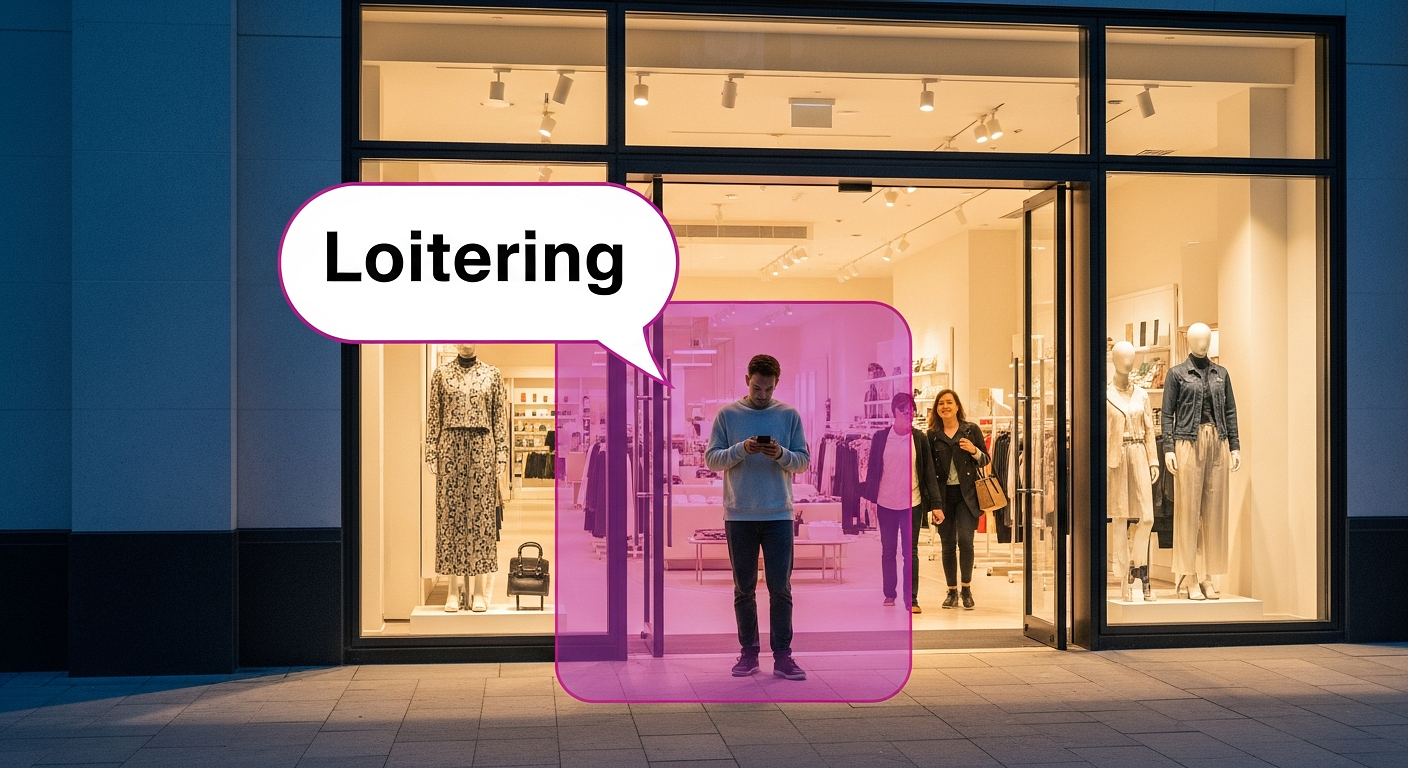


Storefronts are tricky environments to manage. A person standing near your entrance might be a loyal customer waiting for an Uber, or they might be a bad actor casing the store for a grab-and-run. For store and operations leaders, distinguishing between the two is a daily source of stress. You want to maintain a welcoming environment for guests, but you also need to ensure safety for staff and guests in an era where retail crime is becoming more aggressive.
The limitation is that manual video systems cannot tell the difference. To a standard camera, a person is just pixels on a screen. This leaves your already thin staff with the impossible task of monitoring every corner of the parking lot while trying to run the floor.
Advanced loitering detection changes this dynamic. By using video AI agents, retailers can now analyze context—time of day, dwell duration, and proximity to entrances—to filter out noise. This technology turns passive video data into an anticipatory teammate that alerts you only when storefront safety monitoring is truly required, helping you mitigate escalation without disrupting the customer experience.
The operational reality of retail loitering
Loitering is often dismissed as a nuisance issue, but for operations leaders, it is a leading indicator of more serious safety threats. Organized Retail Crime (ORC) groups frequently use loitering tactics to assess security coverage, identify staffing gaps, and coordinate theft.
The stakes for identifying these behaviors have never been higher. Retailers reported a 93 percent increase in the average number of shoplifting incidents per year in 2023 compared to 2019 (Source: National Retail Federation). More concerning is the human cost; 84 percent of retailers experienced an increase in violence during shoplifting incidents over that same period (Source: National Retail Federation).
When loitering goes unchecked, it sends a signal that the property is unmanaged. This perception invites further testing of your perimeter, leading to:
- Increased safety risks: staff facing confrontation during opening or closing shifts.
- Customer friction: guests feeling unsafe walking from their cars to the entrance.
- Operational disruption: managers pulled off the floor to deal with police calls or de-escalate conflicts.
Why manual monitoring fails to differentiate
Most retail locations rely on a mix of passive recording and manual observation. This approach creates substantial gaps in forward-looking retail security.
- Alert fatigue: traditional motion detection is binary. If a leaf blows across the parking lot or a stray cat walks by, the system triggers an alert. Security teams eventually stop checking these notifications, leaving the store vulnerable to real threats.
- Thin staffing: store teams are stretched thin. You cannot expect a shift supervisor to watch a monitor for eight hours to catch after-hours perimeter protection breaches.
- Lack of context: a security guard viewing a feed remotely may not know that the person standing by the curb is a regular customer waiting for a ride. This lack of context leads to false positives, where legitimate customers are approached as if they were threats.
Video AI agents solve this by adding a layer of intelligence that mimics human reasoning but operates with the consistency of a machine.
How AI distinguishes customers from threats
To effectively differentiate customers from loiterers, retail video analytics must look beyond simple presence. The system analyzes behavioral patterns to determine intent. This process transforms raw video into actionable video insights that support decision-making.
1. Contextual dwell time tracking
- Customer behavior: a person pauses at the window display for 30 seconds, then enters the store.
- Loitering behavior: an individual lingers near the emergency exit or loading dock for 10 minutes without entering.
2. Time-of-day analysis
- Business hours: a car idling at the curb at 2:00 PM is likely a customer pickup.
- After hours: a car idling at the curb at 3:00 AM is a potential perimeter intrusion detection event.
3. Zone-specific logic
Smart storefront technology allows you to define "no-go zones" or high-sensitivity areas.
- Safe zones: waiting areas, benches, and main entrances where dwelling is expected.
- Restricted zones: behind dumpsters, near electrical panels, or close to back-of-house doors where no customer should be lingering.
| Feature | Legitimate customer signal | Potential threat signal |
|---|---|---|
| Location | Main entrance, pickup zone, window display | Loading dock, fire exit, blind spots |
| Duration | Short intervals (<5 mins) | Extended periods (>10 mins) |
| Interaction | Looking at phone, carrying shopping bags | Pacing, looking into windows, wearing face coverings |
| Time | During operating hours | Late night or early morning |
The role of the AI Security Guard
Spot AI approaches this obstacle by deploying the AI Security Guard. Unlike passive cameras that simply record crime, the AI Security Guard acts as an intelligent teammate that helps you maintain control of your perimeter.
This system addresses the specific pain points of store leaders who need to ensure staff safety monitoring without hiring 24/7 physical guards.
- Real-time detection: the system identifies people or vehicles entering designated zones. It filters out routine movement (like passing traffic) and focuses on behaviors that match your defined criteria for loitering.
- Automated loitering alerts: instead of bombarding you with noise, the system sends real-time loitering notifications only when specific thresholds are met. This ensures that when your phone buzzes, it is worth your attention.
- Contextual talkdowns: this is where detection turns into deterrence. Upon detecting a loiterer in a restricted zone (like a loading dock after hours), the system can trigger automated voice-downs or lighting strobes. This rapid feedback signals that the property is managed, often causing the individual to leave before a crime occurs.
By automating this response, you reduce the risk of confrontation for your staff. You stop issues before they reach the doorway, creating a safer environment for everyone.
Beyond security: operational efficiency
While safety is the primary driver for loitering detection, the same technology drives retail operations efficiency. Differentiating between customers and loiterers clarifies your data, allowing you to make better business decisions.
- Queue management vs loitering: Video intelligence software can distinguish between a line of customers waiting to pay and a group of people crowding a counter. This helps in accurate queue management vs loitering analysis, ensuring you staff registers appropriately without false data skewing your labor models.
- Traffic flow analysis: understanding where customers naturally pause (dwell) helps optimize store layout. If customers frequently stop at a specific display, it is a merchandising win. If they bottle up in an aisle, it is a flow problem.
- Customer service opportunities: Automated crowd detection can alert managers when a customer has been dwelling in a high-value aisle for a long time. Rather than treating them as a suspect, a staff member can approach them to offer assistance, converting a potential loitering alert into a sales opportunity.
Implementing smart storefronts
Deploying AI camera systems for retail does not require a "rip-and-replace" of your existing infrastructure. Spot AI is camera-agnostic AI software, meaning it connects to your existing cameras to provide these advanced capabilities.
Key steps for rollout
- Define your perimeter: identify the areas where loitering creates the highest safety risk (e.g., dark corners of the parking lot, rear entrances).
- Set operational baselines: determine what constitutes "normal" behavior for your location. Is 5 minutes too long to wait at the curb? Is 15 minutes?
- Configure automated responses: decide where and when to use intelligent escalation like audio warnings. Use these tools primarily for after-hours security to avoid disturbing legitimate daytime guests.
- Train your team: ensure your staff understands that these alerts are tools to help them, not to replace them. Clarify that the goal is customer vs loiterer differentiation to prioritize their safety.
Managing the storefront environment
For store and operations leaders, the goal is not to create a fortress but to create a controlled, safe environment. When the parking lot feels managed, customers feel comfortable, and staff feel supported.
By leveraging smart cameras for business, you move from reactive incident reporting to forward-looking prevention. You gain the ability to extend your visibility beyond the glass doors, ensuring that your perimeter is secure even when staffing is thin. This technology empowers you to stop managing incidents and start engineering safer outcomes for your people.
See how Spot AI’s video AI agents can help secure your storefront—request a product demo today.
"We've set up the system to understand normal versus abnormal behavior. If someone's in our lobby showcase area after hours, or if there's unusual movement patterns around sensitive areas, the system alerts us immediately."
— Mike Tiller, Director of Technology, Staccato (Source: Spot AI Customer Story: Staccato)
Frequently asked questions
What are the best technologies for preventing retail theft?
The most effective technologies combine high-definition video with video AI agents that offer capabilities for early intervention. Loitering detection, perimeter intrusion detection, and contextual talkdowns are critical for preventing theft by deterring bad actors before they enter the store. These systems are more effective than passive recording because they allow for real-time intervention.
How can AI improve operational efficiency in retail?
AI improves efficiency by turning video into data. It automates dwell time tracking to identify merchandising hotspots, monitors queue lengths to optimize staffing, and filters out noise so managers only respond to real issues. This allows staff to focus on customers rather than monitoring security feeds.
What is the role of video analytics in loss prevention?
Retail video analytics shifts loss prevention from reactive investigation to anticipatory response. By identifying pre-theft behaviors like casing, loitering in high-risk areas, or after-hours perimeter protection breaches, analytics allow teams to intervene early. Additionally, features like attribute search for security drastically reduce investigation time from hours to minutes.
How do automated alerts enhance security measures?
Automated loitering alerts and similar notifications ensure that security protocols are consistent 24/7. They remove human error and fatigue from the equation. When a specific threat behavior is detected, the right people are notified instantly, enabling faster response times and better coordination with law enforcement if necessary.
What metrics should retailers track for operational efficiency?
Retailers should track dwell time to understand customer engagement, queue wait times to measure service speed, and traffic flow patterns to optimize layout. Additionally, tracking the reduction in false alarms and the speed of incident resolution can quantify the efficiency gains from your security investments.
About the author
Sud Bhatija
Sud Bhatija is COO and Co-founder at Spot AI, where he scales operations and GTM strategy to deliver video AI that helps operations, safety, and security teams boost productivity and reduce incidents across industries.

