






Retail asset protection has shifted from a focus on simple inventory counts to a complex battle against organized crime, liability claims, and operational hazards. For Asset Protection Directors and VPs, the modern retail floor is a convergence of risks: organized retail crime (ORC) groups are becoming more aggressive, while safety incidents remain a primary driver of liability costs.
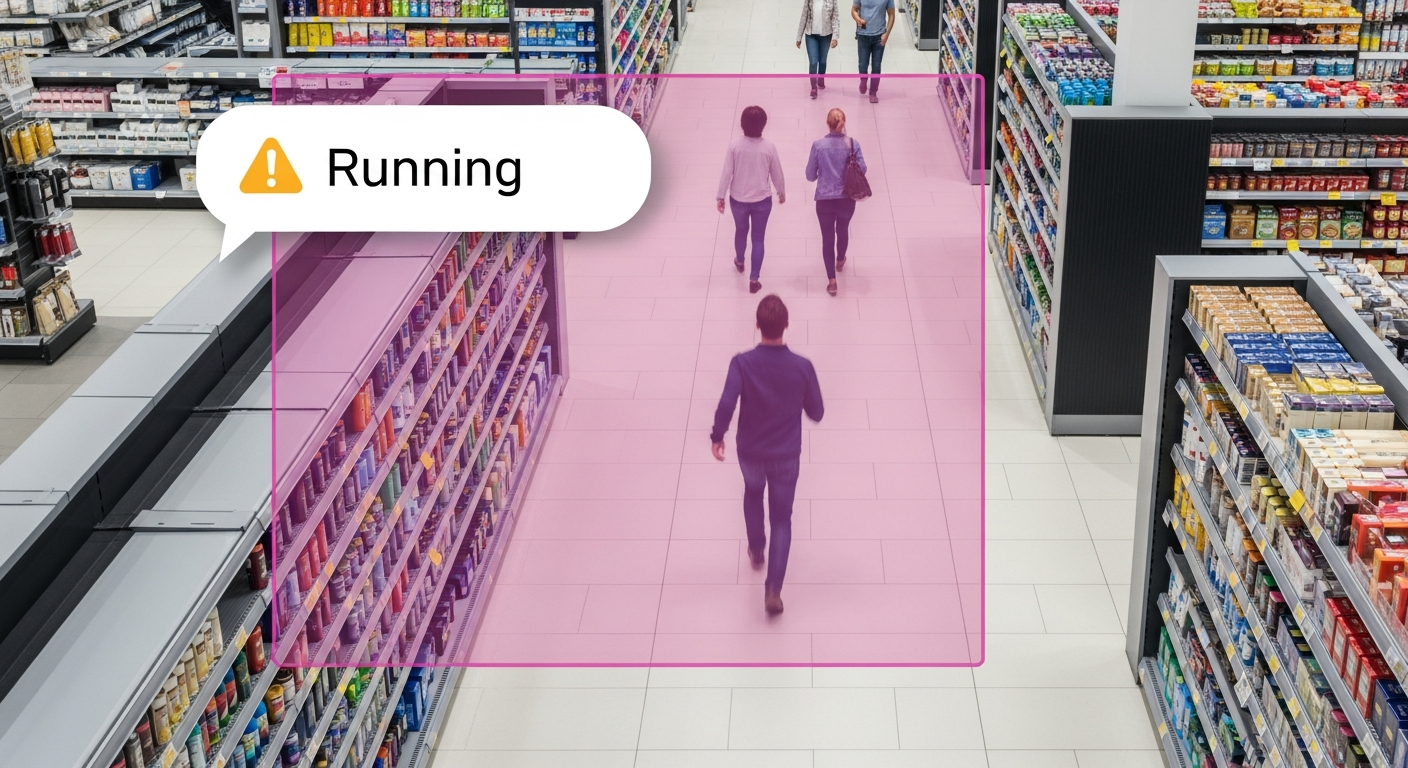
Traditional video systems often fail to address these challenges because they are reactive—recording events for review only after the damage is done. To combat rising shrink rates and safety incidents, leaders are turning to AI-driven behavioral analysis. Specifically, "running" alerts serve as a powerful proxy for a wide range of unsafe behaviors, from "grab-and-run" theft scenarios to emergency evacuations and slip hazards.
By using cameras with AI-driven analysis, retailers can detect certain behavioral patterns in real time. This article explores how running alerts and broader video AI strategies help teams create consistent safety practices, mitigate risk, and protect assets across the enterprise.
Key terms to know
Before exploring specific strategies, it is helpful to define the core technologies and concepts driving modern retail safety.
- Video AI agents: Intelligent software that analyzes video feeds in real time to detect specific behaviors (like running or loitering) and environmental conditions, acting as a digital teammate for security staff.
- Behavioral analytics: The process of using algorithms to identify patterns of human movement—such as crouching, running, or aggressive gestures—that deviate from normal shopping behavior.
- Proxy metrics: Using a detectable behavior (e.g., running) to identify a broader, often harder-to-detect issue (e.g., a theft in progress or a medical emergency).
- Hybrid cloud architecture: A system design that processes video data locally on an edge device for speed while backing up critical clips and metadata to the cloud for accessibility and long-term storage.
- ONVIF (Open Network Video Interface Forum): A global standard that allows IP-based physical security products from different manufacturers to communicate, ensuring camera-agnostic compatibility.
The escalating cost of reactive security in retail
Asset protection leaders face a mounting set of obstacles that legacy systems cannot address. According to the National Retail Federation, retailers reported an 18% increase in the average number of shoplifting incidents per year in 2024 compared to the previous year (Source: National Retail Federation). More concerning is the aggression associated with these events; threats or acts of violence during theft increased by 17% in the same period (Source: National Retail Federation).
For the Asset Protection VP, these statistics translate into specific operational frustrations:
- Reactive blind spots: Traditional systems provide evidence only after an incident, making it impossible to intervene during "grab-and-run" events.
- False alarm fatigue: Legacy motion detection triggers alerts for harmless events (like shadows or balloons), causing staff to ignore notifications.
- Liability exposure: Retail trade reported 212,470 workplace injuries in 2024, the fourth-highest sector overall (Source: Program Business).
To solve these problems, retailers need systems that filter noise and surface only the behaviors that indicate genuine risk.
How running alerts serve as a risk proxy
Running is rarely a normal behavior in a retail store. When a video AI system detects running, it can be a signal that an important event is unfolding. By configuring alerts for this specific behavior, asset protection teams create a focused signal for three major risk categories.
1. A proxy for theft and Organized Retail Crime (ORC)
"Grab-and-run" tactics are a hallmark of modern ORC and opportunistic theft. Offenders frequently enter, rapidly select high-value merchandise, and sprint toward the exit to evade apprehension.
- The signal: Rapid movement toward an exit or through a high-value zone (e.g., electronics or cosmetics).
- The operational response: Real-time alerts allow floor staff or security to position themselves safely or log the event for law enforcement, rather than discovering the empty shelf hours later.
2. A proxy for unsafe movement and liability risk
Running significantly increases the probability of accidents, particularly on hard retail flooring.
- The signal: Running in aisles, near entrances on rainy days, or in crowded zones.
- The operational response: Identifying areas where running frequently occurs helps managers redesign layouts or deploy additional signage to calm traffic, directly reducing premises liability exposure.
3. A proxy for emergency situations
Sudden running by staff or customers often indicates a "fight or flight" response to an unseen threat, such as a medical emergency, fire, or aggressive altercation.
- The signal: Multiple individuals running away from a specific location.
- The operational response: This serves as an early warning system for broader security threats, allowing rapid deployment of emergency protocols.
Mapping video AI capabilities to asset protection pain points
Implementing video AI goes beyond simple alerts; it requires mapping technological capabilities to specific business problems. The following table outlines how distinct Spot AI features address the core frustrations of Asset Protection Directors.
| Asset protection pain point | Spot AI capability | Operational outcome |
|---|---|---|
| Reactive security & theft | Running detection | Identifies "grab-and-run" attempts in real time, enabling faster response and evidence collection. |
| Loitering & casing | Loitering alerts | Flags individuals lingering in high-value zones or back-of-house areas so teams can review and respond promptly. |
| Employee theft & fraud | POS integration & no-go zones | Correlates video with transaction data (voids/refunds) and tracks unauthorized access to cash offices. |
| False alarm fatigue | AI context analysis | Filters out non-human motion (shadows, banners), helping staff focus on more relevant alerts. |
| Multi-location visibility | Unified cloud dashboard | Provides a single view of safety and security across hundreds of stores without VPNs or complex IT setups. |
Implementing best practices for retail safety
Deploying technology is only half the battle; integrating it into daily workflows helps achieve ROI.
1. Integrate video data with POS systems
Internal theft and sweet-hearting remain difficult to detect. By integrating video AI with Point of Sale (POS) systems, retailers can correlate specific transactions with video evidence.
- Context: A "refund" transaction occurring with no customer present at the desk is a red flag that surfaces in real time.
- Action: Set alerts for "Unattended Checkout" or specific transaction types to streamline investigations.
2. Establish "no-go zones" for safety and compliance
Guarding against unauthorized access is critical for both safety and loss prevention.
- Stockrooms: Alert when individuals enter back-of-house areas during operating hours without authorization.
- Loading docks: Use "Vehicle Enters No-go Zones" to mitigate collisions between delivery trucks and pedestrians, a critical OSHA compliance measure.
- High-value cages: Trigger real-time alerts upon entry to secure inventory storage areas.
3. Streamline OSHA compliance documentation
Liability claims from on-site incidents are a major cost for retailers. Video AI helps mitigate this risk by creating an objective record of events and documenting that safety protocols were followed.
- Documentation: In the event of an incident, the system can be used to verify that aisles were clear, emergency exits were unobstructed, or that staff had recently inspected the area.
- Audit trails: Automated logs of safety checks help document that the retailer took reasonable care.
Measuring success: ROI and safety outcomes
For the Asset Protection VP, justifying the budget for new technology requires demonstrating clear Return on Investment (ROI). Shifting from analog CCTV to AI-driven video intelligence delivers measurable financial impact.
Reducing shrink and liability
Retailers deploying comprehensive video analytics have reported shrinkage has been cut by 25-35% in monitored areas (Source: Spot AI). Furthermore, systems that help manage crowd density and identify hazards are an important tool for mitigating the risk of workplace injuries.
Operational efficiency gains
Manual investigation is a major drain on resources. Searching for a specific incident across hours of footage can take half a shift.
- Metric: Lowering investigation time.
- Impact: AI-powered search (e.g., "show me people running in the electronics aisle between 2 PM and 4 PM") can reduce investigation time from hours to minutes.
Total cost of ownership (TCO)
Legacy systems often carry hidden costs: expensive hardware replacements, per-camera licensing fees, and maintenance.
- Spot AI advantage: The platform is camera-agnostic, meaning it works with many existing IP cameras. This often removes the need for a "rip-and-replace" project, lowering the barrier to entry and speeding up time-to-value (Source: Spot AI).
Comparing video AI solutions for retail
When selecting a partner to modernize asset protection, leaders must evaluate deployment speed, flexibility, and scalability.
| Feature | Spot AI | Traditional Video Systems / VMS | Cloud-only cameras |
|---|---|---|---|
| Deployment speed | Live in under a week (Plug-and-Play) | Weeks to months (Complex wiring/servers) | Varies (Requires replacing all cameras) |
| Hardware compatibility | Camera agnostic (Works with existing cameras) | Proprietary (Vendor lock-in) | Proprietary (Must buy their cameras) |
| Bandwidth usage | Hybrid edge/cloud (Low bandwidth impact) | High (if remote viewing is needed) | High (Constant streaming required) |
| AI capabilities | Built-in video AI agents (Running, Loitering, PPE) | Limited or requires expensive add-ons | Basic motion detection |
| Scalability | Unlimited users & locations | Per-seat licensing fees | Per-camera subscription costs |
Future-Proofing Retail with Proactive Video AI
The retail landscape has changed, and the tools used to protect it must evolve. "Running" alerts are a powerful signal, indicating moments that matter for store safety and operations. By detecting these behavioral signals in real time, Asset Protection leaders can shift from a reactive posture to a more proactive safety approach.
Spot AI helps retail leaders build consistent practices across shifts, reduce risk, and strengthen security without the complexity of traditional enterprise systems. By applying AI to existing cameras, retailers can better protect their people and profits.
Curious how video AI can help you mitigate risk and improve retail safety? Request a Spot AI demo to see the platform in action.
Frequently asked questions
What are the best practices for retail safety?
Best practices include implementing proactive monitoring, establishing clear "No-Go Zones" for restricted areas, integrating video data with POS systems to curb internal theft, and maintaining rigorous documentation of safety audits to support OSHA compliance.
How can technology improve asset protection in retail?
Technology improves asset security by automating parts of incident detection. Video AI can identify certain behaviors (like running or loitering) in real time, allowing staff to intervene earlier. Additionally, it streamlines investigations, which can shorten the time spent reviewing footage from hours to minutes.
What are the compliance requirements for retail safety?
Retailers must adhere to OSHA standards, which mandate keeping workspaces free of known dangers, ensuring clear emergency exits, and providing proper employee training. Video AI helps document compliance by creating audit trails of safety inspections and incident responses.
How can AI enhance incident detection in retail environments?
AI enhances incident identification by using behavioral analytics to minimize false alarms. Instead of flagging every motion, AI highlights specific actions like running, crowding, or unauthorized entry, helping security teams focus on higher-risk activity.
What are effective loss prevention strategies for retailers?
Effective strategies combine physical deterrence with data-driven insights. This includes using video AI to identify loitering in high-value aisles, integrating cameras with checkout data to spot sweet-hearting, and using signage to indicate active monitoring, which deters opportunistic theft.
About the author
Tomas Rencoret leads the Growth Marketing team at Spot AI, where he helps safety and operations teams use video AI to cut safety and security incidents as well as boost productivity.

