






When a production line stops, every second counts. The pressure to diagnose the issue, coordinate a response, and restore operations is substantial, especially when unplanned downtime carries steep financial implications. Despite these high stakes, many operations leaders find themselves slowed by fragmented information. Critical data is often scattered across disconnected systems—maintenance logs in a CMMS, production data in an MES, and video footage siloed in a separate security system. This forces teams to piece together clues manually, turning urgent incident investigations into a slow, frustrating exercise in digital archaeology.
This article explores how unified search and share tools break down these information silos, enabling manufacturing teams to resolve production incidents faster. By integrating data, video, and communication into a single platform, organizations can move from reactive firefighting to rapid, collaborative problem-solving, protecting both uptime and the bottom line.
The high cost of fragmented incident response
For many plant and operations leaders, the daily reality is one of reactive management. A call about a line stoppage on the third shift, an unexpected quality issue, or an equipment failure sends teams scrambling. The core obstacle isn't a lack of data, but a lack of unified access to it. This fragmentation creates several major roadblocks that directly impact efficiency and profitability.
The average time it takes to resolve these incidents has increased in recent years. This decline in efficiency is happening even as the cost of downtime has also increased. The root of this issue often lies in systemic obstacles:
- Pervasive data silos: Critical operational data lives in disconnected systems. When an incident occurs, a supervisor might need to check a CMMS for maintenance history, an ERP for material data, and then manually scrub through hours of video footage to see what happened. This is exacerbated by the fact that many manufacturing facilities still don't use a computerized maintenance management system (CMMS), relying instead on spreadsheets or paper records. This makes getting a real-time, holistic view of plant performance challenging during a crisis.
- Accountability gaps and knowledge loss: Without a single source of truth, determining the root cause of an incident often devolves into a "he-said-she-said" situation. This not only hinders accountability, but also keeps teams from learning from past events. The problem is compounded by a demographic shift in the workforce; with 40 percent of manufacturing workers expected to retire by 2030, decades of institutional knowledge are at risk of disappearing (Source: Deloitte).
- Ineffective cross-shift communication: Critical information is frequently lost during shift handoffs. An issue noticed on one shift may not be properly documented or communicated to the next, allowing a minor problem to escalate into a major stoppage. This creates blind spots, especially during off-hours, forcing managers to either overstaff night shifts or accept considerable operational risk.
These roadblocks trap teams in a cycle of repetitive problem-solving, where the same issues recur because the underlying causes are never fully identified and addressed.
A modern framework for faster incident resolution
To break the cycle of reactive firefighting, manufacturing organizations need a new approach—one centered on unifying data, tools, and teams. A modern incident management framework provides a single pane of glass, allowing everyone from the plant floor to the front office to see the same information, collaborate in real time, and make faster, data-driven decisions.
This approach is built on three essential pillars:
- Unified search and data integration: The foundation of rapid incident resolution is the ability to find relevant information quickly. Unified search platforms aggregate and index data from multiple sources—including MES, CMMS, ERP, and video systems—into a single, searchable interface. Instead of logging into multiple applications, a technician can use one search bar to ask a natural language question like, "What are the common failure modes for the #3 press?" and receive contextualized answers drawn from across the organization's knowledge base.
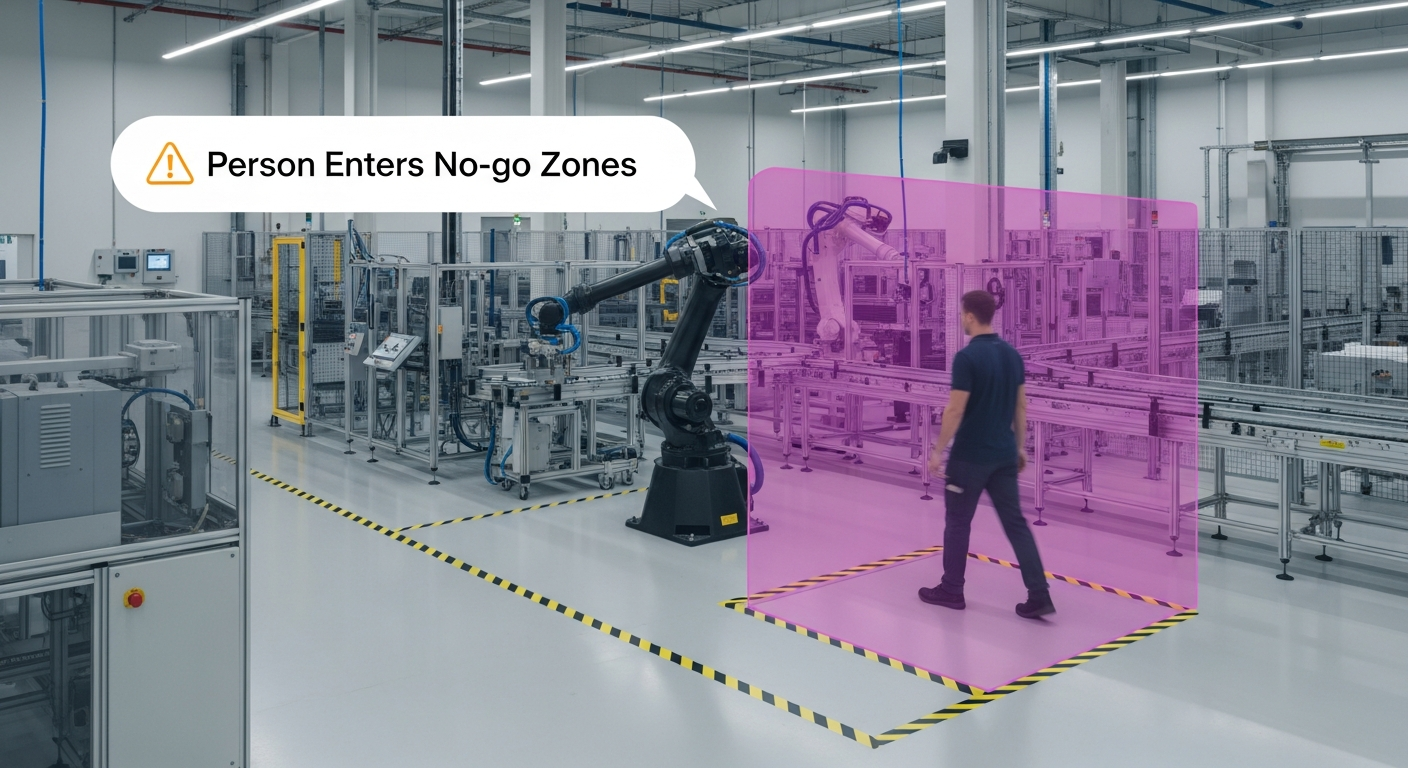
- Real-time monitoring and detection: The fastest way to resolve an incident is to detect it before it causes a major disruption. By integrating real-time data from process control systems, video AI, and more, organizations can identify anomalies as they happen. For example, AI-powered video analytics can automatically detect when a person enters a restricted no-go zone, sending an alert in seconds rather than waiting for a manual discovery.
- Collaborative incident workspaces: Modern platforms provide shared digital workspaces where cross-functional teams from operations, maintenance, and quality can collaborate on an incident. All communications, shared files, and actions taken are documented in a single, time-stamped record, eliminating confusing email chains and creating an authoritative audit trail for post-incident analysis.
By adopting this framework, organizations can transform their incident response from a sequential, siloed process into a parallel, collaborative one.
How Spot AI unifies search and share capabilities
Spot AI's Video AI platform is designed to be the collaborative hub for incident resolution in manufacturing. It turns your existing camera system into an intelligent network of AI teammates that help you search, share, and resolve production incidents faster. By unifying video with powerful search and collaboration tools, Spot AI directly addresses the core frustrations of fragmented incident management.
| Capability | Traditional Fragmented Systems | Spot AI's Unified Platform |
|---|---|---|
| Incident Investigation | Hours of manual video scrubbing and data gathering across multiple systems. | Seconds to find relevant video with natural language search (e.g., "person near Line 3"). |
| Data Accessibility | Video, maintenance logs, and production data are siloed and difficult to correlate. | A single platform to view, search, and share time-stamped video evidence. |
| Cross-Team Collaboration | Relies on emails, phone calls, and meetings, leading to information loss. | Shareable links to video clips and cases allow teams to collaborate in real time. |
| Root Cause Analysis | Often based on incomplete information and anecdotal accounts. | Fact-based analysis using verifiable video evidence to eliminate back and forth. |
| Anticipatory Detection | Reactive; issues are typically found after they impact production. | Forward-thinking; AI agents detect anomalies like missing PPE or no-go zone entries and send real-time alerts. |
Here’s how Spot AI’s unified approach helps resolve common manufacturing pain points:
- Accelerate emergency response and root cause analysis: With Spot AI's intelligent video search, you can instantly find the exact moment an incident occurred. Instead of manually reviewing hours of footage, a manager can search for "forklift in Zone A" or "unattended workstation" and get to the relevant clip in seconds. This reduces investigation time, allowing teams to move from diagnosis to resolution much faster.
- Eliminate accountability gaps with shareable evidence: Disagreements over what caused an incident can delay resolution and hinder learning. Spot AI allows you to create a case by compiling time-stamped video clips into a single, shareable folder. This creates a record of events that can be shared with maintenance, safety, and engineering teams. It transforms subjective arguments into fact-based discussions, driving accountability and supporting continuous improvement initiatives.
- Break down data silos with an open platform: Spot AI’s AI VMS works with any IP camera, allowing you to unify your entire video infrastructure—whether existing or new—onto a single cloud dashboard. This turns your siloed video data into an accessible, searchable asset. With an open, camera-agnostic platform, you can integrate video insights into your broader incident management workflow without being locked into a single hardware vendor.
- Shift from reactive to forward-thinking with AI teammates: Spot AI’s Video AI Agents act as a digital force multiplier, monitoring your facility 24/7. Pre-trained agents can automatically detect safety and operational anomalies, such as a person entering a hazardous no-go zone or missing required PPE. These real-time alerts empower supervisors to intervene on the spot, turning your video system into a forward-looking tool for risk reduction.
A practical roadmap to faster incident resolution
Implementing a unified incident management system is a journey, not a single project. A phased approach allows your organization to build momentum and demonstrate value at each stage.
- Establish a foundation of visibility: Start by consolidating your most critical data sources. Unify all your camera feeds onto a single platform to create a baseline of visual intelligence. This gives you a single place to search and review footage from across all your sites.
- Automate detection and alerting: Once you have visibility, deploy AI agents to monitor for high-priority events. Focus on critical risks like no-go zone violations or missing PPE to get quick wins. This shifts your team from passive monitoring to active, real-time response.
- Standardize and digitize key workflows: Use digital tools to formalize processes that are prone to communication breakdowns, such as shift handoffs and changeover procedures. Digital logbooks and checklists ensure that information is captured consistently and is easily searchable during an investigation.
- Foster cross-functional collaboration: Create formal incident response teams with members from operations, maintenance, quality, and safety. Use a collaborative platform to give them a shared space to document findings, share evidence, and track progress toward resolution.
- Measure, refine, and improve: Continuously track key performance indicators (KPIs) to measure the impact of your efforts. Focus on metrics like Mean Time to Repair (MTTR), Overall Equipment Effectiveness (OEE), and First-Pass Yield to quantify improvements and identify new opportunities for optimization.
From reactive firefighting to resilient operations
In today's competitive landscape, manufacturers can no longer afford the financial and operational drain of slow, fragmented incident response. The path to building more resilient and productive operations lies in breaking down the silos that separate data, teams, and tools. By embracing a unified platform for search, sharing, and collaboration, you empower your teams to resolve production incidents faster and minimize their recurrence.
Curious how unified video AI can streamline incident resolution and minimize downtime? Request a demo to see Spot AI in action with your existing cameras.
Frequently Asked Questions
What are the best tools for incident management in manufacturing?
The most effective tools are unified platforms that integrate data from multiple sources, such as a CMMS, MES, and video systems. Look for solutions that offer powerful search capabilities, real-time alerting, and collaborative workspaces to connect teams from the plant floor to the front office. Video AI platforms like Spot AI are becoming essential for providing the visual context needed for rapid root cause analysis.
How can collaboration improve incident resolution?
Collaboration improves incident resolution by breaking down information silos and bringing diverse expertise together. When production, maintenance, and quality teams can view the same data and communicate in a shared digital workspace, they can diagnose problems faster and develop more effective solutions. This avoids the delays caused by sequential hand-offs and ensures all perspectives are considered.
How can technology minimize downtime in production?
Technology minimizes downtime primarily in two ways. First, real-time monitoring and AI-powered alerts enable early detection of anomalies, allowing teams to reduce minor issues that could turn into a full stoppage. Second, unified search and data integration tools dramatically accelerate diagnosis by giving technicians real-time access to all relevant information, including historical data, equipment manuals, and video evidence.
What are the best practices for sharing incident data across teams?
Best practices include using a centralized platform for all incident-related information to create a single source of truth. Standardize reporting with digital logbooks and forms to ensure data consistency. Use automated notifications to keep all relevant stakeholders informed in real time. Finally, make visual evidence, like time-stamped video clips, a standard part of every incident report to provide clear, objective context.
What is the best AI to detect incidents across a multi-site manufacturing network?
For multi-site operations, the most effective solution is a cloud-native, camera-agnostic Video AI platform. This architecture allows you to unify all your existing IP cameras from every location into a single dashboard, regardless of the hardware manufacturer. This provides centralized visibility to monitor performance across all sites from one place. It also enables you to standardize key AI alerts for events like no-go zone entries or missing PPE, ensuring consistent operational and safety protocols across the entire enterprise.
About the author
Sud Bhatija is COO and Co-founder at Spot AI, where he scales operations and GTM strategy to deliver video AI that helps operations, safety, and security teams boost productivity and reduce incidents across industries.

