




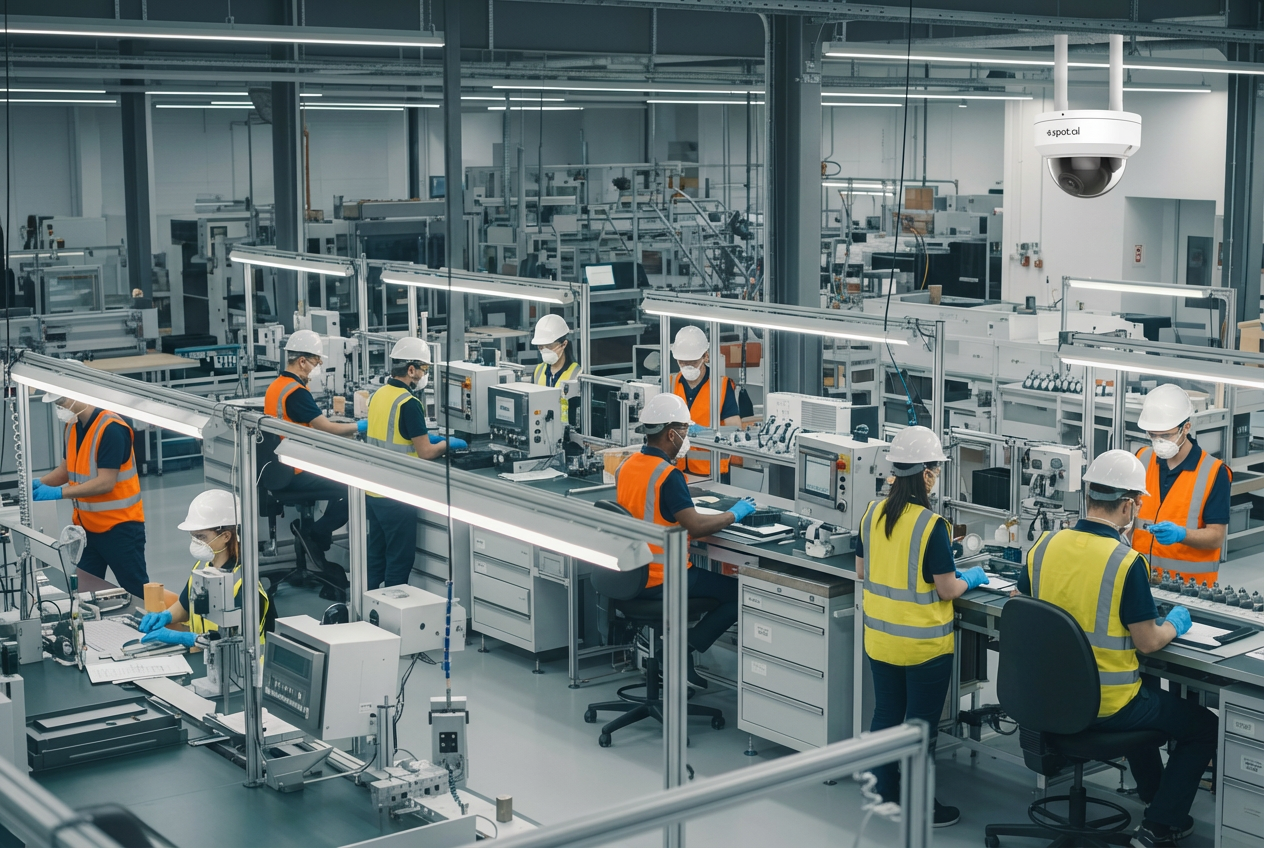


For manufacturing leaders overseeing operations, the roadblocks are familiar: performance inconsistencies across sites, the daily grind of reactive problem-solving, and the hurdle of scaling best practices. While traditional methods for improvement have hit a ceiling, a new approach is emerging. Video AI is not about replacing skilled teams but augmenting them, turning your existing cameras into AI teammates that multiply productivity.
This shift empowers your organization to move from fighting daily fires to strategically improving key aspects of production. By providing real-time visibility and data-driven insights, video AI helps standardize excellence, minimize errors, and unlock higher efficiency across more facilities and shifts.
The operational roadblocks in modern manufacturing
For executives managing multi-plant operations, achieving consistent performance is a common challenge. Identical equipment and processes often yield vastly different results, making enterprise-wide forecasting difficult and frustrating demands for predictable output. These operational obstacles create a cycle of inefficiency that impacts everything from cost per unit to on-time delivery.
- Cross-site performance inconsistency: It's a frequent frustration: top-performing plants outpace laggards, but the reasons why remain obscure. This variability makes it impossible to standardize best practices, as there's no clear, data-backed way to identify what "good" looks like and replicate it across the enterprise. This leads to endless coordination calls and an inability to scale operational excellence.
- The high cost of reactive problem resolution: By the time a quality issue or production stoppage is reported through traditional channels, substantial damage has already occurred. Leaders spend their days addressing issues that could have been mitigated, leading to burnout and delaying strategic initiatives. Unplanned downtime is a major financial drain, with 83% of industry leaders agreeing it costs a minimum of $10,000 per hour (Source: Motion Drives). For many facilities, these costs can reach up to $500,000 per hour, turning minor interruptions into major financial events.
- Limited visibility into operations: The third shift often operates like a "black box," with minimal supervision and delayed reporting. Key decisions are postponed until the next day, costing thousands in lost productivity. This lack of real-time data means leaders are making critical resource allocation decisions based on yesterday's reports, not what's happening on the floor right now.
- Manual compliance and knowledge transfer: Documenting OSHA compliance and safety protocols can consume a considerable portion of a manager's time. When an incident occurs, compiling evidence from disparate systems can take days. Furthermore, with experienced operators retiring, critical institutional knowledge is lost. Training new workers is time-consuming, and ensuring they adhere to standard operating procedures (SOPs) is a constant struggle, especially since human error is the source of 80% of manufacturing defects (Source: National Institute of Standards and Technology).
Video AI as a digital force multiplier for your team
Video AI helps your existing camera infrastructure deliver more insight-driven, intelligent monitoring. It serves as a helpful assistant, augmenting your teams with capabilities that enhance their judgment and effectiveness. This empowers workers to focus on high-value problem-solving instead of routine monitoring.
In a manufacturing context, video AI combines computer vision and machine learning to analyze footage in real time. It continuously scans for deviations from standard procedures, potential quality issues, and safety hazards, then integrates those insights directly into your production workflows.
| Feature | Legacy Video Systems | Spot AI Video AI Platform |
|---|---|---|
| Primary Function | Records video for post-incident review | Analyzes video in real time to augment teams |
| Alerts | Generic motion alerts | Context-aware alerts for specific events (e.g., SOP deviation, no-go zone entry) |
| Investigation | Manual video scrubbing | Keyword-based search to find events in seconds |
| Deployment | Often requires proprietary cameras and complex setup | Camera agnostic; connects to existing IP cameras in minutes |
| Scalability | Complex and costly to scale across sites | Unified dashboard for unlimited sites and users |
This augmentation model is critical in today's labor market. With persistent skills shortages, the goal is to make existing teams more effective. Organizations that implement AI-augmented workforces generate 1.7 times more revenue growth than their competitors (Source: Gloat).
How video AI augments manufacturing teams to multiply productivity
By turning cameras into AI teammates, you can directly address the core frustrations that limit productivity. Spot AI's platform is designed to integrate seamlessly into your operations, providing the tools needed to standardize processes, coach performance, and drive continuous improvement.
1. Standardize SOPs and scale best practices across all facilities
- Define gold standard SOPs: Capture video of your top performers executing a task, like a machine changeover. Use this footage to create a visual, step-by-step "gold standard" SOP that can be shared across all facilities.
- Monitor SOP adherence: Use AI Agents to monitor whether teams are adhering to the established procedures. The platform can observe timing and activity patterns, flagging deviations without requiring a supervisor to be physically present.
- Coach with data: Automated scorecards and shift recaps provide objective, data-driven feedback to teams and individuals. This helps pinpoint specific coaching opportunities and track progress over time, supporting more objective, evidence-based performance discussions.
2. Shift from reactive work to planned improvements
- Detect anomalies as they happen: Set up AI Agents to monitor for specific events, such as a person or forklift entering a restricted no-go zone or an unattended workstation on a critical line.
- Accelerate root cause analysis: When an issue does arise, the ability to search video by keyword (e.g., "person without hard hat near Line 3") allows managers to find the exact moment an incident occurred in seconds, not hours.
- Mitigate unplanned downtime: Maintenance programs can reduce downtime when teams identify equipment issues earlier. Video AI can help surface visible anomalies for your maintenance tools to investigate. Video AI contributes by monitoring equipment for visual or timing anomalies that indicate a developing problem.
3. Gain near real-time visibility and streamline compliance documentation
- Get timely insight throughout shifts: Automated alerts and a cloud-based dashboard mean managers can check on operations from anywhere, at any time. This helps reduce the "black box" of overnight shifts and helps teams address critical issues promptly.
- Automate compliance records: AI Agents can automatically detect and log events like missing PPE, creating a searchable, time-stamped video record for compliance audits. This substantially reduces the manual effort required to prove OSHA compliance. One manufacturer achieved a 281% return on investment within a year by implementing AI-powered quality control systems (Source: Glean).
4. Address skilled labor variability and accelerate onboarding
- Create a visual training library: Use video of expert operators to build a library of best practices. This visual training material is far more effective than written manuals for teaching complex, hands-on procedures.
- Ensure procedural consistency: AI assists with monitoring for SOP adherence, helping new workers follow correct procedures. This reduces the variability that comes with a blended workforce of new and experienced employees.
- Reduce onboarding time: Augmented reality training, powered by video and 3D models, can reduce assembly errors by 49% and significantly shorten the time it takes for new employees to become proficient (Source: Matterport).
Improve your operations with an AI teammate
Video AI provides the data-driven foundation to standardize excellence, empower your teams, and unlock new levels of productivity. By augmenting your workforce with an intelligent, reliable AI teammate, you can address operational hurdles that have held your facilities back.
Curious how video AI can help you standardize more shifts and boost productivity? Request a demo to see Spot AI in action.
Frequently asked questions
How can AI improve productivity in manufacturing?
AI improves manufacturing productivity by automating repetitive tasks like visual inspection, supporting earlier detection of equipment issues to minimize downtime, and optimizing production schedules. It also augments workers by providing real-time guidance and performance feedback, which helps standardize processes and minimize human error, the source of 80% of manufacturing defects (Source: National Institute of Standards and Technology).
What are the benefits of using AI cameras for quality assurance?
AI cameras for quality assurance offer higher accuracy, consistency, and speed than manual inspection. They can detect defects with higher accuracy than many manual inspections and operate for extended periods without fatigue (Source: ScanFlow). This leads to a steep drop in defects, scrap, and rework costs, driving a significant return on investment.
What challenges do manufacturers face when implementing AI?
Key hurdles include integrating AI with existing legacy systems (MES, ERP), ensuring data quality and security, managing change with the workforce, and demonstrating a clear return on investment. A successful strategy often involves starting with a focused pilot project to prove value before scaling enterprise-wide.
How does AI help minimize production line errors?
AI helps minimize production line errors by monitoring for SOP adherence in real time, providing on-the-spot feedback to operators when they deviate from standard procedures. For quality control, AI-powered visual inspection automatically detects product defects, assembly errors, or contamination, helping prevent flawed products from moving down the line.
How does improving uptime with video AI help lower overtime costs?
Overtime is often a direct result of unplanned downtime, which forces teams to work extra hours to meet production targets. Video AI can help minimize downtime by surfacing alerts for equipment anomalies and process bottlenecks. By ensuring production runs smoothly and consistently during standard shifts, you can meet output goals without relying on expensive overtime labor, directly lowering operational costs.
What is the ROI of AI in manufacturing?
The ROI of AI in manufacturing is substantial and varies by application. For example, AI-augmented workforces have been shown to generate 1.7 times more revenue growth than competitors (Source: Gloat). Other applications like anticipatory maintenance and AI-powered quality control also deliver significant returns by lowering costs and improving efficiency.
About the author
Sud Bhatija is COO and Co-founder at Spot AI, where he scales operations and GTM strategy to deliver video AI that helps operations, safety, and security teams boost productivity and reduce incidents across industries.

