






Leading asset protection teams for big box retailers often feels like managing competing priorities. On one side, you address external risks like organized retail crime (ORC). On the other, you manage the silent, steady erosion of profit through internal process failures, operational errors, and safety incidents. With global retail shrinkage reaching $132 billion in 2024, the pressure to protect inventory and margins has never been higher (Source: Cin7).
For years, the standard approach to monitoring warehouse standard operating procedure (SOP) compliance relied on clipboards, sporadic floor walks, and reactive video review. If an incident occurred, you spent hours scrubbing through footage to understand what went wrong. This manual approach leaves important gaps in visibility. You cannot fix what you cannot see, and human supervisors cannot continuously monitor every bay, dock door, and packing station.
Video AI changes this dynamic.
By using existing cameras with AI, asset protection and operations leaders can automate SOP monitoring.
This shifts the focus from reacting to incidents after the damage is done to proactively identifying hazards and process deviations in real time.
The high cost of inconsistent SOP adherence
Standard operating procedures are the backbone of a proactive, profitable warehouse. They define how inventory is received, how forklifts operate safely, and how orders are packed to guard against damage. However, non-compliance is endemic in complex logistics environments.
When workers deviate from established protocols—whether due to fatigue, lack of training, or pressure to meet quotas—the consequences ripple through the P&L.
Inventory shrinkage and operational waste
Shrinkage isn't just theft; a substantial portion stems from procedural errors. Receiving mistakes, improper inventory placement, and failure to follow handling protocols result in lost or damaged goods. In big box retail environments, where volume is high and margins are thin, these "small" errors compound. Research indicates that improving SOP compliance in receiving and storage can cut shrinkage by 15-30% (Source: Cin7).
Safety incidents and regulatory risk
OSHA data for fiscal year 2024 reported nearly 250,000 work-related injuries in the warehouse and transportation sectors (Source: Program Business). Most of these incidents—forklift collisions, and machinery accidents—are avoidable and stem from specific SOP violations. Beyond the human cost, these incidents lead to higher insurance premiums, workers' compensation claims, and potential regulatory fines.
The multi-shift visibility gap
A major frustration for directors of asset protection is the "night shift effect." Compliance rates often vary dramatically between shifts. While day shifts benefit from active management presence, evening and night operations frequently suffer from reduced supervision. Without automated monitoring, these off-hour shifts become black boxes where procedural drift goes undetected until a serious incident occurs.
Moving beyond reactive video systems
Traditional camera systems are passive tools. They record video that is typically only viewed after a theft or accident. For an asset protection director managing dozens of locations, this reactive model is inefficient.
Video AI analyzes video feeds in real time.
It uses computer vision to detect specific behaviors, objects, and spatial relationships. Instead of waiting for a report that a forklift entered a pedestrian zone, the system detects the event as it happens.
| Feature | Traditional video systems | Video AI platforms |
|---|---|---|
| Detection | Passive recording | Real-time behavior & object recognition |
| Search | Manual scrubbing (hours) | Keyword/Attribute search (seconds) |
| Alerts | Basic motion (high false alarms) | Context-aware alerts with significantly less noise |
| Data Utility | Evidence only | Operational insights |
| Scalability | Limited by human review capacity | Scalable automated monitoring |
Key warehouse SOPs to monitor with video AI
To drive rapid value, asset protection and operations leaders should focus video AI implementation on high-risk, high-impact procedures.
1. Dock operations and receiving accuracy
The receiving dock is the first line of defense against shrinkage. SOPs here dictate how trucks are unloaded, how counts are verified, and how goods are staged.
Video AI application: Monitor for "Unattended Kiosks" or workstations to ensure tally clerks are present during unloading.
Benefit: Helps ensure chain of custody is maintained and that inventory is logged correctly upon arrival.
2. Forklift and pedestrian safety
Collisions between material handling equipment and workers are among the most severe warehouse accidents.
Video AI application: Utilize "Forklift Enters No-go Zones" and "Person Enters No-go Zones" capabilities.
Benefit: The system triggers alerts if a forklift crosses into a pedestrian walkway or if a worker takes a shortcut through an active machinery lane. This allows for on-the-spot coaching rather than waiting for a report.
3. PPE compliance monitoring
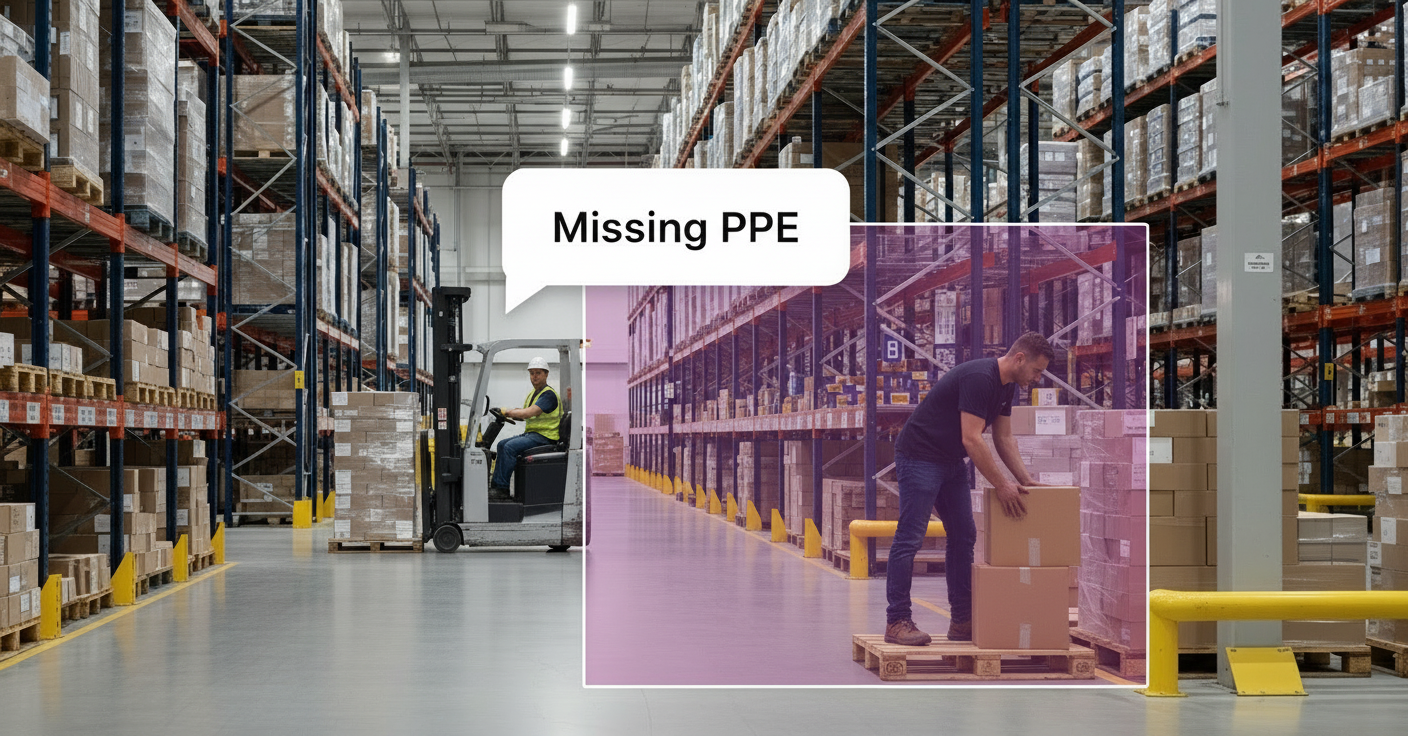
Personal Protective Equipment (PPE) is non-negotiable for safety and OSHA compliance, yet adherence is difficult to track manually.
Video AI application: Deploy "Missing PPE" agents to detect the absence of high-visibility vests or hard hats in designated zones.
Benefit: Provides objective data on safety culture, allowing managers to identify shifts or teams that require retraining.
4. Loss mitigation and internal controls
Internal theft accounts for a considerable percentage of retail shrink (Source: Cin7). This often occurs at transition points like trash removal areas or emergency exits.
Video AI application: Set up "Loitering" detection near back doors or high-value cages and "Unattended Checkout or Desk" monitors for sensitive inventory control points.
Benefit: Surfaces suspicious dwelling behavior early, without the need for invasive, morale-damaging surveillance of every employee.
Mapping asset protection pain points to video AI solutions
For asset protection leaders, the goal is to solve specific business problems, not just deploy technology. Here is how video AI capabilities directly address the core frustrations of the role.
Pain point: reactive security posture
The Pain Point: Traditional cameras only provide value after a loss has occurred. By the time you review the footage, the merchandise is gone.
The Solution: Spot AI’s real-time agents, such as Loitering detection, identify suspicious behavior patterns—like ORC scouts casing a facility—so teams can respond quickly when risks emerge.
Pain point: false alarm fatigue
The Pain Point: Legacy motion sensors trigger on everything from shadows to stray animals, causing security staff to ignore alerts.
The Solution: Advanced computer vision distinguishes between genuine events and environmental noise. This can significantly cut false alarms, helping teams focus on alerts for Person Enters No-go Zones that are more likely to require attention.
Pain point: manual investigation drain
The Pain Point: Spending hours reviewing footage to find a single incident is a massive drain on resources.
The Solution: Intelligent search capabilities allow investigators to find relevant footage in minutes using natural language or attribute filtering (e.g., "red vest," "forklift"). This cuts investigation time dramatically, improving case resolution rates.
Pain point: multi-location inconsistency
The Pain Point: Managing consistent standards across hundreds of locations with varying layouts is tough to manage with manual oversight.
The Solution: A unified cloud dashboard provides a single view of compliance metrics across all sites. Leaders can compare SOP adherence rates between different distribution centers and shifts, identifying top performers and areas needing support.
Implementation best practices for big box retailers
Deploying video AI for SOP monitoring benefits from a phased approach to support workforce adoption and measurable outcomes.
- Start with a targeted pilot: do not attempt to monitor every SOP at once. Begin with 1-2 high-priority use cases, such as Forklift Enters No-go Zones or Missing PPE.
- Position as a tool for protection, not punishment: clear communication is vital. Explain to warehouse teams that the technology is there to mitigate the risk of accidents and improve efficiency, not to watch their every move. When workers understand the safety benefits, adoption improves (Source: Spot AI).
- Leverage existing infrastructure: choose a camera-agnostic platform. Spot AI connects to existing IP cameras, eliminating the need for a costly hardware rip-and-replace.
- Integrate with operational workflows: ensure alerts go to the right people. A safety violation should notify the floor safety manager, while a dock door breach should alert security.
- Use data for coaching: use the video clips of SOP violations as training tools during shift stand-ups. Visual evidence is a powerful teaching aid that helps standardize best practices.
Measuring ROI and business impact
To justify the investment to the C-suite, asset protection directors must demonstrate clear financial and operational returns.
- Shrinkage reduction: by tightening receiving and storage SOPs, organizations can see shrinkage reductions of 15-30% (Source: Cin7). For a large retail operation, this represents millions in recovered margin.
- Operational efficiency: correcting workflow inefficiencies identified by video AI can improve labor productivity by 5-10% (Source: Shopify).
- Safety cost avoidance: reducing incident rates lowers workers' compensation claims and insurance premiums. Facilities implementing comprehensive safety monitoring often see injury rates drop by 15-30% in the first year (Source: OHS Online).
- Investigation speed: reducing investigation time from hours to minutes frees up AP staff to focus on strategic initiatives and complex case building.
Transforming Asset Protection into a Strategic Partner
Manual-only warehouse monitoring is increasingly insufficient. For big box retailers facing aggressive shrinkage targets and complex operational roadblocks, relying solely on periodic audits and reactive video review is tough to scale. Video AI can help standardize processes across shifts and sites.
By automating the detection of SOP violations—from safety hazards to process deviations—asset protection leaders can improve their departments. The technology helps shift security from a cost center that documents losses to a partner that supports operational efficiency and broader business goals.
Curious how video AI can help standardize SOP compliance at your facilities? See Spot AI in action with a personalized demo.
Frequently asked questions
What are the best practices for warehouse SOP compliance?
Best practices include digitizing SOPs for easy access, implementing real-time monitoring to catch deviations as they occur, and using data for continuous coaching. Focusing on leading indicators (like unsafe behaviors) rather than lagging indicators (like accident reports) is critical for proactive improvement.
How can AI improve warehouse safety?
AI improves safety by continuously monitoring for hazards that human supervisors might miss. It can detect missing PPE, identify workers entering dangerous forklift zones, and flag blocked emergency exits in real time, enabling timely intervention to mitigate risk.
What technologies are available for monitoring warehouse compliance?
Key technologies include Warehouse Management Systems (WMS) for inventory tracking, IoT sensors for environmental monitoring, and Video AI platforms. Video AI is particularly effective as it leverages existing camera infrastructure to provide visual verification of procedural adherence.
What are the common obstacles in warehouse compliance?
Common roadblocks include the "night shift effect" where supervision is lower, high staff turnover leading to training gaps, and the difficulty of manual documentation. Inconsistency across multiple locations is also a major barrier for large retailers.
How can video analytics enhance operational efficiency in warehouses?
Video analytics identifies bottlenecks such as excessive wait times at loading docks or inefficient changeover processes. By providing visual data on where time is being lost, managers can optimize workflows to increase throughput and cut labor costs.
About the author
Sud Bhatija is COO and Co-founder at Spot AI, where he scales operations and GTM strategy to deliver video AI that helps operations, safety, and security teams boost productivity and reduce incidents across industries.

