






Cargo theft losses surged to an estimated $725 million in 2025, representing a 60 percent increase from the prior year (Source: Verisk). While organized criminal groups targeting high-value freight grab headlines, a quieter but equally damaging threat persists inside the warehouse: internal theft. Nearly 29 percent of retail shrinkage stems from employee dishonesty, often exploiting the chaotic environment of the loading dock to mask inventory loss (Source: SafetyCulture).
For technical evaluators and supply chain security leaders, the obstacle is not just "watching" the dock; it is about verifying the flow of goods without disrupting operations. Traditional video security systems record history but fail to provide the real-time data needed to stop shrinkage as it happens. To close the execution gap between documented manifests and physical reality, organizations are turning to video AI agents for logistics that integrate with warehouse management systems (WMS) to automate verification and secure the perimeter.
This article explores how modern video technology transforms the loading dock from a vulnerability into a secure, data-rich control point.
Key terms to know
- Shrinkage: the difference between recorded inventory and actual physical inventory, caused by theft, damage, or administrative error.
- Exception-based reporting (EBR): a method of data analysis that flags transaction outliers (e.g., short shipments, unauthorized overrides) for review, rather than requiring manual analysis of all data.
- Dwell time: the duration a vehicle remains at a dock or in a yard. reducing dwell time is a primary metric for improving loading dock efficiency.
- Video AI agents: intelligent software that processes video feeds to detect specific behaviors or anomalies (like "no-go zone" violations) and triggers automated responses.
- Edge AI: processing video data locally on hardware at the facility rather than sending all raw footage to the cloud, reducing bandwidth consumption and latency.
The operational bottleneck: where loss meets inefficiency
Security and IT leaders in retail often face a difficult balancing act: securing a distributed network of stores and distribution centers (DCs) while minimizing network complexity and support tickets. The loading dock is often the friction point where these priorities collide.
The execution gap
Losses frequently occur during the transition from planning to physical fulfillment. A worker might receive a shipment and manually compare pallet counts to an invoice, but if the data is logged hours later, discrepancies are discovered too late. This "execution gap" creates a window where internal theft can occur disguised as administrative error.
Network and support overhead
Deploying high-resolution cameras to cover every bay door often raises red flags for network teams. Streaming 4K video from 50 dock doors can cripple a facility's bandwidth if not managed correctly. Furthermore, maintaining hundreds of devices across multiple sites creates a substantial support load. If a camera goes offline at a remote site, it often results in a "blind spot" that persists until a technician can be dispatched—a costly and slow process.
The cost of dwell time
Security protocols that rely on manual checks can slow down throughput. Every minute a truck sits idle at a dock impacts the facility's capacity, so even small reductions in average dwell time can significantly increase throughput. The goal is to deploy loading dock security solutions that accelerate verification rather than hindering it.
Automating delivery verification with computer vision
To close the execution gap, video technology must move beyond passive recording to active verification. By integrating camera feeds with WMS and transportation management systems (TMS), organizations can create a visual audit trail that aligns physical inventory with digital records.
- Visual manifesting: when merchandise is loaded, computer vision systems can capture images of the pallet from multiple angles. this creates a "visual manifest" that proves the condition and quantity of goods at the moment of transfer.
- Automated license plate recognition (LPR): LPR systems identify inbound and outbound vehicles, correlating the physical truck with the scheduled appointment. this verifies that the correct carrier is at the correct dock, guarding against cargo diversion.
- RFID integration: while barcodes require line-of-sight, RFID readers can interrogate multiple cases simultaneously. when combined with video evidence, this allows for rapid identification of short shipments or extra cases without manual scanning delays.
Stopping internal theft with intelligent monitoring
Internal theft is rarely opportunistic; it is often calculated. Employees who know the facility layout also know the blind spots. Common tactics include "sweet-hearting" (passing goods to accomplices), staging merchandise in unmonitored areas for later removal, or falsifying damage reports.
Establishing "no-go zones"
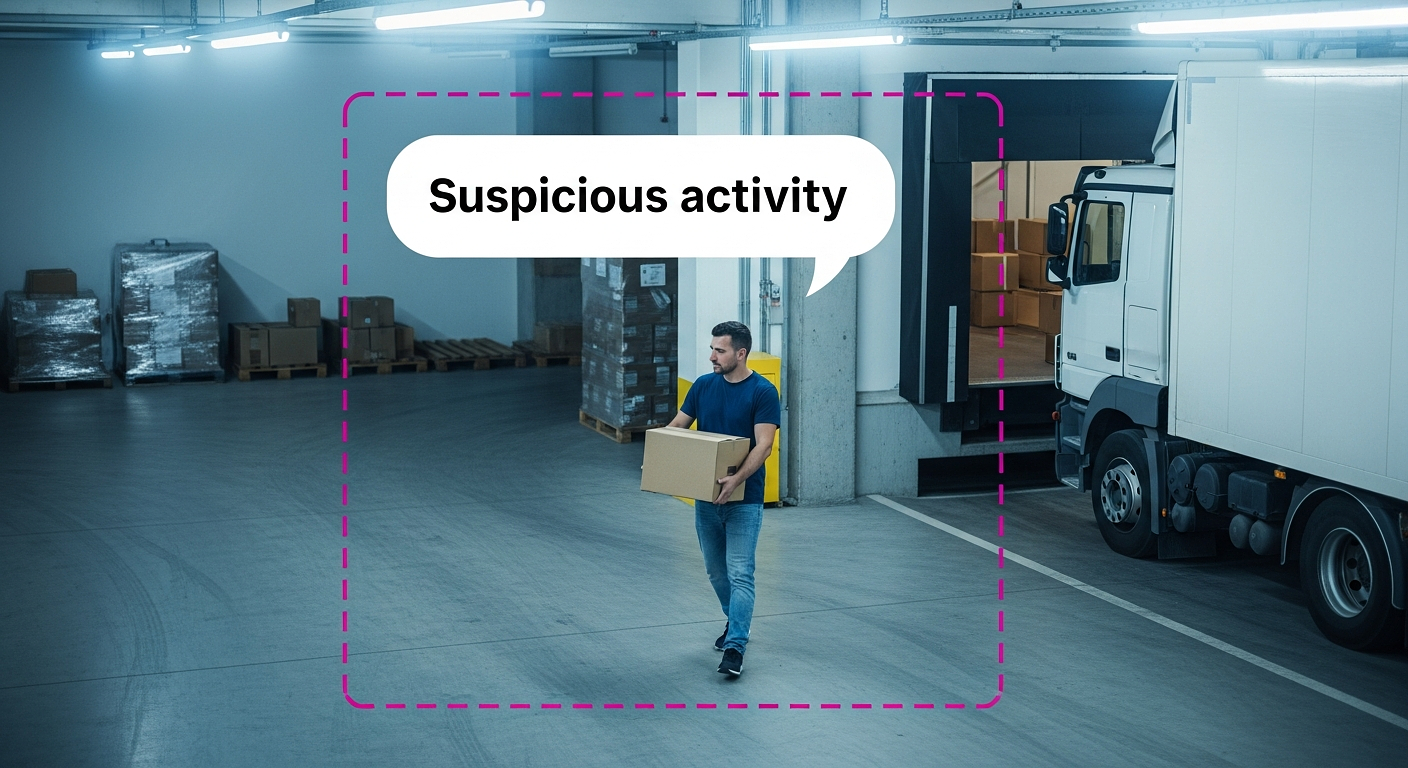
One of the most effective warehouse theft prevention strategies is the implementation of "No-Go Zones." Using video AI, security teams can define virtual perimeters around sensitive areas, such as high-value cages or dock doors that should be closed.
If a person or forklift enters a restricted zone during a shift change or after hours, the system triggers a real-time alert. This moves security from a reactive posture—reviewing footage after items go missing—to an anticipatory one, allowing for timely intervention.
Detecting anomaly patterns
AI agents excel at spotting deviations from the norm. Anomaly detection systems learn typical dock operations—the standard timing, personnel, and vehicle flows—and flag outliers.
- Loitering detection: identifying individuals lingering in loading bays or near exit doors when no active loading is scheduled.
- Unusual timing: flagging a dock door opening at 3:00 AM when no deliveries are expected.
- Process deviation: detecting if a vehicle departs without the proper "sealed" status or if a pallet is moved to a staging area and left for an extended period, which could indicate an attempt to hide it for later theft.
By focusing on these exceptions, security teams can reduce alert fatigue and focus on genuine risks.
Selecting the best video system for enterprise logistics
For the technical evaluator, the choice of architecture determines the long-term viability of the system. The market offers on-premises, cloud-only, and hybrid solutions. For distributed retail and logistics operations, a hybrid approach often provides the best balance of bandwidth management and accessibility.
The following table compares architectural approaches based on key criteria for supply chain security:
| Feature | Spot AI (hybrid edge-cloud) | Traditional on-prem (NVR/DVR) | Pure cloud cameras |
|---|---|---|---|
| Bandwidth impact | Low: processes video at the edge; only uploads metadata/clips. | None: unless remote viewing is attempted, then high. | High: constant upstream bandwidth required for all cameras. |
| Deployment speed | Fast: plug-and-play with existing cameras; no port forwarding. | Slow: requires complex manual configuration and networking. | Medium: requires replacing all hardware; dependent on internet. |
| Scalability | High: centralized dashboard manages unlimited sites/users. | Low: difficult to manage multiple NVRs across sites. | Medium: can get expensive as camera counts rise. |
| Hardware flexibility | High: camera-agnostic; works with any IP camera. | Medium: often locked into proprietary hardware. | Low: proprietary cameras required. |
| Cybersecurity | High: outbound-only connections; no open inbound ports. | Low: often requires port forwarding, creating vulnerabilities. | High: generally secure, but relies on constant connection. |
Why edge processing matters for logistics
In a busy distribution center, internet connectivity can fluctuate. Pure cloud cameras may stop recording or analyzing if the connection drops. Spot AI's Intelligent Video Recorder (IVR) processes data locally on the edge, ensuring that AI agents continue to monitor for safety and security risks even if the internet goes down. This "always-on" reliability is critical for maintaining a secure perimeter.
Case study: unifying visibility across the supply chain
The pain point of managing security across a fragmented network is common in logistics. Tidewater Fleet Supply, a distributor of heavy-duty truck parts with 3 distribution centers and 14 retail locations, faced major visibility gaps. Their legacy system required hours to search footage, and blind spots led to unaddressed theft incidents.
By deploying Spot AI, Tidewater unified all locations onto a single cloud-native dashboard. This shift allowed them to:
- Centralize monitoring: gain multi-site visibility from Florida to Virginia without VPNs or complex networking.
- Accelerate investigation: reduce investigation time from hours to minutes using AI-powered search to locate specific incidents.
- Ensure uptime: receive timely camera health alerts, eliminating the risk of discovering a camera was down only after an incident occurred.
- Avoid costs: the camera-agnostic approach allowed them to keep functioning hardware, avoiding an estimated $250–$500 per camera in upgrade costs.
This transition turned their video data into a forward-looking tool for managing operations and loss prevention (Source: Spot AI Customer Story).
Implementation: security and governance considerations
For IT and Network leaders, the "how" of deployment is just as important as the "what." A successful rollout of commercial security camera systems must address data governance and network integrity.
- Secure-by-design: modern systems should not require opening inbound firewall ports. outbound-only connections (via port 443) ensure that the local network remains improved against external threats.
- Role-based access control (RBAC): not every user needs access to every camera. granular permissions ensure that a dock supervisor sees only their facility's loading bays, while the regional loss prevention director has a comprehensive view.
- Bandwidth management: by processing video at the edge and only streaming when a user views footage, the impact on the business network is minimized. this allows for high-resolution 4K streams for local forensic review without clogging the wide area network (WAN).
- Health monitoring: automated alerts for camera offline status or hard drive issues allow IT teams to proactively manage fleet health, reducing the "operational support burden" of manual checks.
Conclusion
Automating the dock is no longer a futuristic concept; it is a necessity for reducing the $725 million in cargo theft losses and the significant shrinkage that occurs internally. By leveraging video AI agents, organizations can verify deliveries, enforce "No-Go Zones," and detect anomalies in real-time.
For the technical evaluator, the value lies in selecting a platform that acts as a force multiplier—improving security posture and operational efficiency without adding complexity to the network. The result is a supply chain that is not just monitored, but actively managed.
"Before implementing this system, tracking tailgating relied entirely on human observation. Now we receive swift alerts when someone holds the door open or if multiple people enter in quick succession, allowing us to address security protocols in real-time rather than after the fact."
— Mike Tiller, Director of Technology, Staccato (Source: Spot AI Customer Story: Staccato)
See Spot AI in action—request a demo to explore how video AI can streamline your dock security and operations.
Frequently asked questions
What are the best security camera systems for businesses with multiple locations?
The best systems for multi-site businesses are hybrid cloud solutions. These combine the reliability of local recording (on-prem) with the accessibility of cloud management. This architecture allows centralized viewing of all locations on a single dashboard without the high bandwidth costs of pure cloud cameras or the management complexity of traditional NVRs.
How can AI improve operational efficiency in logistics?
AI improves efficiency by automating manual tasks. For example, AI can track dock dwell times to identify bottlenecks, use license plate recognition to speed up gate entry, and verify pallet counts visually to reduce manual scanning errors. This data helps logistics leaders make informed decisions to increase throughput.
What strategies can prevent internal theft in retail supply chains?
Preventing internal theft requires a mix of process and technology. Key strategies include implementing "No-Go Zones" to alert on unauthorized access, using exception-based reporting to flag unusual transaction patterns (like excessive voids), and utilizing video verification to ensure that physical shipments match digital manifests.
How do I install a security camera system without disrupting my network?
Choose a system that is "camera-agnostic" and uses edge processing. This allows you to use existing cabling and cameras (avoiding "rip-and-replace"). Systems that process video locally and only transmit metadata use minimal bandwidth, ensuring that your business-critical operations are not impacted by video traffic.
What are the costs associated with business security systems?
Costs vary based on architecture. Traditional systems have high upfront hardware costs but lower ongoing fees. Pure cloud systems have lower upfront costs but high per-camera subscription fees. Hybrid solutions often provide the best total cost of ownership by allowing the use of affordable, standard cameras combined with a predictable platform subscription that includes hardware, software, and support.
About the author
Joshua Foster
Joshua Foster is an IT Systems Engineer at Spot AI, where he focuses on designing and securing scalable enterprise networks, managing cloud-integrated infrastructure, and automating system workflows to enhance operational efficiency. He is passionate about cross-functional collaboration and takes pride in delivering robust technical solutions that empower both the Spot AI team and its customers.

