




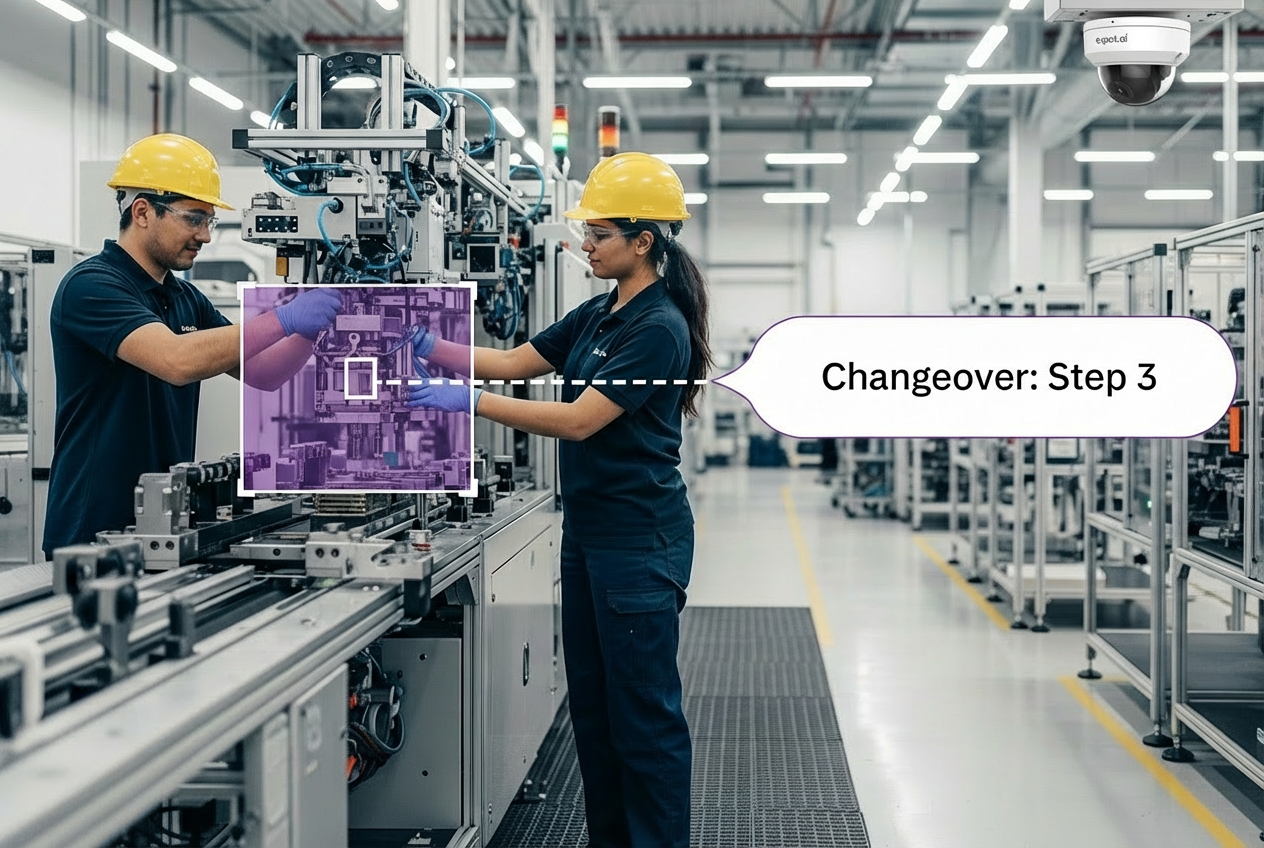


In modern manufacturing, where customer expectations for speed and customization are high, the efficiency of your changeover process is no longer just an operational detail—it's a critical driver of profitability. For many leaders, however, changeovers remain a source of substantial production downtime. Inconsistent execution between shifts, prolonged ramp-up periods, and a lack of visibility into what’s actually happening on the floor can make hitting aggressive Overall Equipment Effectiveness (OEE) targets feel like a hurdle. This guide provides a practical framework for transforming your changeover process from an unpredictable roadblock into a standardized, data-driven competitive advantage using video AI analytics.
Understanding the basics of changeover optimization
To begin, let’s clarify the key concepts that form the foundation of an effective changeover optimization strategy.
- Changeover: Also known as setup time, this is the entire process of converting a production line from one product to another. It includes every activity from removing old tools and recalibrating machinery to staging new materials and performing quality checks before the new run begins at full speed.
- Single-Minute Exchange of Dies (SMED): A systematic lean manufacturing methodology developed to dramatically shorten changeover time. The core principle of SMED is to analyze the changeover process, separate tasks into those that must be done while the machine is stopped (internal) and those that can be done while it's still running (external), and then work to convert internal tasks to external ones and streamline all remaining steps.
The hidden costs of inefficient changeovers
Excessive changeover time creates a cascade of operational and financial obstacles that go far beyond lost production minutes. When changeovers are lengthy and unpredictable, the impact is felt across the entire facility.
- Production and opportunity costs: Every minute a production line is idle is a minute that expensive capital equipment isn't generating revenue. In high-mix environments with frequent changeovers, these opportunity costs add up quickly, directly impacting return on assets.
- Excess inventory: Many facilities resort to large batch sizes to minimize the frequency of painful changeovers. This approach ties up working capital in excess inventory, which incurs carrying costs that can amount to 20–30% of the inventory's value annually (Source: ism.ws, manufacturersalliance.org). This buffer stock also hides underlying operational issues like bottlenecks and quality defects.
- Inconsistent quality and yield: When changeover procedures vary between shifts or operators, it introduces process variability. This often leads to longer ramp-up periods as the equipment stabilizes, generating products with defects that require rework or must be scrapped. This directly impacts first-pass yield and erodes profitability, a major concern in regulated industries like pharmaceuticals or aerospace (Source: centerforlean.com).
The SMED methodology: A foundation for changeover excellence
The Single-Minute Exchange of Dies (SMED) methodology provides a proven, systematic approach to cutting setup times. Developed by Shigeo Shingo at Toyota, SMED is built on the principle that changeover time is not fixed but can be systematically shortened through disciplined analysis and process redesign. The implementation follows four key stages.
- Observe the current process: The first stage involves meticulously documenting the entire changeover from start to finish. This observation almost always reveals that processes take longer than assumed, steps are performed inconsistently, and considerable time is lost searching for tools or waiting for materials.
- Separate internal and external activities: Next, categorize every task. Internal activities can only be performed when the machine is stopped (e.g., changing a die). External activities can be completed while the machine is still running (e.g., gathering tools, staging materials). Many organizations find they are performing external tasks during machine downtime out of habit, not necessity.
- Convert internal to external activities: This stage focuses on finding creative ways to perform tasks that were previously internal while the machine is still operating. Pre-staging materials, preparing documentation, and assembling changeover kits before the line stops are common examples that dramatically shorten the required downtime (Source: centerforlean.com).
- Streamline all remaining activities: Finally, optimize all remaining tasks, especially internal ones. This involves implementing quick-release mechanisms instead of bolts, using color-coding for faster setup, and creating standardized checklists or digital work instructions to guide operators. This stage aims to make every remaining step as fast and error-proof as possible.
Manufacturers applying these principles often cut changeover times by 50–90%, leading to higher equipment utilization, shorter lead times, and improved quality (Source: centerforlean.com, ism.ws).
How video AI analytics transforms changeover optimization
While SMED provides the framework, video AI analytics acts as a force multiplier, providing the real-time visibility and data needed to perfect the process. Traditional methods rely on manual time studies and supervisor spot-checks, which inevitably miss inconsistencies, especially across multiple shifts. Video AI analytics, layered on top of your existing cameras, provides continuous, objective monitoring of every changeover.
With a unified video AI platform like Spot AI, you can turn your cameras into AI teammates that help standardize every shift. The Changeover Optimization module recognizes each step of the process as it happens, tracks SOP adherence against your established best practices, and delivers real-time scorecards and shift recaps. This addresses the common frustration of changeover times that vary between teams, costing millions in lost production annually.
| Limitation of Traditional Methods | How Video AI Analytics Solves It |
|---|---|
| Inconsistent execution across shifts | Captures "gold-standard" processes from top performers and uses them as a visual baseline for coaching all teams |
| Lack of visibility into root causes of delays | Automatically flags deviations from SOPs and pinpoints the exact step where a bottleneck occurred, enabling rapid root cause analysis |
| Manual and inefficient compliance checks | Continuously monitors procedures, providing an automated audit trail and alerting supervisors to non-compliance in real time |
| "Tribal knowledge" lost with departing staff | Creates a visual library of best practices, turning individual expertise into a standardized, teachable asset for new and existing operators |
Gaining control with real-time monitoring and continuous improvement
Video AI analytics moves your team from reactive firefighting to forward-looking management by providing a clear, objective view of shop-floor reality.
- Establish an accurate baseline: The system analyzes video to establish what a "normal" changeover looks like, creating a performance baseline. It then monitors current operations and automatically alerts supervisors when deviations occur, allowing for on-the-spot coaching and correction.
- Drive cross-shift standardization: By capturing best practices from your highest-performing teams, video AI creates "gold-standard" visual SOPs. This transforms tribal knowledge into a replicable standard, ensuring that excellence on one shift becomes the benchmark for all shifts. New operators can review these recordings to compress their training time and achieve full productivity faster.
- Validate procedure compliance: Video AI provides automated visual confirmation that all external activities are complete before the machine stops. It can detect if materials are not staged correctly or if required tools are missing, avoiding false starts that extend downtime. This automated verification eliminates accountability gaps and ends the "he-said-she-said" scenarios that often follow a delayed changeover.
Ensuring quality during changeover and ramp-up
The instability of a changeover often extends into the initial production run, leading to quality issues and scrap. Video analytics helps mitigate this risk.
- Automate quality verification: Computer vision can automatically detect misaligned components, incorrect fixture positioning, or other setup errors before the line resumes full-speed operation. This anticipatory verification lowers reliance on manual checks and keeps defective products from entering the production stream.
- Integrate with preventive maintenance: Consistent changeovers depend on reliable equipment. By aligning preventive maintenance with planned changeovers, you ensure machines are in optimal condition, minimizing variability and enabling faster stabilization. This leads to higher first-pass yield and less scrap during the critical ramp-up period (Source: manufacturersalliance.org).
- Enforce SOPs for Quality Checks: Video analysis can confirm that mandatory quality checks are performed consistently during every transition. Digital compliance monitoring tracks whether procedures are followed, alerting supervisors to deviations and ensuring quality standards are met regardless of shift or schedule pressure.
From data silos to unified operational intelligence
To achieve true operational excellence, data from the shop floor must connect with your planning systems. Video analytics platforms like Spot AI integrate with Manufacturing Execution Systems (MES) and Enterprise Resource Planning (ERP) systems, breaking down data silos.
This integration directly enhances Overall Equipment Effectiveness (OEE), the gold-standard metric for manufacturing performance.
- Availability: Shorter changeover time directly increases machine availability.
- Performance: Faster ramp-up to full speed after a changeover boosts performance.
- Quality: Consistent, standardized changeovers cut defects and improve the quality score.
AI video analytics also provides detailed downtime categorization, automatically identifying if a stoppage was due to a changeover, maintenance, or material delay. This empowers you to focus improvement efforts where they will have the greatest impact.
Take control of your changeover process
Inconsistent, inefficient changeovers affect your production schedule and undermine your profitability. By combining the proven principles of SMED with the real-time visibility of AI video analytics, you can empower your teams, standardize excellence across every shift, and turn operational challenges into competitive advantages.
Ready to see how video AI can streamline your changeover process? Request a Spot AI demo and experience the platform in action.
Frequently Asked Questions
What are the best practices for shortening changeover time?
The most effective practices are rooted in the SMED methodology: separating internal and external tasks, converting internal activities to external ones, and streamlining all remaining steps. This is amplified by standardizing procedures, using quick-change tooling, and leveraging technology like video AI for real-time monitoring and coaching.
How can AI improve changeover processes?
Video AI analytics provides continuous, objective monitoring of every changeover. It automatically tracks SOP adherence, identifies bottlenecks in real time, captures best practices from top performers to standardize across shifts, and provides a visual audit trail for compliance and training.
What tools are available for changeover optimization?
Tools range from physical aids like quick-release clamps and color-coded fixtures to digital solutions. Digital tools include scheduling software, MES platforms, and advanced AI video analytics systems like Spot AI, which offer modules specifically for changeover monitoring and SOP adherence.
What metrics should be used to measure changeover efficiency?
Key metrics include total changeover duration, first-pass yield immediately following a changeover, changeover-related scrap percentage, and variation in changeover time between shifts and operators. Tracking these provides a holistic view of both speed and quality.
How does video analytics contribute to changeover optimization?
Video analytics provides the ground truth of what happens during a changeover. It replaces manual observation with 24/7 automated monitoring, enabling teams to identify inefficiencies, validate SOP compliance, coach operators with objective data, and create a visual library of best practices for continuous improvement.
About the author
Sud Bhatija is COO and Co-founder at Spot AI, where he scales operations and GTM strategy to deliver video AI that helps operations, safety, and security teams boost productivity and minimize incidents across industries.

