






Construction sites are complex environments where physical hazards and operational pressures converge, creating ongoing safety hurdles. One in five American workplace deaths occurs in the construction industry, with falls, struck-by incidents, and electrocutions remaining stubbornly high despite decades of safety initiatives (Source: U.S. Bureau of Labor Statistics). Compounding this, a growing mental health crisis affects worker vigilance and decision-making, with 64% of construction workers reporting feelings of anxiety or depression (Source: Clayco). For innovation and technology leaders, the core roadblock is moving safety management from a reactive, compliance-driven posture to an anticipatory system that surfaces risks sooner so teams can respond quickly.
This article outlines how construction leaders can leverage video AI to systematically teach safer practices, understand real-time jobsite risks with new clarity, and solve the recurring safety blockers that traditional methods have failed to address. By turning existing cameras into AI-powered tools that assist your team, organizations can build a safer, more predictable, and more profitable operational environment.
The persistent safety blockers confronting construction leaders
For technology and innovation professionals in construction, the goal is to implement solutions that scale without adding headcount and show clear, measurable impact. However, several recurring blockers stand in the way of building a truly forward-looking safety program. These frustrations are not just operational hurdles; they are fundamental barriers to improving worker wellbeing and project profitability.
- Reactive operations and a lack of real-time data: Many safety programs remain stuck in a reactive loop, catching up on incidents, theft, and violations only after they occur. This gap in real-time visibility forces critical decisions to be made based on outdated information from periodic inspections or retrospective reports. Without live insights into what is happening across multiple jobsites, supervisors cannot intervene before a hazard escalates into an incident.
- Ineffective training and field resistance: Traditional safety training often functions as a compliance activity rather than an effective learning tool. High workforce turnover makes it difficult to ensure every worker is adequately trained, and one-off sessions fail to drive lasting behavioral change. Furthermore, superintendents and foremen may view new technology as "Big Brother" monitoring rather than a tool for safety and efficiency, creating resistance to adoption.
- Too many tools and difficult integrations: The construction technology landscape is crowded with disconnected point solutions that don't communicate with each other. This creates data silos and forces teams to juggle multiple platforms, leading to frustration and inefficient workflows. Integrating new tools with existing tech stacks like Procore or BIM 360 is often a complex, time-consuming process that can stall promising pilot programs.
- Data overload without actionable insights: While digital safety tools are becoming more common, only 35% of construction firms report using AI to improve jobsite outcomes (Source: Construction Business Owner). Many organizations find themselves accumulating vast amounts of data without the capacity to analyze it systematically, identify actionable patterns, or implement evidence-based interventions. This leaves valuable insights buried in reports, and safety investments yield diminishing returns.
The teaching dimension: how video AI transforms safety training
Traditional construction safety training—delivered via classroom sessions or printed manuals—often fails to engage workers or translate into durable behavioral change. It’s treated as a one-time event, disconnected from the on-the-ground, real-world hazards workers face daily. Adult learners retain information best when it is personalized, visually engaging, and directly applicable to their current tasks.
Video AI improves safety education from a periodic requirement into a continuous learning process woven into daily workflows. It provides the raw material for highly effective, evidence-based training that resonates with field teams.
- Create targeted micro-learning modules: Instead of generic annual training, use video clips of actual jobsite events to create powerful, context-rich micro-training. A short video from your site showing a close call caused by improper equipment handling is far more impactful than a stock photo in a presentation. With a video AI platform, you can search for specific events—like "SOP adherence" deviations or "loitering" in an unsafe zone—and use those clips to teach teams what to do and what to avoid.
- Enable just-in-time coaching: Video AI systems can identify the precursors to unsafe behavior. When a pattern is detected, it creates an opportunity for timely, on-the-spot coaching. For example, if video analysis shows a crew consistently forgoing safety checks on a specific piece of equipment, a supervisor can use that footage to facilitate a conversation, understand the roadblock, and reinforce the correct procedure. This is digital coaching that addresses issues as they arise, not weeks later.
- Reinforce best practices with visual evidence: Identify your top-performing teams by analyzing video for consistent SOP adherence. Use clips of their work as a "gold standard" to train other crews. This approach shifts the focus from disciplinary action to positive reinforcement, showing teams what success looks like in a real-world context. It helps answer the question, "What does 'good' look like on this jobsite?"
The understanding dimension: gaining real-time risk visibility with video analytics
The most substantial limitation of traditional safety management is its reliance on human observation and after-the-fact reporting. A supervisor can’t be everywhere at once, and inspections only capture a single moment in time. This leaves organizations blind to the vast majority of at-risk behaviors and unsafe conditions that occur daily.
AI-powered video analytics provides continuous, objective monitoring of jobsite conditions, using each camera feed to provide continuous, automated monitoring. These systems use computer vision to recognize specific, safety-relevant patterns and alert teams in real time, supporting faster intervention when risks are detected.
With Spot AI, pre-trained AI Video Agents can be deployed to monitor for the most common and severe construction hazards. These agents act as a digital force multiplier, extending visibility across designated areas of the jobsite.
| Recurring safety blocker | How Spot AI provides real-time understanding |
|---|---|
| Unauthorized Area Access | The Person Enters No-go Zones AI Agent sends a real-time alert when a worker enters a restricted or hazardous area, minimizing exposure to falls or machinery. |
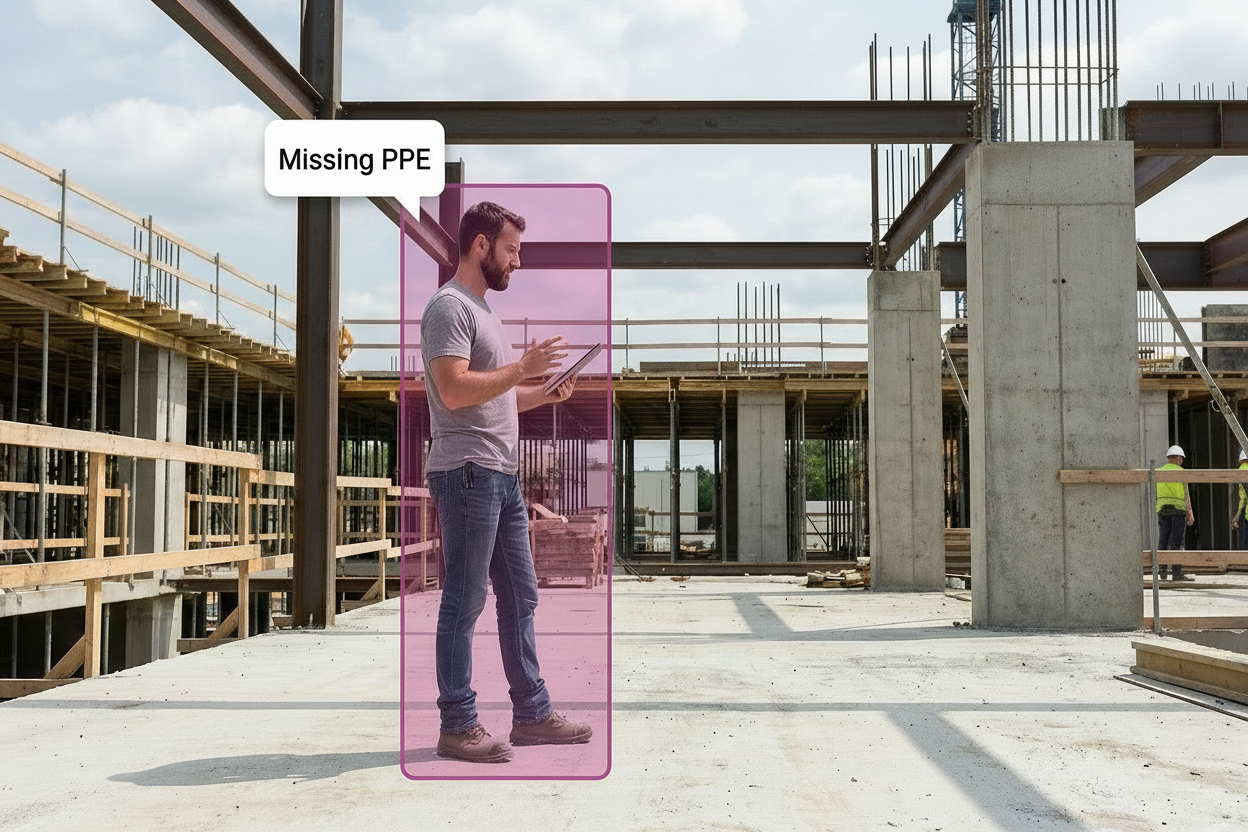
| Lack of Protective Gear | The Missing PPE AI Agent automatically detects when workers are not wearing required hard hats, vests, or harnesses, helping enforce OSHA compliance. |
| Vehicle & Pedestrian Conflicts | The Forklift Enters No-go Zones and Vehicle Enters No-go Zones AI Agents help enforce safe traffic routes, mitigating the risk of struck-by incidents. |
This real-time visibility closes the gap between what you think is happening and what is actually happening, allowing you to move from a reactive posture to earlier, data-informed action. For example, firms that implement video AI monitoring can significantly improve visibility and decision-making, leading to fewer safety incidents.
The solving dimension: using data to address safety blockers at their source
The ultimate goal is not just to see problems but to address them more effectively and reduce recurrence. Video AI provides the objective data needed to move beyond reactive firefighting and address the root causes of recurring safety blockers. By analyzing trends in alerts and incidents, you can identify systemic issues and make data-driven decisions to engineer safer work environments.
- Identify and reduce hazard patterns: A spike in "Person Enters No-go Zone" alerts in a specific area may point to issues beyond non-compliance, such as a flawed workflow, inadequate signage, or the need for a physical barrier. With a unified dashboard, you can visualize these trends across sites and over time, allowing you to pinpoint and resolve the underlying issue. This shifts safety management from assumptions toward evidence-based decisions.
- Accelerate incident investigations: When an incident does occur, the investigation process can be slow and rely on subjective witness accounts. With video AI, you can search for the event and review time-stamped footage in minutes, not hours. This allows you to understand the exact sequence of events, identify contributing factors, and implement effective responses swiftly to minimize recurrence.
- Justify safety investments with hard data: Defending innovation spend to leadership requires a clear business case. Video AI provides quantifiable metrics on safety compliance, unsafe event frequency, and behavioral trends. This data allows you to demonstrate the ROI of safety initiatives by correlating leading indicators (like increased PPE compliance) with reductions in lagging indicators (like incident rates and lost workdays).
A strategic framework for implementing video AI on your jobsite
Successful technology deployment requires a thoughtful implementation strategy that aligns with your organization's goals and culture; it is about more than the hardware and software alone. For innovation leaders, this means navigating technical integrations, managing change, and proving value quickly.
- Start with a pilot program: Instead of a full-scale rollout, begin with a pilot on a single high-risk jobsite or work area. This allows you to demonstrate ROI with limited data, learn how the system works in your environment, and build a business case for expansion. A "pilot-in-a-box" solution with plug-and-play hardware can bypass slow IT approval processes and get you operational in days.
- Integrate with your existing tech stack: To avoid tool sprawl, choose a video AI platform with an open API that can integrate with your existing systems like Procore or BIM/VDC solutions. This creates a unified data ecosystem, eases login fatigue for your teams, and ensures safety data is incorporated into your overall project management framework.
- Focus on culture and communication: Overcome field resistance by framing the technology as a tool for worker protection, not punishment. Be transparent about what is being monitored and how the data will be used. Involve workers and safety representatives in the process to build trust. When teams see the system flagging real hazards and helping minimize the likelihood of injuries, they are more likely to embrace it as a valuable AI teammate.
- Refine and scale: Use the lessons from your pilot to refine alert configurations and workflows. Once you have a proven model, you can scale the solution across other sites with confidence. A camera-agnostic platform that works with your existing cameras makes this process faster and more cost-effective.
From safety data to strategic decisions: your path forward
Shifting from a reactive to a forward-looking safety culture requires more than just new technology; it requires a new way of thinking. Video AI provides the tools to teach your teams more effectively, understand your jobsite risks in real time, and solve the recurring safety blockers that put your people and projects at risk. By turning your video data into an engine for continuous improvement, you can build a safer, more predictable, and more profitable organization.
See how Spot AI’s video AI platform can help you address safety hurdles and gain real-time visibility across your jobsites. Request a demo to experience the platform in action.
Frequently asked questions
How can AI improve safety in construction?
AI improves construction safety by providing real-time monitoring of jobsites for hazards like missing PPE or unauthorized entry into dangerous zones. It automates the detection of unsafe behaviors and conditions, allowing for rapid intervention. It also provides objective data for incident analysis and personalized safety training, helping teams spot risks earlier and respond quickly.
What are the best practices for using AI in safety management?
Best practices include starting with a pilot program to prove value, integrating the AI system with existing software like BIM or Procore, and being transparent with workers about how the technology is used. It's also critical to align AI monitoring with specific safety goals, refine alerts to avoid fatigue, and use the data to drive operational changes and coaching.
How does video analytics enhance safety compliance?
Video analytics enhances safety compliance by providing continuous, objective monitoring of company policies and OSHA regulations. For example, AI can automatically detect and log instances of missing PPE or failure to follow specific safety procedures (SOP adherence). This data provides an auditable record of compliance and helps identify areas where additional training or enforcement is needed.
How can AI be integrated into existing safety protocols?
AI can be integrated by using it to automate and enhance current processes. For instance, AI-powered alerts can be routed through existing communication channels to supervisors. Video evidence can be attached to digital incident reports in your safety management system. Data from AI can also be used to inform the topics of toolbox talks and pre-task safety briefings, making them more relevant and effective.
What should I look for in a real-time video analytics system for safety?
Look for a camera-agnostic platform that works with your existing cameras and offers plug-and-play deployment. It should feature pre-trained AI agents for specific construction hazards, like Missing PPE or No-go Zones, to ensure accuracy. The system must also integrate with your existing tech stack, like Procore, and provide clear dashboards to help you identify root causes and demonstrate ROI.
About the author
Sud Bhatija is COO and Co-founder at Spot AI, where he scales operations and GTM strategy to deliver video AI that helps operations, safety, and security teams boost productivity and reduce incidents across industries.

