






Car wash cameras: what each one should read, from the entry arch to the vacuum bays
Updated November 2026
Car wash cameras earn their keep at four moments: the entry arch, where a damage claim is settled; the tunnel, where the seconds between cars set the hourly ceiling; the pay station, where a membership is offered or missed; and the vacuum bays after close. Spot AI runs video AI on the cameras a car wash already owns, so each of those cameras can flag the event it covers instead of only storing footage. The first objection operators raise is the bay itself: car and truck wash products, rust removers and aluminum brighteners often contain hydrofluoric acid (Source: CDC), while the IP ratings on camera spec sheets are tested with fresh water under IEC 60529.
Key takeaways
- Plan car wash cameras around four moments, each with a placement, a reading and a decision: the entry arch, the tunnel, the pay station and the vacuum bays after close.
- Run throughput as a time study: cars per hour at the load point equal 3,600 divided by the average seconds between cars.
- IPX7 does not establish jet protection, and IPX9 alone does not establish IPX5 or IPX6 protection; in the bay, look for IPX6 or a dual code such as IPX6/IPX9.
- Spot AI runs on the cameras a car wash already owns, and GO Carwash reports a 54% increase in membership conversion at its pay stations.
- Vacuum bays need two rules: daytime counts checked against wash sales, and an after-close zone with an escalation path.
Which car wash camera covers which decision?
Spot AI runs AI agents on the cameras a car wash already owns, so the useful question is which event each camera should report and who acts on it. The table below maps the four moments to a placement, what to measure or review from that view, and the decision it supports:
Moment | Camera placement | What to measure or review | Decision it supports |
|---|---|---|---|
Damage claims at the entry arch | A camera on each side of the arch or prep lane, low enough to see wheels, rocker panels and mirrors, one framing the front plate, plus an exit camera | A reviewer compares the claimed panel in the entry and exit clips, confirming the vehicle by plate and time | Pay, deny or settle a claim, with the before and after clips attached |
Throughput through the tunnel | Pay lanes, the conveyor load point and the tunnel exit | Vehicle idle time at the pay station and load point, the gap between cars, stoppages inside the tunnel | Where to add an attendant, which gate or loader to fix, when to open a second lane |
Membership and plates at the pay station | Each pay lane, framing the kiosk, the driver's window and the plate | How long a car waits without staff help, whether staff are at the lane, repeat visits by plate | Who stands at the kiosk at peak, and which shifts miss the membership offer |
Vacuum bays after close | Above the vacuum row, wide enough to count cars across every bay | Cars per bay per day, and people or vehicles in the bays after closing time | Vacuum use against wash sales, and who responds to an after-hours visit |
Coverage stops where today's cameras stop; a moment with no camera on it is a gap to plan with an installer.
How do car wash cameras settle a damage claim?
Spot AI's AI-powered search pulls the entry and exit clips for a claim, so a review starts from the car's own footage rather than a scrub through a full day. What decides a claim is whether the entry clip shows the panel in question before the car reached the brushes. Placement decides that more than resolution does: a camera mounted high above the arch sees roofs and windshields, while scratches, curb rash and loose mirrors sit lower on the car.
A claim review that holds up follows five steps:
- Pull the entry clip by plate or by time, and confirm it is the claimant's car.
- Check the claimed panel in the entry clip before any equipment touched the car.
- Pull the exit clip for the same car and compare the same panel.
- Check the tunnel view for a stoppage or equipment fault during that car's pass.
- Record the decision with both clips attached, so a repeat claimant meets the same evidence.
GO Carwash used Spot AI's license plate reporting to track unique vehicle visits and link video clips to plates, which simplified its damage claim investigations (GO Carwash customer story). For how plate reads work and where they fail, see how license plate recognition works. Keep clips at least as long as the claims window in the wash's own posted policy, because a claim filed weeks later is only as good as the footage still on file.
How should a car wash measure throughput through the tunnel?
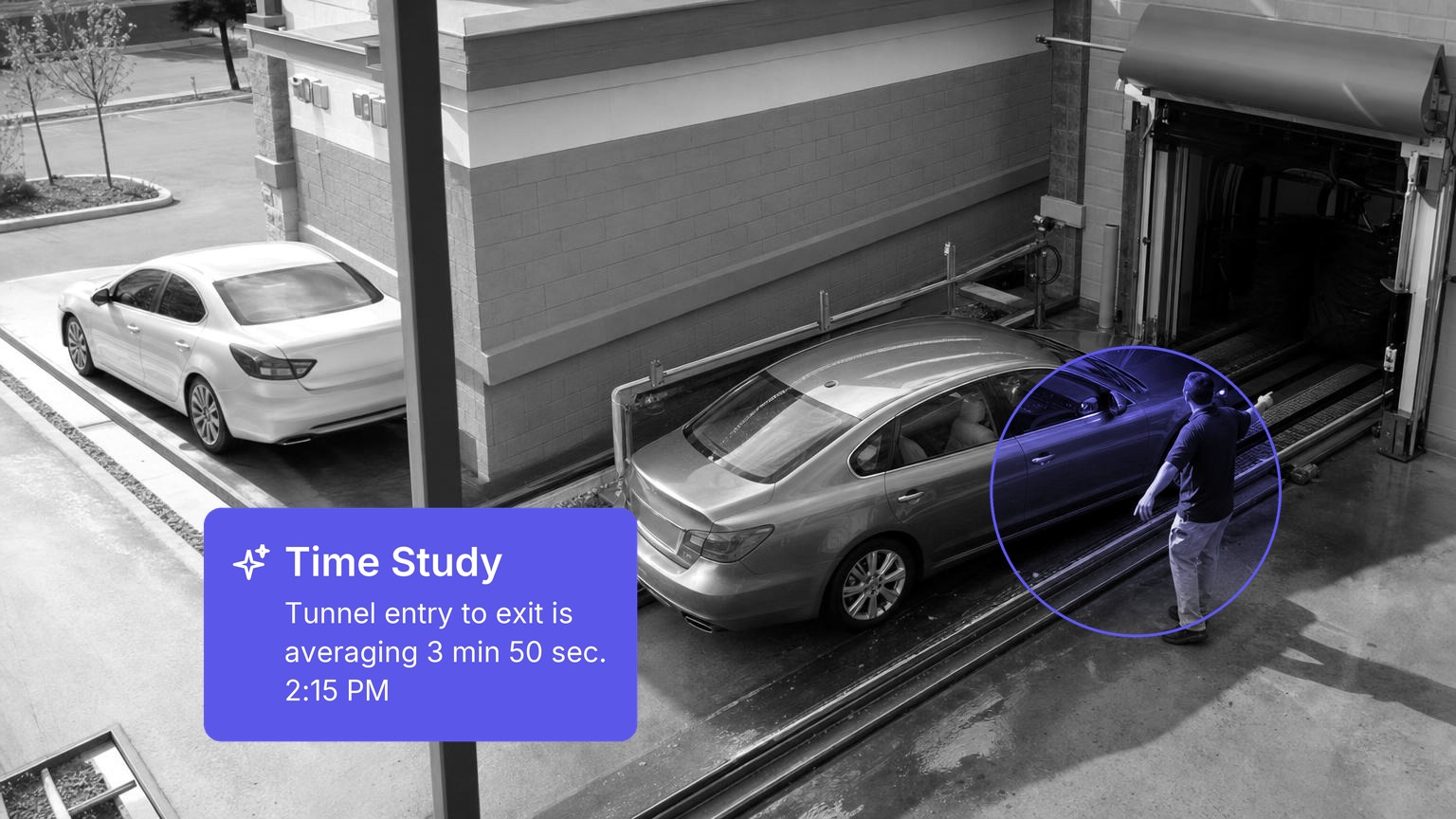
Spot AI helps car washes lift throughput by timing where cars wait at the pay lanes and the load point, which turns throughput into a time study: break each car's visit into segments, time each segment, and find the one that sets the pace. The segments that matter are the queue, the pay station, the load point and the tunnel itself.
While cars are waiting and the conveyor has room, cars per hour at the load point equal 3,600 divided by the average seconds between cars starting on the conveyor. At a 36-second gap that is 100 cars an hour; at 30 seconds it is 120. In this illustration, six seconds taken out of the average gap is worth 20 more cars in every peak hour, and nothing in an off-peak hour, which is why the study belongs on the busiest hours of the week.
Time the gap between cars, not the length of the queue. With a continuous queue, no stoppages and conveyor capacity to spare, average loading gaps of 36 and 30 seconds correspond to 100 and 120 cars an hour.
Each long segment points somewhere specific:
- Pay station. Payment failures, gate faults and non-members pulling into a member lane all show up as idle time before the gate opens.
- Load point. A long gap with no queue at the pay station points to the guide-on or to where the loader is standing.
- Inside the tunnel. A car that stops mid-tunnel is a mechanical or wash interruption, and every car behind it waits.
Glide Xpress used Spot AI's Vehicle Idle Time to see where bottlenecks started at its tunnel entrances, including vehicle spacing and pay station issues such as gate malfunctions, credit card problems and non-members entering member lanes, and to estimate how many more vehicles each location could serve per hour (Glide Xpress customer story). GO Carwash set Vehicle Idle Time alerts to catch unexpected stoppages inside the wash tunnel.
"Spot AI is game-changing stuff, for us and for the industry."
Shawn Peterson, EVP of Operations, Glide Xpress
When the same stoppage returns at more than one site, a standing method for root cause analysis across sites links each recurrence to the clip and the step that changed. The cross-industry view of these metrics is in vehicle idle time and people presence.
What should the pay station camera tell a manager about memberships?
Spot AI can flag a car waiting at the pay station without a team member nearby, which marks a moment to review for missed help and missed membership opportunities. An attendant can help a driver weigh a membership; camera presence data does not show whether an offer was made.
GO Carwash set up Spot AI's Unattended Kiosk AI Agent to see how often vehicles idled at the pay station without employee help, addressed the service gaps it found, and reports a 54% increase in membership conversion rate at its pay stations (GO Carwash customer story). The same team used people presence analytics to compare staff time at customer touchpoints with time in the site office, and used the data to adjust scheduling.
Three readings from the pay lane camera are worth a weekly review:
- Unattended dwell at the kiosk by hour, which identifies periods to review for missed assistance and membership opportunities.
- Staff presence at the lane against the queue, which shows whether the schedule matches the traffic.
- Repeat vehicle visits from plate reporting, checked separately against the wash's own membership system, because repeat visits alone do not show whether an offer was made.
Plate reads tie a visit to a clip, so decide early who can search them and how long plate records are kept. A record nobody owns tends to be kept forever.
What should the vacuum bay cameras do after close?
Spot AI can count cars in the vacuum row by day and, after close, treat the same row as a zone where a person or vehicle triggers a response, which gives one camera two jobs.
For the daytime job, GO Carwash drew virtual lines across its vacuum spots to get daily usage counts, then compared them with car wash sales over the same period. A ratio that changes on certain days or hours is a signal to investigate before changing a vacuum policy or a schedule; aggregate counts alone do not identify which visits came without a wash.
After close, the rule needs a schedule, a zone and a response:
- Arm the vacuum-bay zone from closing time, after the last staff walk.
- Alert on a person or vehicle in the zone rather than on generic motion, then test the zone in rain and blowing debris to cut nuisance notifications.
- Escalate in steps: Spot AI's AI Security Guard triggers escalating deterrents, from strobe lights and horns to context-aware talk-down audio, and delivers case-ready evidence.
- Route the alert to an on-call manager with a clear threshold for calling law enforcement.
- Review the week's after-hours alerts with the opening team.
GO Carwash used people presence monitoring after hours to step in on trespassing, vandalism and loitering in a timely way, and set a custom alert on its main control center room for unauthorized access. For the customer and employee safety side of the site, see car wash safety for customers and employees.
Which IP rating does a car wash camera need, and how do chemicals change the answer?
Spot AI runs on the cameras already mounted in the bay, so the housing and lens window, not the software, decide whether the picture survives the wash. The IP code on a spec sheet is defined in IEC 60529: the first digit covers dust, the second covers water, and the second digit is the one that matters in a wash bay. Two rules in the standard catch buyers out. A camera marked only IPX7 is not rated for water jets, and one marked only IPX9 is rated for the high-pressure, high-temperature test but not for the IPX5 or IPX6 jets, unless either carries a dual code such as IPX6/IPX7 or IPX6/IPX9. And the water tests use fresh water: the standard warns that protection may not be satisfactory where solvents are used or where high-pressure, high-temperature cleaning goes beyond the IPX9 test.
Water rating | Protected against, per IEC 60529 | Illustrative starting point, to confirm with the camera maker |
|---|---|---|
IPX5 | Water jets from any direction | Pay lanes and vacuum rows, away from the spray path |
IPX6 | Powerful water jets from any direction | Tunnel entrance and exit, prep lanes with pressure wands |
IPX7 | Temporary immersion; not jets unless dual coded | Only as IPX6/IPX7, for example on a low plate camera where water pools |
IPX9 | High-pressure, high-temperature jets; not ordinary jets or immersion unless dual coded | Close to high-pressure arches, as IPX6/IPX9 |
The first digit matters less in a wet bay, though 6 means dust-tight. Chemistry is the harder problem. Car and truck wash products, rust removers and aluminum brighteners often contain hydrofluoric acid, and in Washington State 24 of the 48 hydrofluoric acid burn cases linked to car and truck washing from 2001 to 2013 occurred in car washes (Source: CDC). Hydrofluoric acid is also used to etch glass (Source: CDC), so a glass lens window in the drift from a wheel-cleaning arch is exposed to the same chemistry as the wheels.
A lens care routine that fits a wash bay looks like this:
- Map each camera to the nearest chemical step using the safety data sheets; employers must have one in the workplace for each hazardous chemical they use (Source: OSHA).
- Mount or angle cameras out of direct spray and drift, and ask the camera maker which cleaning agents its housing and window tolerate.
- Clean lens windows on a fixed day each week with the camera maker's recommended cleaner, never with the wash's own acids or an abrasive pad.
- Check the nearest cameras for haze in the week after any chemical change.
- Look at every view once a week at peak and at night, because a fogged camera can stay online while its picture goes soft.
Steam and low sun can also cause the occasional false alert at the tunnel exit; the tuning period after installation is the time to trim those zones.
How does a car wash add video AI without replacing its cameras?
Spot AI connects to the IP cameras a car wash already owns over RTSP and ONVIF, with older analog cameras brought in through the Intelligent Video Recorder (IVR), so a rollout starts from what is mounted today. Spot AI keeps full-resolution video on site on the IVR and sends only metadata to the cloud, and most sites go live in days, without a rip-and-replace project.
A rollout across one or many locations runs in this order:
- List every camera against the four moments, and mark the moments no camera covers.
- Connect the cameras, then draw zones and schedules for each moment.
- Plan a tuning period for the first weeks, trimming zones that produce false alerts.
- Show each manager how to pull a clip by time or plate before the first claim arrives.
- Compare sites on the same readings, so the best location sets the standard for the rest.
Two practical limits apply: each site needs a stable network connection, and managers need a short training session so alerts land in a routine rather than an inbox. Spot AI shows every location in one dashboard with camera health monitoring, and its Iris interface lets a manager ask in natural language what the cameras saw. The same footage trains staff: Glide Xpress leaders pull clips on demand to coach best practices and built consistent, repeatable training programs from real footage (Glide Xpress). More operator use cases are on the car wash solutions page.
The budget has five parts, and only the first is the video AI itself:
- Software: Spot AI is sold as a per-location subscription; there is no public price list.
- Installation and network work at each site, from the wash's own installer.
- Cameras for any moment with no coverage today, bought through that installer.
- Retention long enough to cover the posted claims window.
- Staff time for the tuning period and manager training.
Start with the moment that costs the most at your busiest site, usually the pay station or the load point. Time it for two peak hours, change one thing, and time it again before adding the next moment.
Common misconceptions about car wash camera systems
Four assumptions come up often:
- More megapixels mean better evidence. Placement, sensor quality and light decide whether a scratch is visible; a high-resolution camera aimed at roofs does not settle a claim about a bumper.
- A higher IP number is always better. IPX7 on its own is not a jet rating, IPX9 on its own skips the ordinary jet tests, and every IP water test uses fresh water rather than wash chemistry.
- AI cameras run the site on their own. Spot AI's agents work as coworkers that flag events; a manager still decides on the claim, the staffing change and the after-hours response.
- Cameras are a security cost only. The same cameras time the tunnel, show who is at the pay lane and count the vacuum row.
Key terms
- Vehicle idle time: how long a car stands still in a defined spot, such as the pay station or the conveyor load point.
- Gap between cars: the seconds between one car and the next starting on the conveyor; it sets the hourly ceiling while a queue exists.
- IP code: the ingress protection rating from IEC 60529; the first digit covers dust and the second covers water.
Spot AI's job at a car wash is narrow and measurable: make the cameras already on site surface the clips for a claim, the slow segment, the unattended lane and the after-hours visit for the person who acts on each. For how teams run AI agents on the cameras they already own, drawn from retail and convenience deployments, read Spot AI's white paper, Turning Cameras Into Coworkers.
Frequently asked questions
Do car washes have cameras inside the tunnel?
Spot AI works with existing IP cameras over RTSP and ONVIF, with legacy analog cameras connected through the IVR, and a camera inside the tunnel is the one that catches a stoppage mid-wash. Not every site has one, so check each camera's compatibility and view before planning stoppage alerts.
Where should cameras go in an automatic car wash?
Spot AI gets the most from cameras placed at the four moments that drive decisions: the entry arch, the conveyor load point and tunnel, the pay lanes, and the vacuum row. Mount entry cameras low enough to see wheels, rocker panels and mirrors, and frame the plate at the pay lane or arch.
What IP rating does a car wash camera need?
Spot AI runs on the cameras already installed, so the housing rating decides how they hold up in the bay. Under IEC 60529, look for IPX6 near spray and wands, and a dual code such as IPX6/IPX9 next to high-pressure arches, because IPX7 alone is not a jet rating and IPX9 alone does not establish IPX6 protection. Confirm the choice against the wash's actual pressure, temperature and chemicals with the camera maker.
How do car wash cameras help with damage claims?
Spot AI's AI-powered search pulls the entry and exit clips for a claim, and GO Carwash used Spot AI's license plate reporting to link clips to plates for damage claim investigations. The deciding clip shows the claimed panel before the car reached the equipment, so placement matters more than resolution.
Can a car wash add video AI without replacing its cameras?
Spot AI is camera-agnostic and works with the IP cameras a business already owns over RTSP and ONVIF, with legacy analog cameras brought in through the IVR. Spot AI keeps full-resolution video on site, sends only metadata to the cloud, and most sites go live in days.
About the author
Mike Polodna, Head of Customer Success
Mike Polodna is Head of Customer Success at Spot AI.