






Managing a construction site today involves far more than just keeping the schedule on track. Site and general superintendents are the "eyes and ears" of the project, responsible for orchestrating complex activities, managing multiple trades, and ensuring every worker goes home safe. However, traditional methods of safety management—periodic spot checks, manual logs, and reactive incident reviews—are no longer sufficient. With falls remaining the leading cause of construction fatalities and new OSHA regulations intensifying the focus on proactive risk mitigation, the industry is shifting toward smarter, data-driven solutions.
Video technology has evolved from simple security recording into a powerful tool for operational visibility. By leveraging video evidence to coach operators on safety compliance, leaders can transform safety from a compliance chore into a collaborative culture. This approach does not mean watching screens all day to catch people doing wrong; it means using intelligent systems to identify hazards in real time and providing the visual feedback necessary to encourage safer behavior and minimize risk.
Key terms to know
- Video AI: A technology that uses computer vision to analyze video feeds in real time, detecting specific objects (like hard hats) or behaviors (like entering a no-go zone) without human intervention.
- Behavior-Based Safety (BBS): A forward-thinking approach that focuses on identifying and modifying unsafe behaviors through observation and feedback, rather than just enforcing rules.
- Leading Indicators: Anticipatory metrics (e.g., number of safety observations, training participation) that indicate future safety performance, as opposed to lagging indicators like injury rates.
- Total Recordable Incident Rate (TRIR): A standard metric used to calculate the number of recordable incidents per 100 full-time workers during a one-year period.
The shift from reactive enforcement to anticipatory coaching
The regulatory landscape for construction is changing rapidly. OSHA's 2025 safety standards represent a major departure from traditional compliance, emphasizing risk mitigation over enforcement. This shift places a heavy onus on superintendents to demonstrate that risks were evaluated and mitigated before work commenced. It is no longer enough to document an accident; companies must now prove they are actively managing hazards to guard against them.
Furthermore, the industry is grappling with a safety training fatigue crisis. Workers are often bombarded with generic "be careful" messages so frequently that they stop registering them. This desensitization, combined with the pressure to maintain tight schedules, creates a dangerous gap between safety protocols and actual site behavior.
To bridge this gap, successful organizations are moving away from disciplinary, after-the-fact consequences. Instead, they are adopting coaching models that use objective data to reinforce safe habits. Video evidence serves as the cornerstone of this strategy, providing the "game tape" that allows supervisors and crews to review performance objectively, identify root causes of unsafe behavior, and agree on improvement plans without the emotional defensiveness that often accompanies verbal reprimands.
Overcoming daily site supervision hurdles
Superintendents face a unique set of frustrations that make safety compliance difficult to maintain manually. Managing 10 to 20 different trades across a multi-acre site creates massive blind spots. You cannot be everywhere at once, and relying on manual site walks means safety violations—such as missing PPE or restricted area breaches—often go undetected until an inspector arrives or an injury occurs.
Video AI directly addresses these core frustrations by serving as an always-available tool for monitoring camera-covered areas. By mapping specific site obstacles to advanced video capabilities, superintendents can regain control over site safety.
Mapping site obstacles to video solutions
| Site obstacle | The superintendent's frustration | Spot AI solution |
|---|---|---|
| Reactive security | Discovering theft or safety breaches only after the damage is done. | Vehicle/Person Enters No-go Zones alerts trigger promptly, enabling timely intervention when issues arise. |
| Time-consuming review | Wasting hours scrubbing footage to find a specific event or violation. | Smart search capabilities allow you to search for "person without hard hat" or "vehicle" to find evidence in seconds. |
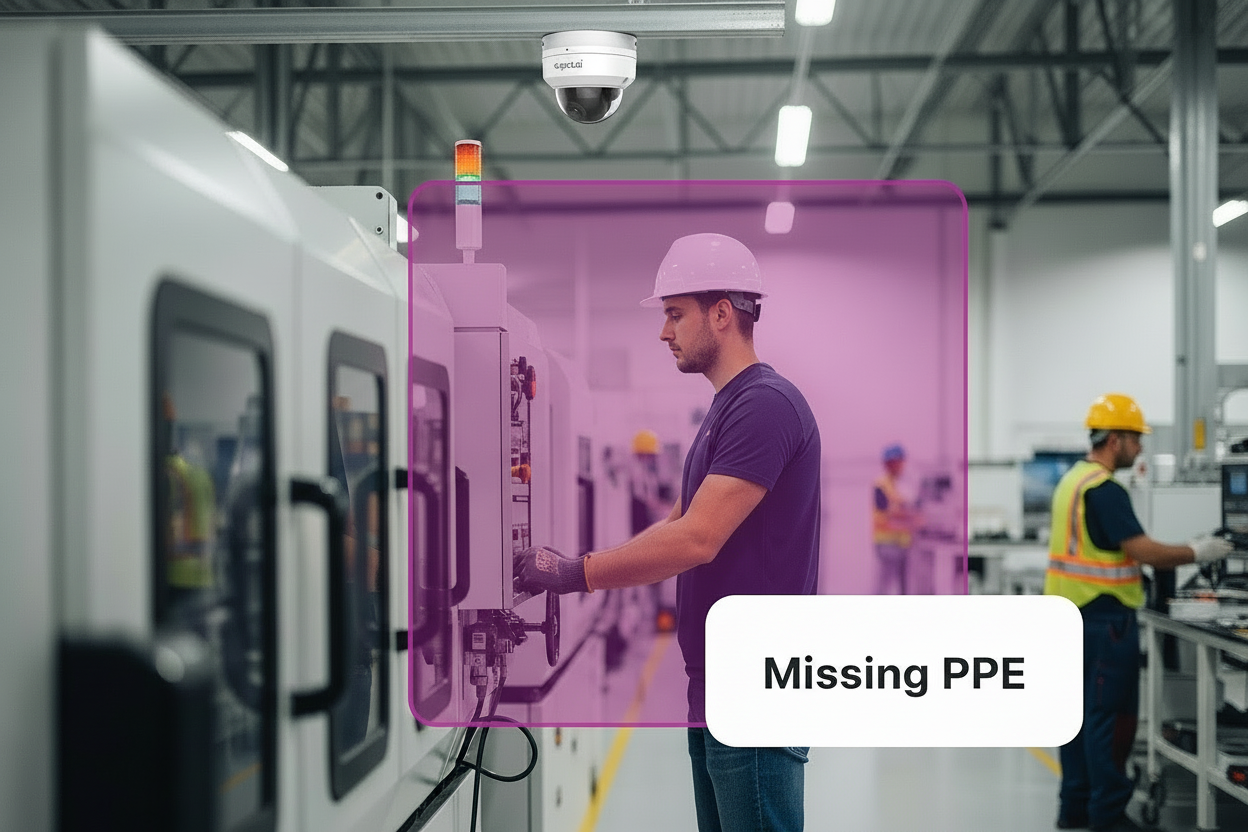
| Real-time compliance | Inability to detect PPE violations or unsafe behaviors as they happen. | Missing PPE detection identifies unsafe behaviors in real-time, allowing for on-the-spot coaching. |
| Subcontractor accountability | Difficulty proving which trade caused a delay or safety violation. | Time-stamped video evidence provides objective data to resolve disputes and enforce contract obligations. |
How video AI transforms safety compliance
The role of modern video systems has evolved from simply recording footage to actively helping interpret what is captured. By integrating with existing camera infrastructure, these platforms use AI agents to monitor for specific safety and operational parameters on an ongoing basis. This added visibility helps identify patterns that sporadic inspections might miss.
Core capabilities for safety coaching
- Automated PPE detection: The system automatically identifies workers missing required personal protective equipment, such as hard hats or high-visibility vests. This allows safety managers to quantify compliance rates by team or subcontractor and address systemic issues rather than isolated incidents.
- Restricted zone monitoring: Construction sites are dynamic, with hazards changing daily. AI agents can be configured to monitor "No-go Zones," triggering alerts if a person enters a swing radius, a trenching area, or a live electrical zone. This helps keep untrained personnel from entering dangerous areas.
- Behavioral analysis: Beyond static rules, video AI can detect dynamic risks. Templates like Running detection serve as proxies for unsafe behavior in busy environments, while Loitering detection can identify unauthorized personnel lingering in secure areas.
- Equipment interaction: Safety incidents often involve heavy machinery. Features like Forklift Enters No-go Zones help enforce traffic management plans and minimize the risk of collisions between vehicles and pedestrians.
Implementing a video-based coaching framework
Technology alone does not improve safety; it is how you use the technology that matters. The goal is to move from a "gotcha" culture to a coaching culture. Research from the Zurich and Arrowsight partnership reported that providing daily video replays of safe and dangerous behaviors increased compliance in one program (results vary by site) (Source: Business Insurance).
Steps to coach operators using video evidence
- Establish a baseline: Before coaching begins, use video data to assess the current state of the site. Identify high-risk areas and quantify the frequency of specific violations, such as PPE non-compliance or "No-go Zone" breaches.
- Adopt question-based coaching: When reviewing footage with an operator, avoid on-the-spot correction. Instead, use the Socratic method. Show the clip and ask, "What do you see here?" or "What safety rule applies to this situation?" This engages the worker's critical thinking and reduces defensiveness.
- Focus on the "why": Use the visual evidence to discuss the potential consequences of the behavior. Video makes the risk concrete. Seeing a close call on screen is far more impactful than hearing a generic warning about it.
- Reinforce positive behavior: Do not just look for violations. Use video to highlight exemplary behavior during toolbox talks. Showing a clip of a crew properly securing a load or following a lockout/tagout procedure reinforces the standard and boosts morale.
- Integrate with daily routines: Incorporate video review into daily safety meetings or toolbox talks. Reviewing actual site footage is more relevant and engaging than generic safety videos, helping to combat training fatigue.
Documenting compliance and minimizing liability
In the current regulatory environment, documentation is your best defense. OSHA inspectors increasingly expect employers to maintain organized, verifiable safety records that demonstrate continuous improvement. Video evidence provides an objective, verifiable record of your safety efforts.
Strengthening your legal position
- Proof of anticipatory measures: By logging safety alerts and documenting the subsequent coaching conversations, you create an audit trail showing that hazards were identified and addressed. This is critical for avoiding citations related to "willful" or "repeated" violations.
- Incident reconstruction: When an accident does occur, video evidence is invaluable for root cause analysis. It allows you to determine exactly what happened, distinguishing between equipment failure, unforeseeable employee misconduct, or systemic process failures.
- Subcontractor accountability: Disputes over safety violations often lead to finger-pointing. Time-stamped video evidence provides the objective data needed to hold subcontractors accountable for their safety performance, protecting the general contractor from liability.
- Insurance benefits: Demonstrating a robust, video-backed safety program may influence insurance premiums, depending on carrier and program. The Zurich pilot program reported a decrease in workers' compensation claims frequency in one context (results vary) (Source: Business Insurance).
Measuring success with safety KPIs
To justify the investment in video technology and coaching programs, superintendents must track key performance indicators (KPIs) that reflect real safety improvements. Moving beyond simple injury counts to measuring forward-looking behaviors provides a clearer picture of site safety health.
Essential metrics to track
- Decrease in Total Recordable Incident Rate (TRIR): Companies with strong safety programs can achieve a substantial drop in their TRIR, directly impacting insurance costs and bid competitiveness.
- Compliance rate improvement: Track the percentage of safe behaviors versus unsafe behaviors observed over time. For example, measure the decline in "Missing PPE" alerts week over week (Source: Business Insurance).
- Coaching frequency: Monitor how often video evidence is used for coaching interventions. The goal is to increase the frequency of proactive coaching to reinforce safe habits before they lead to incidents.
- Rework percentage: Safety and quality are often linked. Tracking the decrease in rework due to better adherence to Standard Operating Procedures (SOPs) helps quantify the operational ROI of video monitoring (Source: Spot AI Solutions).
Standardize Safety with Video Intelligence
The construction industry is at a pivotal moment where the demand for speed intersects with heightened regulatory scrutiny and a moral imperative to protect workers. For site and general superintendents, the ability to see, understand, and act on site data is no longer a luxury—it is a necessity. How to use video evidence to coach operators on safety compliance is not just about installing cameras; it is about adopting a methodology that values transparency, accountability, and continuous improvement.
By leveraging Video AI to detect hazards in real time and using that evidence to drive constructive coaching conversations, construction leaders can break the cycle of reactive firefighting. This approach mitigates risk, ensures compliance with evolving OSHA standards, and, most importantly, builds a culture where safety is a shared value rather than a checklist.
See how Spot AI’s video AI platform can help you standardize safety and operations. Request a demo to experience intelligent video coaching in action.
Frequently asked questions
What are the best practices for using video in safety training?
Best practices include using video for positive reinforcement, not just for disciplinary action; integrating real site footage into daily toolbox talks to make training relevant; and focusing on high-risk behaviors like PPE compliance and zone safety. It is also crucial to maintain transparency with workers about how video data is used to build trust.
How can video analytics improve safety compliance?
Video analytics improve compliance by providing broad, unbiased monitoring of camera-covered areas, detecting violations that manual spot checks may miss. Systems can automatically flag missing PPE, unauthorized entry into no-go zones, and unsafe behaviors, allowing for timely correction and long-term trend analysis.
How effective is video evidence in safety investigations?
Video evidence is highly effective in investigations as it provides an objective timeline of events, helping to distinguish between human error, equipment failure, and environmental factors. It can significantly speed up the investigation process and provides documentation to support OSHA compliance and insurance claims.
What hurdles do operators face in safety compliance?
Operators often face hurdles such as safety training fatigue, where repetitive messages are ignored; pressure to prioritize speed over safety; and a lack of real-time feedback on their behavior. Video coaching addresses these by providing specific, relevant feedback and catching unsafe habits before they become ingrained.
What are the key components of a successful safety coaching program?
A successful program includes clear safety baselines, coaching-focused, question-based techniques, timely feedback loops, and the integration of objective data (video evidence) to remove subjectivity. It also requires the active participation of site leadership to demonstrate that safety is a core operational value.
About the author
Sud Bhatija is COO and Co-founder at Spot AI, where he scales operations and GTM strategy to deliver video AI that helps operations, safety, and security teams boost productivity and reduce incidents across industries.

