




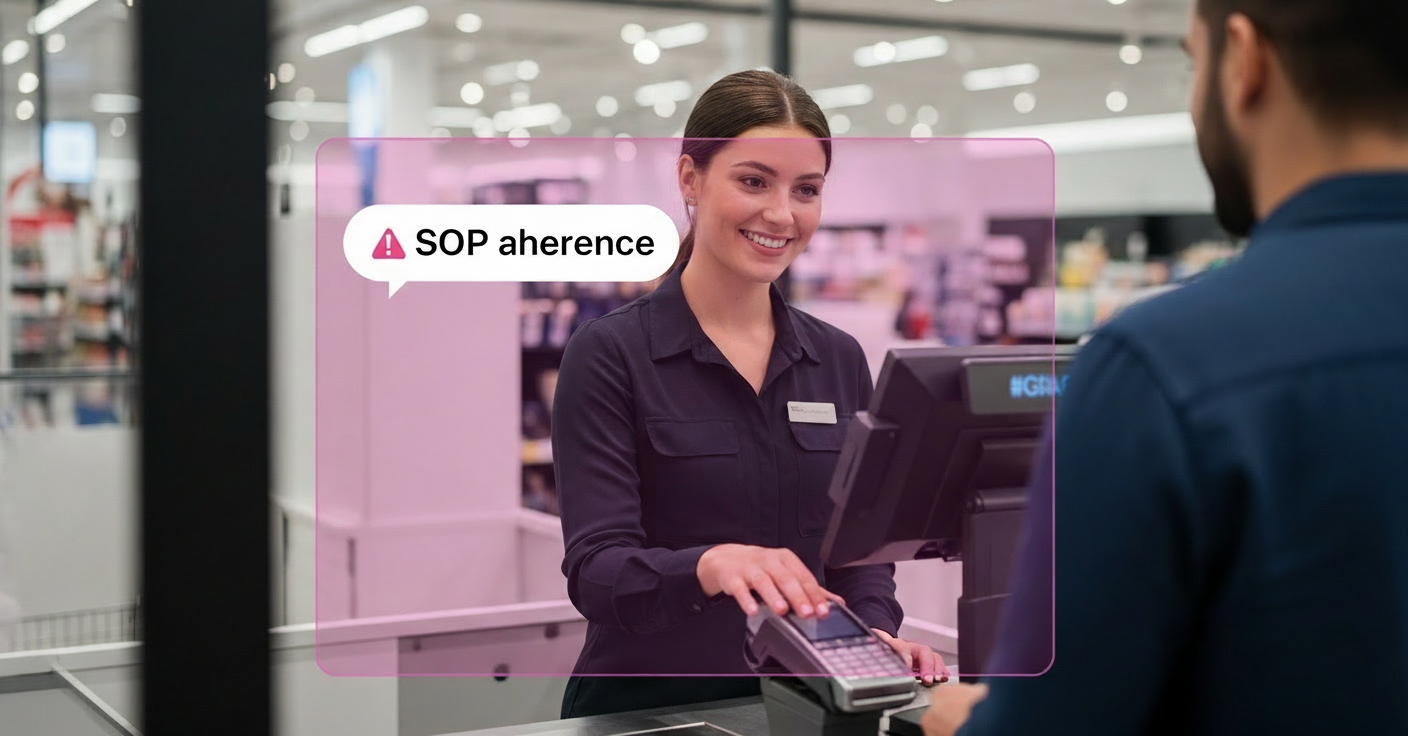


Asset protection leaders and retail operations executives face a compounding obstacle: shrinkage is rising, employee turnover is accelerating, and traditional methods of managing compliance are no longer sufficient. With retail shrink surpassing $112 billion in 2022 and organized retail crime (ORC) becoming increasingly sophisticated, the gap between documented Standard Operating Procedures (SOPs) and actual execution on the sales floor has become a critical vulnerability (Source: NRF).
For Asset Protection Directors and VPs responsible for hundreds of locations, the old model of quarterly audits and reactive video review is unsustainable. It leaves blind spots where procedural errors, safety violations, and theft occur undetected until the financial damage is done.
This guide explores how video scorecards and video AI technology help turn cameras into practical tools for associate training and SOP compliance. By using existing video infrastructure to measure performance, retailers can standardize operations, reduce risk, and demonstrate impact across the enterprise.
Understanding the basics
- Video Scorecards: a structured performance measurement framework that connects video evidence of operational activities to specific, measurable criteria. Unlike general monitoring, scorecards evaluate specific behaviors—such as cash handling steps or safe lifting techniques—against a standard to generate objective compliance data.
- SOP Adherence: the degree to which employees follow the documented Standard Operating Procedures established by the organization. In retail, this covers everything from opening/closing protocols to point-of-sale (POS) interactions and safety checks.
- Microlearning: a training approach delivering content in short, focused bursts (typically under 10 minutes). When combined with video clips of actual workplace scenarios, microlearning improves knowledge retention by approximately 50% compared to traditional methods (Source: Vouch).
- Video AI Agents: intelligent software that processes video feeds in near real time to detect specific objects, behaviors, or anomalies—such as a person entering a no-go zone or a vehicle loitering—and surface events for human review.
The compliance gap in modern retail
The disconnect between written policy and daily practice is a primary driver of operational loss. For an Asset Protection Manager, the frustration often stems from the inability to be everywhere at once. Written SOPs fail to capture the nuance of complex tasks, and traditional training methods—often consisting of reading manuals or watching generic videos—result in low retention rates.
Traditional compliance measurement relies on periodic audits. These audits create a "snapshot" bias: stores often prepare for the audit, demonstrating high compliance for one day, only to revert to non-compliant behaviors once the auditor leaves. This intermittent visibility means that procedural deviations—such as skipping steps during high-value merchandise transfers or failing to verify ID at checkout—can occur thousands of times between inspections.
Video AI helps increase ongoing visibility. Instead of a quarterly snapshot, asset protection teams get a more consistent view of SOP adherence. This shift enables leaders to move from purely reactive reviews to earlier coaching, addressing issues like "sweethearting" or unsafe stocking practices before they escalate.
How video scorecards drive associate training
Retail environments are characterized by high turnover, making rapid and effective onboarding critical. Video scorecards transform training from a passive consumption model to an active, evidence-based process.
1. Leveraging microlearning for retention
Research indicates that microlearning achieves an 80% completion rate compared to just 20% for traditional long-form courses (Source: Vouch). By using short clips of actual store associates performing tasks correctly (or incorrectly), managers can create relatable, bite-sized training modules.
- Capture best practices: use video AI to identify high-performing associates executing complex tasks consistently, such as a compliant refund transaction.
- Create visual SOPs: convert these clips into training assets. Seeing a peer perform the task is more effective than reading a text description.
- Deploy to mobile: deliver these modules to associate devices for quick review during shift briefings or downtime.
2. Evidence-based coaching
Video scorecards provide supervisors with objective data for performance reviews. Instead of subjective feedback, a manager can show an associate specific instances of their work.
- Identify skill gaps: if video analytics flag that an associate consistently misses a safety step during stocking, the manager knows exactly what to retrain.
- Remove bias: feedback is based on recorded events, not opinion, fostering a sense of fairness and accountability.
- Reinforce positives: managers can use video to recognize and reward associates who consistently adhere to SOPs, boosting morale and retention.
3. Accelerating time-to-competency
New hires need to reach productivity quickly. Video-based training has been shown to reduce onboarding time by up to 30% while improving satisfaction (Source: Vouch). By integrating video scorecards into the onboarding phase, new associates receive on-the-spot visual feedback on their adherence to safety and operational protocols, correcting errors early before they become bad habits.
Improving SOP compliance and reducing shrink
For the Asset Protection VP, the ultimate goal of video scorecards is to protect the bottom line. By integrating video AI with operational workflows, retailers can tackle the root causes of shrinkage and inefficiency.
1. Combatting self-checkout fraud
Self-checkout areas are high-risk zones for shrinkage. Common tactics include barcode swapping and "pass-arounds" (failing to scan items).
- Real-time detection: AI video analytics can correlate POS data with video feeds to detect when an item is bagged without a corresponding scan.
- Behavioral alerts: the system can flag suspicious behaviors, such as a customer handling items but not interacting with the scanner, prompting staff to review and intervene promptly.
- Investigation efficiency: rather than reviewing hours of footage, teams can search for specific transaction types or behaviors, reducing investigation time by up to 50% (Source: Security 101).
2. Optimizing store operations
Operational efficiency directly impacts profitability. Video scorecards help measure and improve the execution of daily tasks.
- Queue management: monitor checkout lines to ensure staffing levels match customer demand, reducing walk-offs and improving experience.
- Cleanliness and brand standards: help review that aisles are clear and that displays match planograms by surfacing relevant video for periodic checks.
- Opening/closing procedures: verify that staff are following security protocols during high-risk opening and closing times, such as two-person rules for cash handling.
3. Enhancing safety and OSHA compliance
Safety incidents lead to costly claims and workforce disruption. Video AI helps teams monitor for safety-related events more consistently.
- Blocked exits and fire safety: detect objects blocking emergency exits or fire extinguishers and alert management to clear them quickly.
- PPE detection: help flag when associates in stockrooms or loading docks may not be wearing required high-visibility vests or safety gear.
- Spills and obstacles: detect spills or items left in aisles that could create hazards, allowing teams to address them quickly.
Comparing video analytics platforms
| Feature | Spot AI | Legacy Monitoring Systems | Generic Cloud VMS |
|---|---|---|---|
| Deployment Speed | Minutes (Plug-and-play with existing cameras) | Weeks (Requires complex cabling/servers) | Days (May require specific camera brands) |
| Camera Compatibility | Camera-Agnostic (Works with any IP/analog camera) | Proprietary (Vendor lock-in) | Limited (Often requires specific brands) |
| AI Capabilities | Edge + Cloud (Low bandwidth, real-time processing) | None or Basic Motion | Cloud-only (High bandwidth usage) |
| Search functionality | Google-like Search (By keyword, color, object) | Manual Scrubbing (Time-consuming) | Basic Event Search |
| User Limit | Unlimited Users (Access for as many team members as you need) | Per-seat licensing | Per-user fees |
Spot AI stands out by allowing retailers to use their existing camera infrastructure. Rather than a "rip and replace" project, Spot AI’s Intelligent Video Recorder connects to current cameras, quickly adding AI capabilities. This approach helps minimize disruption and capital expenditure, allowing more budget to go toward operational improvements.
Implementation best practices
- Start with a pilot: select a small number of high-risk or high-volume locations to test the system. This allows you to refine the metrics and workflows before a full rollout.
- Define clear KPIs: focus on metrics that drive business value, such as "reduction in self-checkout void transactions" or "improvement in back-room safety compliance." Avoid measuring everything at once.
- Engage the frontline: communicate clearly that the system is a tool for safety and improvement, not just passive monitoring. Show associates how video evidence protects them from false claims and highlights their good work.
- Integrate with existing systems: ensure your video platform connects with POS and exception-based reporting tools. This unified view is essential for identifying complex fraud patterns.
- Establish routine reviews: make video scorecard review a standard part of weekly management meetings. Consistent attention to the data drives sustained behavioral change.
Measuring the impact
- Lowering shrink: retailers implementing video AI report that shrink can be lowered by up to 30% in high-risk stores within the first year (Source: Security 101).
- Investigation speed: AI-powered search can cut investigation times from hours to minutes, allowing AP teams to resolve more cases and recover more assets (Source: Security 101).
- Training efficiency: video-based microlearning can reduce training-related time away from the sales floor by 40% (Source: Vouch).
- Safety improvements: earlier identification of potential issues contributes to safer environments and may support safety initiatives.
Closing the Gap Between SOPs and Execution
For retail Asset Protection leaders, the pressure to do more with less is constant. Video scorecards offer a path to operational excellence that scales across hundreds of locations without adding headcount. By turning video data into actionable insights for training and compliance, organizations can close the gap between SOPs and execution.
The transition from reactive video review to insight-driven performance management improves day-to-day operations. It supports better training for associates, provides managers with objective data, and gives executives clearer visibility into performance.
Want to see Spot AI video scorecards in action? Request a demo to explore how video AI can help your team improve compliance and training outcomes.
Frequently asked questions
How do video scorecards improve retail training?
Video scorecards improve training by providing visual, objective evidence of performance. Managers can use clips of actual associate interactions to demonstrate correct procedures (best practices) or highlight areas for improvement. This "game film" approach makes coaching more concrete and relatable than abstract policy discussions.
What are the best practices for using video in training?
Best practices include keeping training modules short (microlearning), using footage of actual employees (peer modeling), providing timely feedback while the event is fresh, and focusing on positive reinforcement alongside corrective coaching. It is also crucial to ensure transparency about how video data is used to build trust.
How do you measure SOP compliance effectively?
Effective measurement involves defining specific, observable behaviors that constitute compliance (e.g., "Associate checks ID for age-restricted purchase"). Video AI can then track these specific events over time, generating a percentage score of adherence. This data should be reviewed regularly via dashboards to track trends by store, shift, or region.
Can video analytics reduce shrinkage in retail?
Yes, significantly. Video analytics help lower shrinkage by detecting theft precursors (like loitering or concealment gestures) in real time, flagging point-of-sale irregularities (like non-scans), and providing the rapid evidence needed to prosecute organized retail crime. The visible presence of intelligent monitoring also acts as a deterrent.
Is Spot AI compatible with my existing security cameras?
Yes. Spot AI is designed to be camera-agnostic. It connects to your existing IP or analog cameras via the Intelligent Video Recorder (IVR), quickly adding AI capabilities and cloud accessibility to your current hardware infrastructure.
About the author
Sud Bhatija is COO and Co-founder at Spot AI, where he scales operations and GTM strategy to deliver video AI that helps operations, safety, and security teams boost productivity and reduce incidents across industries.

