




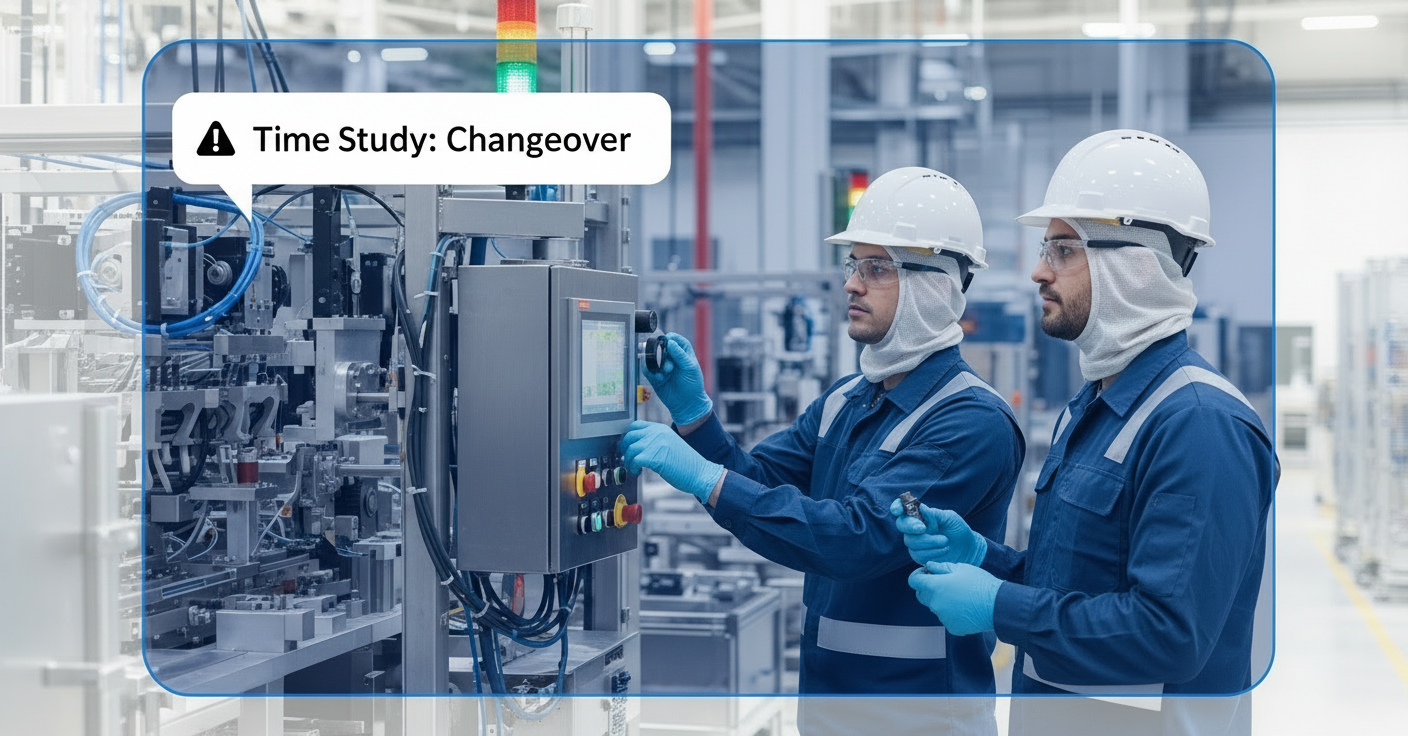


In manufacturing, every minute of downtime is a minute of lost value. For professionals focused on driving operational excellence, changeover processes—the transition from making one product to the next—are a major source of this lost capacity. Long changeovers create production bottlenecks, inflate inventory costs, and limit the flexibility needed to respond to market demands. While traditional time studies and manual observation have been the go-to methods for analysis, they are often slow, subjective, and fail to capture the full picture.
This is where video AI transforms the landscape of continuous improvement. By turning existing cameras into intelligent teammates, video AI platforms provide an objective, data-rich view of every changeover. This allows organizations to move beyond guesswork and conduct precise time studies that uncover hidden inefficiencies, validate improvements, and systematically eliminate the bottlenecks that hinder productivity.
Understanding the fundamentals of changeover optimization
Before diving into solutions, it is important to clarify the core concepts that underpin any successful changeover improvement initiative. These terms provide the context for how video AI drives measurable results:
- Changeover: This is the entire process of switching a production line or machine from one product to another. It includes all activities from the last good piece of the previous run to the first good piece of the next run. Every minute spent in changeover is a minute the equipment is not producing value.
- Bottleneck: A bottleneck is any point in a process that limits the overall throughput of the entire system. In manufacturing, changeovers frequently become bottlenecks, as equipment downtime, material delays, and human factors combine to create considerable idle time that impacts the entire production schedule.
- Time Study: A time study is a structured method for observing and measuring the time required to perform a specific task or series of tasks. The goal is to break down a process into its fundamental elements, measure the duration of each, and identify opportunities to eliminate wasted time and effort.
- Single-Minute Exchange of Dies (SMED): This is a lean manufacturing methodology for dramatically reducing the time it takes to complete a changeover. The core principle is to convert as many setup steps as possible to "external" activities—tasks that can be done while the machine is still running—and to simplify and streamline the remaining "internal" steps that must be done while the machine is stopped.
The persistent challenges of manual changeover analysis
For leaders tasked with continuous improvement, the goal is always to move from a reactive culture of firefighting to a proactive one of optimization. However, traditional methods for analyzing changeovers often reinforce a reactive cycle, creating several core frustrations.
- Slow and inefficient improvement cycles: Root cause analysis and improvement validation can take weeks or months. This is because gathering sufficient evidence often relies on manual observation, which provides only snapshots of the process. Critical events that cause delays may occur infrequently or between observation periods, making them difficult to capture and diagnose.
- Hidden process waste goes undetected: Minor inefficiencies, like searching for tools, unnecessary motion, or brief waiting periods, are often invisible during periodic Gemba walks. These small delays accumulate over time, leading to major productivity losses that are never formally logged or addressed.
- Difficulty quantifying improvement opportunities: Without automated data collection, it is a struggle to accurately measure baseline performance and the subsequent impact of improvements. This makes it tough to build a business case for new initiatives or demonstrate return on investment to leadership.
- Inability to verify SOP adherence at scale: Ensuring consistent adherence to standard operating procedures (SOPs) across all shifts and facilities is a major hurdle. Without a way to monitor processes continuously, variability creeps in, leading to inconsistent changeover times and quality issues.
How video AI delivers objective data for time studies
Video analytics technology addresses the limitations of manual time studies by providing a continuous, objective, and searchable record of every changeover. Instead of relying on an analyst with a stopwatch, you can leverage your existing camera infrastructure to automatically capture and analyze every step of the process.
Spot AI’s Video AI platform transforms your cameras into AI teammates that assist with time studies and changeover optimization. The platform’s AI analytics templates for Time Studies and Changeover Optimization are designed to capture granular data without disrupting production. Here is how it works:
- Automated data capture: The system continuously monitors production lines, automatically recording every changeover from start to finish. This replaces time-consuming manual Gemba walks and captures every process variation, 24/7.
- Granular time stamping: Every action within the changeover is time-stamped, allowing teams to precisely measure the duration of each step. This objective data eliminates the guesswork and subjectivity inherent in manual observation.
- Searchable video evidence: All recorded footage is indexed and becomes searchable. If a changeover takes longer than expected, managers can use natural language to search for specific events—like "forklift absent" or "technician arrives at machine"—to instantly find the root cause without scrubbing through hours of video. This accelerates improvement cycles from weeks to minutes.
- SOP adherence monitoring: By training the AI on a "gold standard" changeover, the system can automatically detect deviations from the established SOP. This ensures procedures are followed consistently across all shifts and helps identify where additional coaching may be needed.
A data-driven approach to cutting changeover time with video AI
By integrating video AI into the SMED framework, organizations can accelerate and enhance each stage of the process. This creates a data-driven cycle of improvement that delivers reliable and sustainable results.
| Methodology Stage | Traditional Approach | Video AI-Enhanced Approach |
|---|---|---|
| 1. Observation & Baseline | An analyst manually observes and times several changeovers with a stopwatch. | Video AI automatically records every changeover, creating a rich dataset of objective, time-stamped video. This provides a more accurate and comprehensive baseline without observer bias. |
| 2. Separate Internal & External | The analyst categorizes tasks based on notes and memory of the observed process. | Teams review video footage to definitively identify which tasks were performed while the machine was stopped versus running. Visual evidence makes the distinction clear and indisputable. |
| 3. Convert to External | Improvement ideas are brainstormed based on the analyst's report and suggestions. | Video analysis reveals opportunities that are otherwise missed, such as pre-staging tools or materials. The system can then be used to visually confirm that all external tasks are complete before the machine is stopped. |
| 4. Streamline & Standardize | New SOPs are written and distributed. Compliance is checked through periodic audits. | A "gold standard" video of the new process becomes the training benchmark. The AI continuously monitors for deviations, providing real-time alerts and data for scorecards to ensure the new SOP is adopted and sustained. |
Using video analysis to find and fix production bottlenecks
Changeover delays are a primary cause of production bottlenecks, but they are not the only one. The true constraint might be hiding upstream in your material flow or in a series of micro-stops that go unrecorded. Video AI makes these hidden bottlenecks visible.
- Uncovering upstream material flow issues: A production line can only run as fast as its material supply. When materials arrive late, in the wrong sequence, or are poorly staged, the line starves and valuable capacity is lost (Source: The Powers Company). Spot AI’s Forklift Absent and Vehicle Absent templates can automatically flag when a workstation is waiting for materials, helping teams identify and resolve these upstream constraints.
- Identifying micro-stops and idling: Brief stoppages, often lasting only a few minutes, can occur frequently throughout a shift. These micro-stops accumulate into substantial downtime that may not appear in traditional logs. Video AI captures every stoppage, no matter how short, providing a true measure of equipment availability and helping teams perform root cause analysis on these recurring interruptions.
- Accelerating root cause analysis: When a bottleneck is identified, traditional investigation methods can be slow. With a video AI platform, teams can instantly pull up footage of the exact moments leading to a stoppage. This searchable visual evidence allows investigators to use techniques like the Five Whys or fishbone diagrams with concrete data, pinpointing the fundamental cause of a problem instead of just treating the symptoms (Source: iSixSigma).
Move your operations forward with data-driven insights
Lingering changeover bottlenecks and hidden process waste are now avoidable, not inevitable. By leveraging video AI for time studies, you can equip your teams with the objective data needed to drive meaningful and lasting improvements in manufacturing efficiency. The ability to see, measure, and analyze every step of your changeover process empowers you to minimize downtime, increase throughput, and build a more flexible and responsive operation.
Curious how Spot AI’s Video AI platform can help you pinpoint and resolve changeover bottlenecks? Book a demo to see the platform in action and explore its capabilities for your operations.
Frequently Asked Questions
What are the best practices for optimizing changeover time?
Best practices are rooted in the SMED methodology, which involves separating setup activities into internal (machine stopped) and external (machine running) tasks. The goal is to convert as many internal tasks to external as possible and then streamline all remaining steps. This includes pre-staging tools and materials, using quick-release fasteners, and creating standardized work procedures.
How can video analytics improve manufacturing efficiency?
Video analytics improves efficiency by providing real-time, objective data on processes like changeovers and cycle times. It helps identify bottlenecks, monitor SOP adherence, and accelerate root cause analysis by making video footage searchable. This allows teams to make data-driven decisions to minimize downtime and improve Overall Equipment Effectiveness (OEE).
What tools are available for bottleneck analysis?
Tools for bottleneck analysis range from manual methods like Gemba walks and value stream mapping to more advanced technological solutions. These include Manufacturing Execution Systems (MES), discrete event simulation software, and video AI platforms that can monitor production lines in real time to detect stoppages and slowdowns as they happen.
What is the role of AI in optimizing manufacturing processes?
AI plays a key role in optimizing manufacturing by analyzing vast amounts of data to identify patterns and anomalies that are invisible to humans. In process optimization, AI-powered computer vision can monitor production for quality defects, track SOP compliance, and conduct time studies to expose inefficiencies in workflows like changeovers.
How can continuous improvement methodologies be applied in manufacturing?
Continuous improvement frameworks like Lean Six Sigma and its DMAIC (Define, Measure, Analyze, Improve, Control) cycle provide a structured approach. In manufacturing, this involves defining a problem like long changeover times, measuring baseline performance, analyzing data to find root causes, implementing improvements, and using control systems to sustain the gains.
What is AI-assisted coaching for changeovers?
AI-assisted coaching uses a video AI platform to compare every changeover against a 'gold standard' procedure. When the AI flags a deviation, it provides managers with a timestamped video clip of that specific moment. This allows for precise, visual feedback to reinforce correct procedures and improve consistency across all shifts, turning coaching into a continuous, data-backed process.
About the author
Sud Bhatija is COO and Co-founder at Spot AI, where he scales operations and GTM strategy to deliver video AI that helps operations, safety, and security teams boost productivity and reduce incidents across industries.

