






How to run a 60-day video AI pilot across stores or sites
A 60-day video AI pilot has one job for a multi-site operator: show whether a result at three sites will hold at 20 sites and then at 100. Spot AI runs pilots on the cameras each site already has, so week one goes to configuration, not camera installation, and five full weeks remain for measurement. The value has to be defined before anything runs: Gartner predicts over 40% of agentic AI projects will be canceled by the end of 2027 because of escalating costs, unclear business value or inadequate risk controls (Source: Gartner). This plan fixes the sites, the baseline, the calendar, the criteria and the math before day one.
Key takeaways
- Spot AI pilots run on the cameras each site already has, so the 60 days split into one week of setup, two weeks of tuning and five weeks of measurement.
- Pilot three sites (the highest-loss store, a representative store, one hard outdoor site) and keep two matched control sites unchanged.
- The baseline comes from your own incident log, because most retailers report fewer than half of their store-related theft incidents to police.
- Go or no-go criteria are written at kickoff and scored on days 57 to 60, with LP, IT, operations and finance each signing.
- Spot AI's Agents Reporting breaks detections down by agent, camera and location, so the ROI formula runs on the pilot's own numbers.
The 60-day calendar at a glance
Spot AI's pilot calendar gives every activity a fixed week, so nobody renegotiates the measurement window once numbers start arriving.
When | Phase | Output |
|---|---|---|
Two weeks before day one | Pick sites and controls, pull the baseline, write the criteria | A signed kickoff document |
Days 1 to 7 | Spot AI set up on the existing cameras | Three sites live |
Days 8 to 21 | Tuning, deterrence off | A frozen configuration |
Days 22 to 56 | Measurement against baseline and controls | Five weekly scorecards |
Days 57 to 60 | Go or no-go meeting and sign-off | Go, extend or stop |
Step 1: Choose three pilot sites and two control sites
Spot AI's pilot plan uses three pilot sites because each one answers a different question the rollout will face later.
Pilot site | What it proves | The trap |
|---|---|---|
The highest-loss store | Detection and response value, with incidents enough to measure | A store picked after its worst quarter often improves anyway (regression to the mean) |
A representative store | That the result transfers to a typical site | Picking the best-run store, whose manager would succeed with any tool |
One hard outdoor site | That detection holds in a lot, yard, dock or forecourt after hours | Camera angles installed for recording, never for analytics |
Add two control sites matched to the pilot sites on format, region and trading hours, and change nothing at them. Background trends move whole estates: in NRF's 2026 study, shoplifting incidents fell 12.4% on average between 2024 and 2025 (Source: National Retail Federation). A pilot compared only with last year can take credit for a drop that happened everywhere.
Then screen every candidate:
- No remodel, closure or manager change in the next 60 days, since any of them breaks the comparison.
- A manager who will classify alerts, because pilot data depends on it.
- A network uplink IT has already measured, or the pilot ends up measuring connectivity.
If the buying committee has not yet agreed what to evaluate, the buyer's checklist for loss prevention technology covers the criteria. This plan picks up where the checklist ends.
Step 2: Capture the baseline before day one
Spot AI produces numbers from the first week, so the before-numbers must exist before the first stream connects. Pull eight to twelve weeks of history for all five sites, plus the same weeks last year.
Baseline metric | How to capture it | Owner |
|---|---|---|
Incidents per site per week, by type | The internal incident or case log | LP |
Minutes to find footage per investigation | A stopwatch on ten recent investigations | Investigators |
Minutes from event to first response | Alarm logs and case timestamps | Operations |
After-hours alarm or guard callouts per week | Alarm company and guard reports | Facilities |
Cameras online, recording and well aimed | A walk-through plus the current recorder's status page | IT |
Police reports undercount. In the same NRF study, 63% of retailers said they report fewer than half of their store-related theft incidents to law enforcement (Source: National Retail Federation). Only the internal log holds the incidents a pilot is meant to change.
The pitfall. Making shrink a go or no-go metric. Inventory cycles rarely fit inside 60 days, so audited shrink belongs in a six-month follow-up.
Step 3: Set up on the cameras already installed in week one
Spot AI connects to the IP cameras each pilot site already has over ONVIF or RTSP and brings legacy analog cameras in through its Intelligent Video Recorder (IVR), which keeps full-resolution video in the building and sends only metadata across the network. One week covers three sites in this order:
- Day 1, inventory the streams. Confirm each stream opens and note angles that miss a zone, using the checks in our guide to adding AI to a camera network you already own.
- Day 2, place the IVR with IT. Agree the network segment, the measured upload and who holds admin access.
- Day 3, draw zones and armed hours. The lot after close, the stockroom door during trading.
- Day 4, turn on three agents per site at most. Match them to the loss pattern, such as loitering after close outdoors or unattended checkout inside.
- Day 5, route the alerts. Name who receives each alert type by email, text, Slack or Teams, plus one backup per site.
- Day 6, add users. Each store manager sees their own site; the LP lead sees all three.
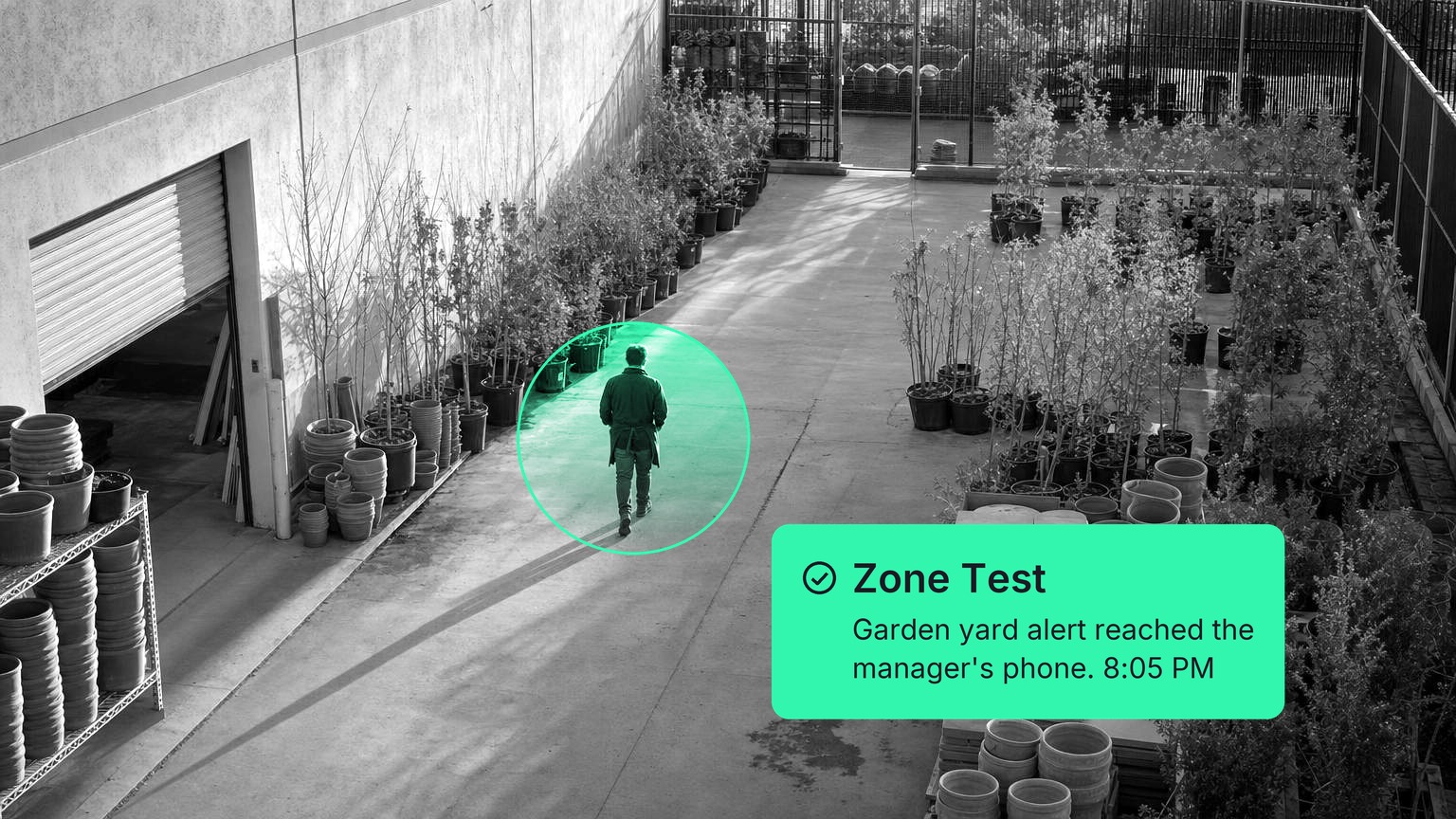
- Day 7, walk the zones. A staff member crosses each zone inside its armed hours to confirm the alert fires and reaches the right phone.
Step 4: Tune in weeks two and three, then freeze
Spot AI keeps a pilot's deterrence switched off during the tuning weeks, so strobes, horns and talkdown go live only once the alert volume is trustworthy. Days 8 to 21 shape what fires:
- Classify every alert as acted on, correct but needing no action, or wrong. The share of wrong alerts is what tuning exists to move.
- Change one setting at a time, logging date, old value, new value and reason.
- Build what the catalog lacks. Iris, Spot AI's custom-detection builder, turns a plain-language description into a detection in about eight minutes, for problems like a yard gate left open after close.
- Count auto-resolution from the start. One Spot AI retail pilot auto-resolved 40 of 54 detections in a single week: one customer over seven days, not a benchmark.
- Freeze on day 21. Switch on the deterrence you plan to evaluate, then change nothing until day 56.
The pitfall. Tuning inside the measurement window, which means weeks four to eight measure your tuning instead of the platform.
Step 5: Measure weeks four to eight against the baseline and the controls
Spot AI's Agents Reporting turns detections into trends by agent, camera and location across days and weeks, which is where the weekly scorecard comes from. The comparison that decides the pilot is control-adjusted:
Control-adjusted change = (pilot after ÷ pilot before - 1) - (control after ÷ control before - 1)
Illustrative numbers: pilot sites fall from 10 to 7 targeted incidents a week (30% lower) and control sites from 10 to 9 (10% lower), a control-adjusted change of 20 points. The other 10 belong to the market.
Keep the weekly review to 30 minutes:
- Read the baseline metrics, pilot and control side by side.
- Watch the week's three most consequential incidents on video, then log each one's detection source, response minutes, outcome and investigation minutes.
- Note anything outside the pilot that moved the numbers, such as a staffing gap or a local event.
The metrics a chain's executives review each week make a sound template for the page.
Step 6: Score the criteria and hold the go or no-go meeting
Spot AI pilots end in a scheduled decision rather than an open-ended extension, so these criteria are signed at kickoff and scored on days 57 to 60. The thresholds are examples to edit, not benchmarks.
Criterion | Example go threshold | Evidence |
|---|---|---|
Alert quality | 80% or more of alerts acted on or correct | The classification log |
Investigation time | Median minutes to find footage at least halved | A stopwatch sample of ten investigations |
Response time | Median minutes to first response below baseline at every pilot site | Case timestamps |
Incidents | A control-adjusted drop in the targeted types | Five weekly scorecards |
Workload | No more than five alerts per site manager per day | The routing log |
IT and security | Review passed, upload within the agreed budget | IT's written findings |
Give the meeting an hour: the scorecard, three incidents chosen by store managers rather than the vendor, IT's findings, the ROI formula, then one of three outcomes: go, extend 30 days against one named gap, or stop.
To run this calendar on your own estate, request a pilot from Spot AI with the site list and baseline drafted. The pilot runs on the cameras those sites already have.
Calculate ROI as a formula, with every input named
Spot AI's reporting produces the pilot's measured inputs and finance sets the prices, so the ROI stays a formula anyone can rerun rather than a number from a vendor deck. Four lines cover most multi-site pilots:
- Annual value per site = (investigation hours saved per month × 12 × loaded hourly cost) + (incidents avoided per year × average cost per incident) + (guard hours reallocated per year × hourly cost)
- Annual net value = (annual value per site × number of sites) - annual platform cost - annual internal cost
- ROI = annual net value ÷ (annual platform cost + annual internal cost)
- Payback in months = one-time rollout cost ÷ (annual net value ÷ 12)
Input | Example value | Where the real number comes from |
|---|---|---|
Investigation hours saved per site per month | 6 (illustrative) | The Step 2 stopwatch sample |
Loaded hourly cost of an investigator | $45 (illustrative) | HR: salary plus benefits |
Incidents avoided per site per year | 26 (illustrative) | The Step 5 scorecards |
Average cost per incident | $1,200 (illustrative) | Claims, replacement and repair records |
Guard hours reallocated per year | 1,040 at the outdoor site (illustrative) | The guard contract and schedules |
Hourly cost of a guard | About $18 before benefits and contract markup | The median annual wage for security guards was $38,020 in May 2025 (Source: Bureau of Labor Statistics) |
Platform and internal cost | Left as variables | Your quote and your team's hours; this plan prices no vendor |
Lifetime cost lines are broken out in our guide to video security cost and ROI.
Solve the formula for the break-even platform cost per site before any quote arrives, and write it into the kickoff document. Finance then judges every quote against a number the pilot produced, not against a figure from a vendor deck.
Roll out from three sites to 20, then 100
Spot AI deploys site by site on the cameras already in place, so the pace of a rollout is set by the site template and the people who run it. YMCA of Greater Richmond deployed Spot AI across 17 locations in 2 weeks.
Phase | Sites | What gets standardized | Gate to the next phase |
|---|---|---|---|
Pilot | 3, plus 2 controls | Criteria, baseline method, weekly scorecard | Four signatures on days 57 to 60 |
Wave one | 20 | The site template: zones, camera names, agents, armed hours, alert routes by region | Two weeks of stable alert volume at every site, template unchanged |
Wave two | 100 | The onboarding checklist, roles by region, the quarterly audit | Weekly scorecards rolling up by district |
Wave one takes the next highest-loss sites plus a spread of formats, so the template meets its exceptions while the team is small, and the pilot's week one becomes the onboarding checklist. The operating model for that stage is set out in managing cameras across 50 or more locations.
Sign-off across LP, IT, operations and finance
Spot AI pilots close with four signatures because each function can stop a rollout for a different reason, and a pilot that skips one meets the objection at site 20.
Function | Evidence it signs against | The usual blocker |
|---|---|---|
LP or asset protection | Weekly scorecards and three incidents on video | One dramatic save standing in for the trend |
IT and security | Measured upload per site, single sign-on, Spot AI's SOC 2 and NDAA documentation, and a data flow showing the IVR keeps video on site | Full-resolution video leaving every site |
Operations | Alerts per manager per day, training time, adoption | Alerts landing on people with no time to act |
Finance | The ROI formula with pilot numbers and a rollout cost schedule | Inputs nobody can trace to a source |
If IT is still weighing cloud-only, hybrid and on-premises designs, our comparison of cloud-based security cameras for business settles it before wave one.
Send each function its row of the sign-off table at kickoff, not at the decision meeting. Every signer then knows which evidence the pilot owes them, and days 57 to 60 confirm what was agreed before day one.
Key terms
- Control site. A site matched to a pilot site on format, region and hours where nothing changes, so a market-wide trend can be subtracted.
- Control-adjusted change. The change at the pilot sites minus the change at the control sites over the same weeks.
- IVR. Spot AI's Intelligent Video Recorder, which runs detections on site and keeps full-resolution video in the building while only metadata crosses the network.
A Fortune 50 consumer goods company took touch-tracking on its packaging lines from one plant to a five-week template and a 40-site first-year plan. Its automation lead set the accuracy bar where a go or no-go meeting should, against the manual method rather than perfection:
"Even at 90% accuracy, Spot AI's vision beats someone standing there making notes."
Rohit, Corporate Automation Lead, Fortune 50 CPG (~$84B revenue)
Spot AI's 60-day pilot ends in a signed decision built on five weeks of control-adjusted numbers from the cameras each site already has. With criteria and baseline drafted, the next move is the site shortlist: request a pilot and bring it, or first compare the AI video analytics companies worth piloting.
Frequently asked questions
How long should a video AI pilot run
Spot AI's pilot plan runs 60 days: one week of setup on the cameras already installed, two weeks of tuning and five weeks of measurement. Shorter pilots end before tuning settles, so the numbers describe configuration rather than performance.
How many sites should a multi-site video AI pilot include
Spot AI's pilot plan uses three pilot sites (the highest-loss store, a representative store and one hard outdoor site) and two control sites. The controls match on format, region and hours and change nothing, so a market-wide trend is not mistaken for a result.
Do you need new cameras to pilot video AI
Spot AI runs pilots on the cameras each site already has, connecting IP cameras over ONVIF or RTSP and legacy analog cameras through its Intelligent Video Recorder. Walk each site first, because an angle installed for recording may miss the zone a detection needs.
How do you calculate the ROI of a video AI pilot
Spot AI's pilot plan treats ROI as a formula filled with the pilot's own numbers: investigation hours saved, control-adjusted incidents avoided and guard hours reallocated, each priced by finance. Subtract platform and internal costs, then divide by those costs.
Who should sign off on a video AI pilot
Spot AI pilots close with four signatures: LP on detection and outcomes, IT on network, identity and data handling, operations on workload, and finance on the ROI inputs. Each signs against evidence agreed at kickoff, so no objection waits for the twentieth site.
About the author
Rish Gupta, CEO and Co-founder
Rish Gupta is CEO and Co-founder of Spot AI, leading the charge in business strategy and the future of video intelligence. With extensive experience in AI-powered security and digital transformation, Rish helps organizations unlock the full potential of their video data.

