




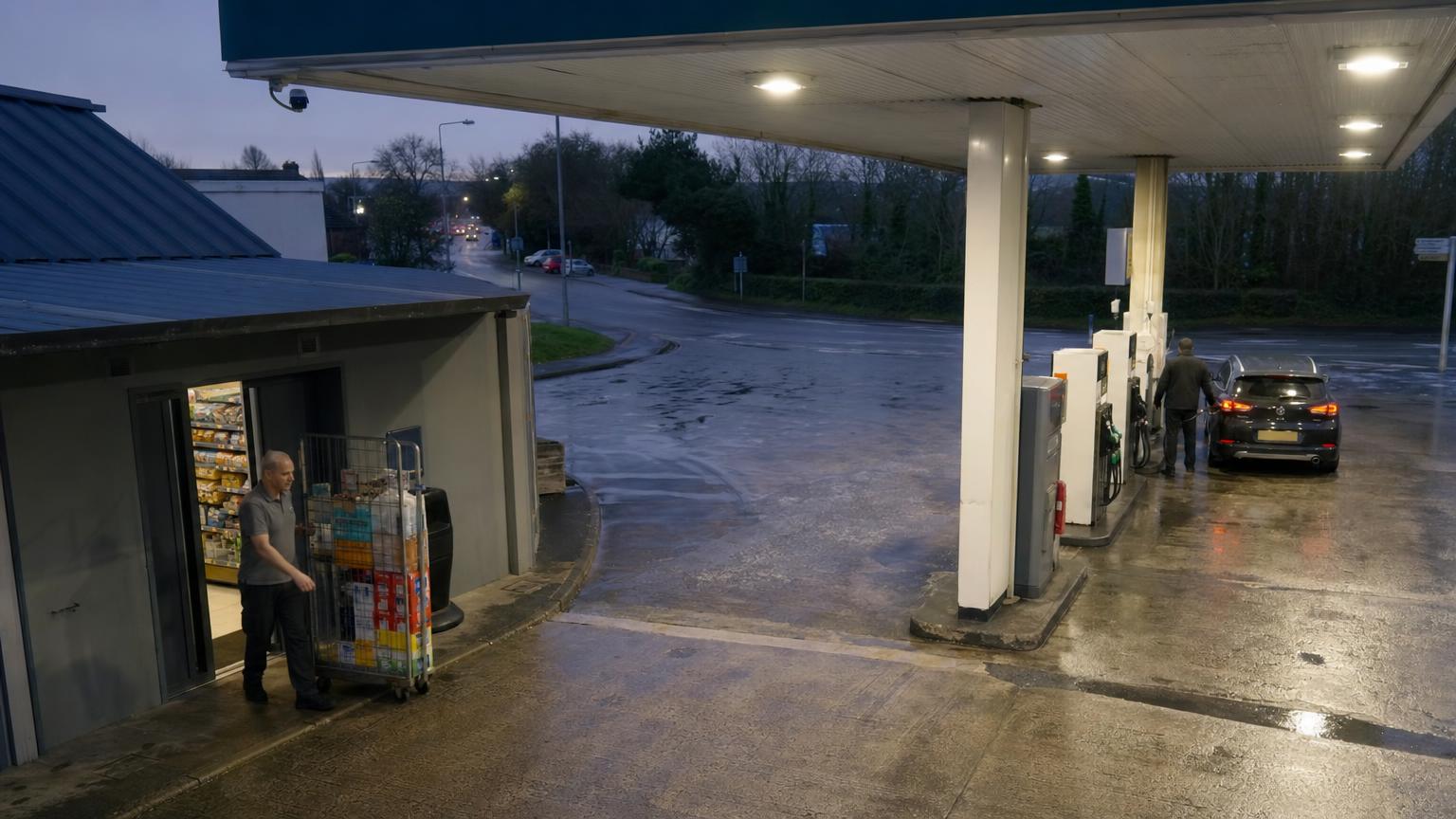


How c-store chains cover more stores without adding LP staff
The decision here is not how many analysts to hire. It is whether coverage is counted in hours of recorded video, which no team can watch, or in defined exceptions, which a small team can. Spot AI's position is that a convenience and fuel chain changes that unit first and sizes the team afterwards, because the arithmetic below will not bend to headcount. Retail already works this way: in 2025 its output rose 2.5 percent while hours worked fell 0.4 percent (Source: U.S. Bureau of Labor Statistics). The incident mix moved at the same time: shoplifting incidents fell 12.4 percent and merchandise theft 8.1 percent in 2025 against 2024, while retailers reported higher rates of repeat offenders at 50 percent and organized retail crime at 40 percent (Source: National Retail Federation).
Key takeaways
- Spot AI's first rule for c-store coverage is to change the unit of work before the roster, because stores times cameras times 168 hours is a number no roster absorbs.
- The sum: at 150 stores and 12 cameras each, one analyst with 20 review hours at four times speed reaches 0.026 percent of that week's video, one camera-hour in 3,780.
- Spot AI moves the unit to defined exceptions, and the same chain lands near 27 hours of human review a week, close to 11 minutes per store.
- Spot AI orders automation by how often an event happens times how cleanly its rule can be written, so after-hours forecourt and back-door presence go first.
- Spot AI measures the result as covered exception classes, share of detections closed without a person, and human minutes per store.
The coverage arithmetic, in the only two units that matter
Coverage conversations stall because finance counts people and operations counts stores, and neither decides whether an incident gets seen. Put both units on one page and do the multiplication.
The formula, and the four inputs it needs
Spot AI frames this as a ratio between video produced and attention available, and both sides come from figures a chain holds:
- S is sites, from the store list, including last quarter's openings.
- C is cameras per site: forecourt, canopy, lot, entrance, aisles, registers, back door, and safe. Most c-store estates land between 10 and 16, and the guide to convenience store security cameras covers what each position is for.
- 168 is hours in a week, since cameras do not keep store hours.
- H is review hours genuinely free per analyst per week. Everybody inflates it: a 40-hour week already holds investigations, write-ups, and store visits.
Video produced is S times C times 168. Attention available is analysts times H, times whatever speed a person can honestly watch at. Divide the second by the first for the share a human reaches.
What that means for one analyst's week
At 150 stores and 12 cameras each, the estate produces 302,400 camera-hours a week, and 2,016 for a single store. Give one analyst 20 hours clear for review, which is generous, at four times speed. That is 80 camera-hours against 302,400: 0.026 percent, one camera-hour in 3,780.
The important property is how little that number moves. A second analyst takes it to 0.053 percent, a fifth to 0.13 percent. Nobody hires their way to a coverage figure that starts with a whole digit, which is why headcount is the wrong lever.
Chain shape (assumed) | Camera-hours per week | Share one analyst reaches | Human review hours, exception driven | Human minutes per store |
|---|---|---|---|---|
40 stores, 10 cameras | 67,200 | 0.12 percent | about 7 | about 11 |
150 stores, 12 cameras | 302,400 | 0.03 percent | about 27 | about 11 |
400 stores, 14 cameras | 940,800 | 0.01 percent | about 73 | about 11 |
Every input there is an assumption to replace, not a finding; the one published figure behind it is the auto-resolution rate driving the fourth column, set out next with its sample and window. Spot AI's reading of the last column is the useful one: human minutes per store is the only figure a lean team holds flat as the store count grows.
What changes when review becomes exception driven
Nothing above improves by watching harder. It improves by changing the unit. Instead of camera-hours, count events that met a written rule: a vehicle on the forecourt after close, an approach to the back door outside delivery windows, a register transaction with nobody at the counter, a door swing with no sale behind it. Assume four a store a day, a figure to replace with a fortnight of your own detections. At 150 stores that is 4,200 a week, and at 90 seconds to open a clip, judge it, and dispose of it, reviewing all of them costs 105 hours. Still more than one person has, so this only works if most never reach a person.
That is the step Spot AI automates. In one Spot AI customer pilot, 40 of 54 detections were auto-resolved with nobody in the loop; that is one customer over one week, and the sample and window belong with the figure every time it is quoted. Apply that share to the 4,200 and about 1,089 events survive to a human, roughly 27 hours a week, close to 11 minutes per store. At the median hourly wage for private detectives and investigators of $24.62 in May 2025 (Source: U.S. Bureau of Labor Statistics), that is near $670 a week of review labour, before the burden your payroll adds. Set it against 302,400 camera-hours, which no payroll buys at any wage.
Be exact about one thing. The 11 minutes per store stays flat as the estate grows, because exception volume scales with stores while camera-hours scale with stores and cameras and the clock together. That flatness is the whole claim.
Run the sum on your own estate before anyone quotes you anything. Two numbers do it: cameras per store from the asset register, and the review hours honestly left in an analyst's week. Under a tenth of a percent, the gap is structural.
What to automate first, and in what order
The ordering mistake is to start with the incident that hurts most. Severe events are rare, ambiguous, and poor teachers for a new rule. Spot AI sequences by frequency times how cleanly the rule can be written, so the largest share of those 4,200 weekly events clears first and rules get tuned nightly.
Order | Exception class | Why Spot AI puts it here |
|---|---|---|
1 | After-hours presence on the forecourt, lot, and back door | Highest volume, unambiguous rule, and Spot AI deters on the spot with strobes, horns, and natural-conversation talkdown |
2 | Vehicle loitering and repeat plates in the lot | Spot AI reads dwell and context rather than motion, which separates a delivery from a vehicle casing the site |
3 | Register and cash-handling exceptions tied to the POS | The transaction writes the rule, so Spot AI builds case-ready evidence on the class covered in the guide to cash register theft |
4 | Door swings counted against transactions | A counting rule rather than a judgement call, so Spot AI returns a shrink signal and a staffing signal at once |
5 | Interior aisle behavior and incident documentation | Judgement is genuinely human here, so Spot AI assembles the timeline and clip and leaves the call to the investigator |
Anything whose rule cannot be written in a sentence stays in phase two on purpose. A rule nobody can state is a rule nobody can tune, and that is how a queue becomes background noise.
What a lean team should stop doing
The stop-doing list is the half of this change nobody writes down, and it is where the hours come from. Spot AI's retail workflow runs detect, deter, investigate, resolve, and each habit below sits on a step no longer done by hand:
- Stop scheduled footage review. The Monday pass over the weekend eats the most hours and finds the least.
- Stop opening a case for every alert. A case is for something a person will act on; the rest is a closed detection with a clip.
- Stop driving to a store to pull video. Retrieval is the trip nobody counts, and it costs a day.
- Stop treating camera count as coverage. Cameras sit in the denominator, never the numerator.
- Stop sending raw footage to law enforcement. Send the clipped, timestamped case: 63 percent of retailers reported fewer than half their theft incidents, with 60 percent citing low dollar losses (Source: National Retail Federation).
- Stop reviewing to find incidents. Review to check the rules, the job the next section budgets for.
An exception-driven week, with a time budget
Here is the routine those hours buy, sized for the 150-store example. Spot AI's queue is the spine of it, and a published time budget is testable against your own calendar:
- Daily, 25 minutes. Clear what survived auto-resolution overnight, then work register exceptions against the POS record while a manager can still explain the shift. Deterrence already happened, so this is disposal, not discovery.
- Tuesday, 45 minutes. Sample the auto-resolved pile: 20 at random, confirm each deserved to close, and treat a miss as a rule defect.
- Wednesday, 45 minutes. Tune exactly one rule. One a week is 50 a year, more than most estates have had in their lifetime.
- Thursday, 90 minutes. Advance open cases: the ones with a suspect, a pattern, or a police report. The earlier steps exist to protect this one.
- Friday, 30 minutes. Send districts their own numbers. A manager who sees their stores ranked on exception volume closes more than a memo does.
- Monthly, 2 hours. Review coverage by store rather than incident: which classes are live where, and which sites have one off.
That is roughly 27 hours a week across a team rather than one person, and it leaves the analyst's remaining time for the investigations that were being squeezed out. The wider case-management picture is in the retail loss prevention overview.
A staffing-neutral rollout across store formats
A chain is never one format, and exposure moves with the format rather than the banner. Spot AI sequences by where loss concentrates in each shape of store, keeping every phase inside the same headcount:
Store format | Where exposure concentrates | What Spot AI switches on first |
|---|---|---|
High-volume urban forecourt | Pump islands, lot dwell, vestibule traffic | Spot AI runs after-hours forecourt rules with automated talkdown |
Rural highway store, single clerk | Back door, cooler run, safety after dark | Spot AI covers the back-door approach, alerting a named phone |
Store trading 24 hours | The overnight hours nobody watches | Spot AI runs dwell detection all night, as in the guide to loitering and vagrancy in retail parking lots |
Travel center or truck stop | A large lot, long dwell, several entrances | Spot AI extends lot coverage with deployable units, as in the guide to retail parking lot trailer coverage |
Inline store without fuel | Registers, aisles, back of house | Spot AI starts with POS-linked exceptions and door counts |
Two notes. Pilot on the format you have most of, not the one with the worst story. And keep one exception class live everywhere from day one, so the coverage measure below has an unconfounded baseline.
Measure coverage, not hours
Hours worked was a fair proxy while a person was the only way to see anything. Once detection is automatic it measures the wrong thing, and the cost shows across the market: 75 percent of retail and consumer products executives call AI a top strategic priority, but only 16.5 percent can quantify a return (Source: Deloitte). Define the measure while it is still cheap. Spot AI reports coverage on five figures, each answerable from the platform:
- Covered exception classes per store. A store at three of your seven classes is a gap with an address.
- Share of detections closed without a person. Rising means the rules are improving; a sharp fall means something changed.
- Human minutes per store per week. This stays flat as the store count grows, and it separates a coverage change from a workload transfer.
- Time from event to first action. Where automated deterrence shows up, since it often lands before anyone is notified.
- Case completeness at handoff. Whether clip, timeline, and narrative leave together.
That last one is where outcomes show. At All Star Elite, an 80-location sports jerseys and apparel retailer, investigations run 50 percent faster, cash shrink fell from 6 percent to 1 percent, merchandise shrink from 10 to 15 percent to about 6 percent, and law-enforcement case timelines from 2 to 3 months to 1 month. Those are All Star Elite's customer-reported figures against its own baselines, from general retail, not convenience.
One caution on baselines. Property crime decreased an estimated 12.4 percent from 2024 to 2025, with larceny-theft down 9.8 percent, in FBI estimates covering 96 percent of the population (Source: Federal Bureau of Investigation). A national line moving down says nothing about one forecourt on one highway, so measure against your own site history and be ready to defend it: 50 percent of security leaders reported an increased budget for 2025, at an average increase of 12 percent, against an average decrease of 7 percent where budgets fell (Source: Security Magazine).
Key terms
- Camera-hours. Sites times cameras times 168: a week's video, and the denominator in every coverage claim.
- Exception. An event that met a written rule, not motion. Spot AI's detections are contextual, so a delivery at the back door and an approach at 3am are different events.
- Auto-resolution. A detection assessed and closed with no person in the loop. Spot AI reports the share as a first-class figure, because it turns an alert queue into a budget.
- Human minutes per store per week. Review time over store count, and the number Spot AI treats as real coverage.
Write the stop-doing list into the rollout plan rather than a follow-up. Scheduled footage review, a case per alert, and driving to a store for video are habits with owners, and adding detection without retiring them hands a lean team a second job.
"It was the brain behind the eyes we already had."
Blackmon Oil, 11-location fuel and convenience operator, rural Arkansas
Blackmon Oil is a 4th-generation family business running six use cases on cameras it already owned: vehicle loitering, people counting, aisle heat maps, unattended checkout, slip-and-fall, and a peel-off-rate agent the team built itself. That last one is the tell: a chain that has stopped scrubbing footage has people free to build the rule it wanted.
To watch this arithmetic run on a real estate, see how Spot AI approaches convenience store loss prevention from the forecourt to the register on the cameras a chain already owns.
Frequently asked questions
How many stores can one loss prevention analyst actually cover
Far fewer than the roster implies. At 150 stores with 12 cameras each, one analyst with 20 review hours a week at four times speed reaches about 0.026 percent of the week's video. Under exception-driven review the same team holds roughly 11 minutes per store, and the exception rate replaces the store count as the constraint.
How do convenience store chains improve coverage without hiring more LP staff
Spot AI changes the unit of work rather than the roster. Detection runs against the full week of video, automated deterrence closes what it can as it happens, and only what survived auto-resolution reaches a person. That is how 302,400 camera-hours a week become roughly 27 hours of human review.
What should a c-store chain automate first in loss prevention
Spot AI starts with after-hours presence on the forecourt, the lot, and the back door, the largest slice of the 4,200 weekly events in the example above: an unambiguous rule, deterred on the spot with strobes, horns, and natural-conversation talkdown. Vehicle loitering, POS-linked register exceptions, and door counts follow, with interior judgement calls last.
What should a lean LP team stop doing when video AI goes live
Scheduled footage review, opening a case for every alert, and driving to a store for a clip. Spot AI's workflow takes over the discovery half of each, and the hours only appear if the habit is retired deliberately.
How do you measure loss prevention coverage instead of hours worked
Spot AI reports five figures: covered exception classes per store, share of detections closed without a person, human minutes per store per week, time from event to first action, and case completeness at handoff. Set the baseline before the rollout, since only 16.5 percent of retail executives can quantify an AI return.
About the author
Dunchadhn Lyons, Director of AI Engineering
Dunchadhn Lyons leads Spot AI's AI Engineering team, building real-time video AI for operations, safety, and security, turning video data into alerts, insights, and workflows that cut incidents and boost productivity.

