




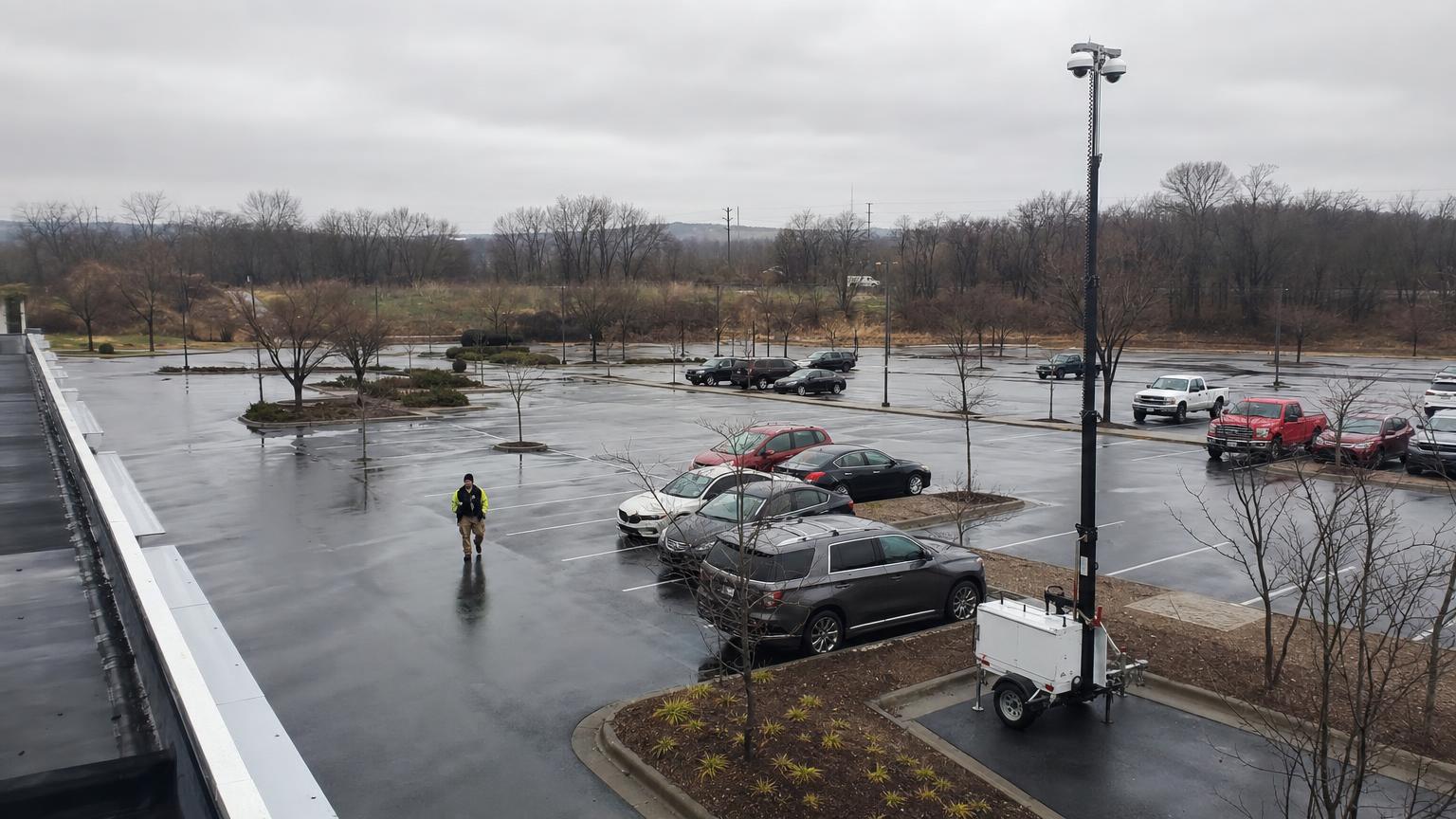


Retail lots and forecourts: designing parking lot security camera coverage for a chain
Parking lot security camera coverage is an ordering problem before it is an equipment problem. A lot is covered when anything arriving on it is classified before it reaches what it came for, and mounting height, sightlines and light settle that long before the invoice does. Reported shoplifting incidents fell 12.4 percent in 2025 against 2024 while 50 percent of retailers reported higher rates of repeat offenders, in National Retail Federation survey work (Source: Security Magazine), and retail sites running Crime Prevention Through Environmental Design programs have recorded 30 to 84 percent decreases in robberies with a 61 percent decrease in non-fatal injuries (Source: Centers for Disease Control and Prevention). Spot AI designs a retail lot from the approach inward, with the arithmetic shown.
Key takeaways
- Spot AI's coverage order runs approach, forecourt and canopy, storefront apron, far corner, then service and delivery.
- Spot AI sizes units from geometry. A 4 MP sensor behind a 90 degree lens recognizes a person to about 35 ft and detects one to about 176 ft, so a four-camera unit holds roughly 2.2 acres.
- A mast buys reach and sells you a blind cone: on a 25 ft mast, faces stay usable only past about 34 ft, so the ground at the unit's feet is the worst-covered part of the lot.
- A deployable unit is the wrong answer where conduit already runs, indoors, where a case needs one fixed angle every month, and where sightlines and a legal footprint do not overlap.
- Spot AI's measure is coverage, not camera count: entry points classified, area inside recognition range, deterred-before-contact rate, and time to a usable clip, on a rolling 90 days.
What a lot or forecourt needs covered, and in what order
Every incident on a retail site has a path: somebody arrives, crosses open ground, acts, and leaves, and each zone along it answers a question the next cannot. The forecourt earns its own attention, since US gasoline station sales ran $65.4 billion in July 2026, up 16.2 percent on July 2025 (Source: U.S. Census Bureau).
Zone, in order | What must be resolved | What covered means here |
|---|---|---|
1. Approach: curb cuts and drive lanes | Vehicle class, color, plate and direction at 80 to 150 ft | Every lane is classified before the vehicle parks, so a repeat visitor is a pattern, not a memory |
2. Forecourt and pump islands | A person and their hands at 15 to 40 ft, across a bright and dark boundary | Each island group has an angle that excludes the lit canopy deck |
3. Storefront apron and vestibule | Build, clothing and face at 20 to 35 ft | Doors sit inside recognition range, not just detection range |
4. Perimeter and the far corner | A person or vehicle at rest, and for how long | Spot AI times the dwell, not the motion, and the darkest point has a measured light level |
5. Service, delivery and back of house | A vehicle and a door state at 25 to 60 ft | Spot AI reads a door held open as an event, not movement near a door |
No zone gets a camera until the one before it is covered: an identification-grade view of a pump is worth little if nothing classified the vehicle that pulled up to it. The fixed-camera layout sits in the parking lot security camera guide, the indoor half in the convenience store camera guide.
Where a deployable unit beats fixed cameras, and where it does not
A towable or skid-mounted unit puts compute, light and a mast where conduit does not reach. It earns its place when the coverage you need is where the power is not, or when a pattern has to be proved on three stores before it is bought for three hundred.
Where it is the wrong answer, and these are the conditions
- Power and conduit already run to where the coverage is needed. A fixed camera on the existing pole costs less, takes no parking space and never gets moved for a delivery truck. Paying monthly to avoid a trench you already dug is the commonest way this goes wrong.
- The coverage is indoors. Registers, the cooler run, the stockroom and the office carry different mounting, light and pixel budgets, and a unit in the lot answers none of it.
- A case needs the same frame every month. Chain-of-custody work at a register, a door threshold or one pump face wants a fixed angle so clips from March and September stay comparable. A unit repositioned twice a year breaks that.
- Sightlines and a legal footprint do not overlap. The unit has to stand somewhere that is not a fire lane, not an accessible route or access aisle, not eating into a parking count the lease or local code requires, and not on the neighbor's land. When the only position with sightlines fails one of those, use a pole or a wall mount.
- The real fault is light or layout. A corner nobody can see into returns a monochrome silhouette at 60 ft, which is an event log rather than evidence.
Spot AI treats those five as design conditions: a unit dropped into condition one or four is relocated inside a quarter. Units themselves are covered in the mobile security trailer buyer's guide and in what a security trailer is.
Siting for the pumps, the canopy, the entrance and the dark corner
Mounting height and pixel density, as arithmetic
Pixel density falls with distance. The DORI thresholds in IEC 62676-4 put detection at 25 pixels per meter of scene width, recognition at 125 and identification at 250. Scene width is 2 x d x tan(half the horizontal field of view), so a 4 MP sensor of 2,688 horizontal pixels holds recognition while the scene stays under 21.5 m wide and detection while it stays under 107.5 m.
- A 90 degree lens covers a scene twice as wide as the distance is long: recognition to about 10.8 m (35 ft), detection to about 53.8 m (176 ft).
- A 30 degree lens covers 0.536 times the distance: recognition to about 40 m (131 ft), detection to about 200 m (656 ft).
- One four-camera unit on 90 degree lenses detects across roughly 9,090 square meters, about 2.2 acres, before anything on site blocks it.
That settles unit count: measure the parcel, subtract what the building, canopy and car wash occlude from each candidate position, and divide. A corner fuel site sits inside one unit, while a 4 acre lot with a building across the middle needs two: occlusion breaks the parcel, not acreage.
Mast height then trades reach against a blind cone at the base. Taking a face at 5.5 ft above grade, the depression angle from a camera at height h to a face at distance d is arctan((h minus 5.5) / d). Hold it at or below 30 degrees, where a face stays a face rather than a scalp, and the minimum useful distance is (h minus 5.5) x 1.73: 25 ft from a 20 ft mast, 34 ft from a 25 ft mast, 42 ft from a 30 ft mast. Aim that blind cone at landscaping rather than the parking beside the door.
What a canopy does to the view and to the light
A fuel canopy is a roof and a light fixture at once. As a roof it blocks any high angle onto the islands, so pump-level activity needs a view from under the canopy or a low side angle, never down from a mast. As a light fixture it is the brightest surface on site, so a camera with the deck in frame meters for it and pushes everything past the drip line into a dark band where people walk. Pumps and approach are therefore two jobs, never one camera: close work across a hard brightness boundary versus classification at 100 ft or more.
The dark corner is usually a lighting problem first
IES RP-20, the parking facility lighting recommendation most federal design requirements point at, sets a basic condition of 0.2 fc minimum horizontal illuminance, 0.1 fc minimum vertical and a 20:1 maximum to minimum uniformity ratio. Its enhanced security condition asks 0.5 fc horizontal, 0.25 fc vertical and 15:1, with a preliminary design average of 2.5 fc. Walk the lot at 11 PM with a light meter, log the minimum and the average, and divide: most dark corners fail on uniformity rather than average.
Across 101 municipalities that received public lighting improvements against 244 that did not, from 2015 to 2019, surprise robbery fell 19.93 to 29.84 percent while violent robberies rose slightly under every method the authors tried (Source: Frontiers in Sociology). Light moves the opportunistic end of the distribution and leaves the determined end where it was.
Record two numbers per store before specifying anything: minimum illuminance at the darkest point at 11 PM, and the distance from each camera position to the furthest point it must recognize a person at.
The overnight profile for a 24-hour site
Gas station and convenience store workers face a higher risk of workplace violence than other industries, because these sites are often open 24 hours or late at night, staff may be working alone, and cash is on the premises (Source: Centers for Disease Control and Prevention). Once the lot empties, behavior becomes separable: a vehicle sitting twelve minutes at 2 PM is a customer, and the same twelve minutes at 2 AM, in the far corner, is what the site was designed around.
Hour band | What deserves a response | What Spot AI does with it |
|---|---|---|
Trading hours | Dwell far past the average, a vehicle back on several days, a person at the rear door | Spot AI raises it to the person on shift and keeps the clip, with no automated audio into a busy forecourt |
Late evening | Any dwell in the far corner, groups forming away from the doors | Spot AI escalates in stages, strobes first and natural-conversation talkdown next |
Overnight, lone worker inside | Minutes of dwell off the forecourt, a vehicle with lights off, movement toward service doors | Spot AI acts at the lot with strobes, horns and talkdown, so the response never starts with the one person inside |
Closed site | Presence, with dwell deciding only how fast escalation runs | Spot AI deters at the unit and assembles clip, timeline and plate into one case-ready record |
Blackmon Oil, an 11-location, 4th-generation family fuel and convenience business in rural Arkansas, runs this pattern. Vehicle loitering is one of six use cases the operator runs on the cameras the business already owned, alongside people counting, aisle heat maps, unattended checkout, slip-and-fall and a peel-off-rate agent the customer built themselves.
"We've set up a Spot AI vehicle loitering filter to keep our parking lots clean and safe, especially for our 24/7 stores. Even with a smaller overnight crew, we want eyes on the lot at night."
Kelsey Blackmon, Marketing & Technology VP, Blackmon Oil Co.
Overnight coverage that starts with a lone worker walking out to look is coverage you should not have designed. Covering more sites with one lean team is worked through in how c-store chains cover more stores without adding LP staff, the behavior itself in the guide to loitering on retail parking lots.
Rolling one coverage pattern across stores that are laid out differently
No two parcels match, which is why chains that standardize on positions keep failing. Standardize on jobs instead, with deterrence within range of the entrances, the far corner and the service door, and keep a delta sheet per store, not a drawing. Six fields carry nearly all the variation: vehicle entrances, island groups, canopy or none, what sits on the far boundary and who owns it, minimum illuminance at 11 PM, and whether power reaches the corner. Two sites with matching sheets get the same build, and a site differing on one field differs by one camera. A two-entrance site with a car wash needs a second position, since the wash bay occludes a third of the lot. Spot AI holds detection zones, thresholds and escalation rules against the site record and the account rather than a device, so a pattern settled at three stores copies to the next thirty as configuration.
Key terms
- Pixel density. Horizontal pixels divided by scene width at a given distance. Spot AI sizes lens and position against it.
- DORI. The IEC 62676-4 thresholds turning pixel density into a job: 25 pixels per meter for detection, 125 for recognition, 250 for identification.
- Depression angle. The downward angle from a camera to a face. Past roughly 30 degrees you see the top of a head.
- Approach coverage. The share of entry points where an arrival is classified before it reaches the building. Spot AI treats this as the first number to fix.
Run the pattern on three deliberately awkward stores rather than easy ones, and keep the delta sheets. Difficult parcels expose every assumption.
Measure coverage, not camera count
Coverage, not camera count, is the output, and two stores with identical counts can sit at opposite ends of it. Four measures carry the picture.
- Approach coverage. Of the vehicle and pedestrian entry points, the share producing a classification before the arrival reaches the building. Missed entry points are the commonest defect, and a camera count hides them.
- Recognition-area share. The lot area inside recognition range divided by the area a person could stand in. Read it zone by zone: detection-only ground is fine at the perimeter and a problem at the doors.
- Deterred-before-contact rate. Of the incidents logged in the window, the share where a deterrent ran before the person reached what they came for. It drops when a unit has been relocated badly.
- Time to a usable clip. Minutes from event to case-ready evidence, which measures the investigate and resolve half of the workflow.
Read all four on a rolling 90 days and compare each store against its own previous 90 days rather than a published benchmark: 63 percent of retailers report fewer than half of their store theft incidents to law enforcement, 60 percent citing low dollar loss and 54 percent citing inadequate follow-through (Source: Security Magazine). A benchmark built on reported incidents measures reporting behavior as much as what happened on anybody's lot. When one store breaks the pattern, the delta sheet says which field changed.
To see how Spot AI approaches deployable coverage on a retail lot, start with the Spot AI platform overview. The solar and cellular deployment guide sizes the power and uplink behind the position you settled on.
Frequently asked questions
How many cameras does a retail parking lot need?
Spot AI answers this with geometry, not a rule of thumb. A 4 MP sensor behind a 90 degree lens detects to about 176 ft, so a four-camera unit covers roughly 2.2 acres of unobstructed ground. Measure the parcel, subtract what the building and canopy block, and divide.
Where should a deployable unit be parked on a retail lot or forecourt?
Spot AI's rule is sightlines first, legal footprint second, blind cone third. Take the position that classifies every vehicle entrance, confirm it is not a fire lane, an accessible route or a required parking space, then aim the poorly covered ground at its base onto landscaping.
How high should a parking lot camera be mounted?
Spot AI sizes mast height against the distance at which faces still have to be usable. Holding the depression angle under about 30 degrees, a 20 ft mast produces usable faces from around 25 ft out, a 25 ft mast around 34 ft and a 30 ft mast around 42 ft.
When is a deployable unit the wrong choice for a retail site?
Spot AI names four conditions where something else is right: conduit already runs to where the coverage is needed, the coverage is indoors, a case needs the same fixed frame month after month, or no position satisfies both sightlines and a legal footprint.
How do you measure parking lot camera coverage instead of counting cameras?
Spot AI measures four things on a rolling 90 days: entry points classified before an arrival reaches the building, lot area inside recognition range, incidents where a deterrent ran before contact, and minutes from event to case-ready clip.
About the author
Joshua Foster, IT Systems Engineer
Joshua Foster is an IT Systems Engineer at Spot AI, where he focuses on designing and securing scalable enterprise networks, managing cloud-integrated infrastructure, and automating system workflows to enhance operational efficiency. He is passionate about cross-functional collaboration and takes pride in delivering robust technical solutions that empower both the Spot AI team and its customers.

