




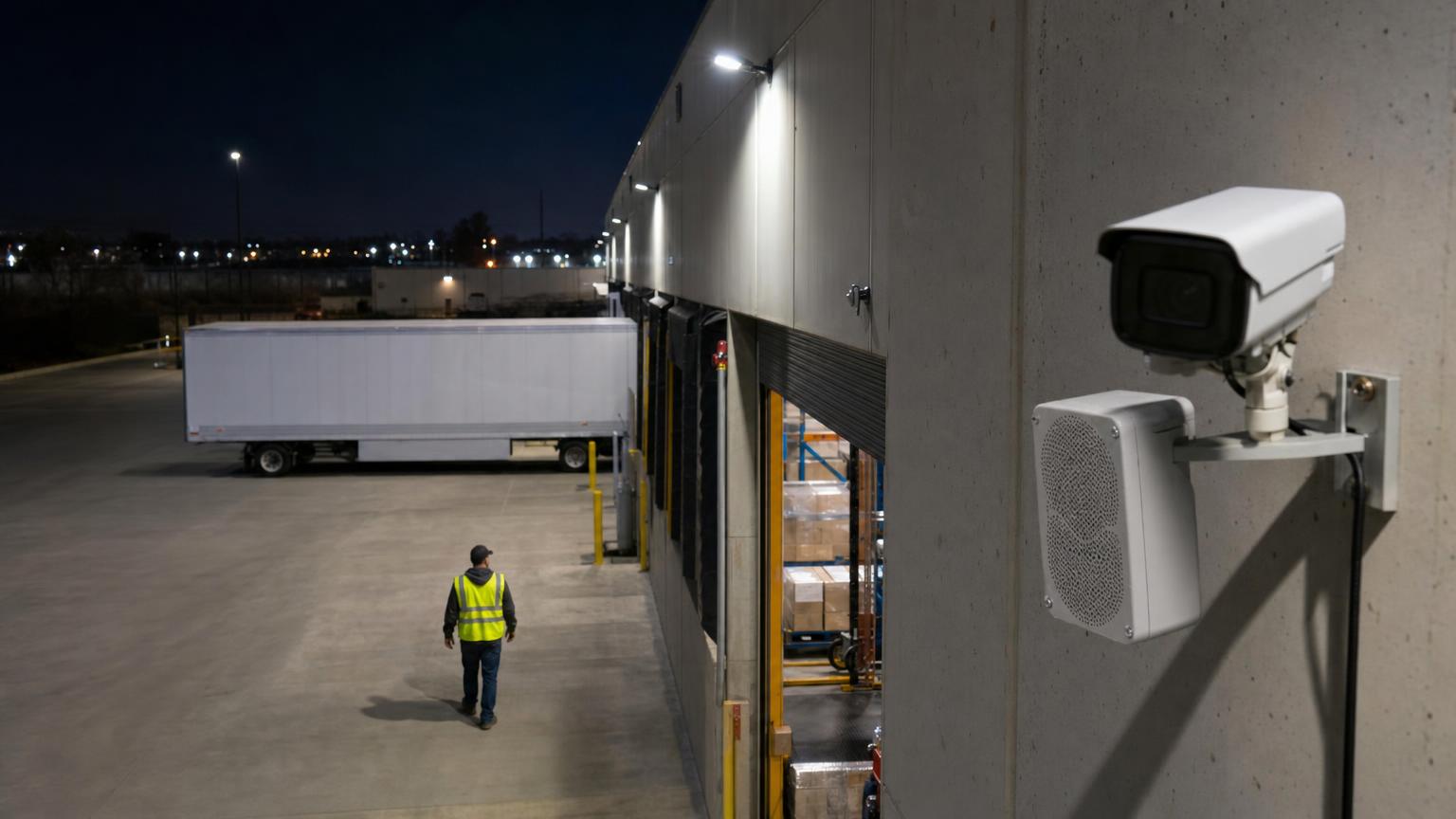


Voice-down deterrence: setup, thresholds and what to say
Voice-down deterrence is three settings: the dwell threshold that opens the speaker, the words it says, and the ladder it climbs when those words fail. The rungs above it are slow. In one 2026 account, 361 of roughly 5,500 backup power cabinets were breached, each attack finished inside three minutes, against a police response often past 45 minutes (Source: Security Magazine). Retailers say the same: 54% cite inadequate police response or follow-up (Source: Security Magazine). Spot AI runs the first rung locally, and this guide sets every number, line, and clause it needs.
Key takeaways
- Spot AI treats voice-down as rung two of a four-rung ladder, with a time budget and an owner per rung, and its dwell defaults run from 45 to 60 seconds in an open lot down to zero on a line crossed into a locked yard.
- The message answers five questions in ten to fifteen seconds, stated in full and repeated in full, at intervals (Source: National Institute of Standards and Technology).
- Spot AI's deterrence reduces the likelihood an incident continues and never promises one cannot start. A top five North American EV charging network reports incidents down 80% without human monitoring.
- Spot AI versions every threshold, because the failure nobody sees is silent: somebody mutes the channel and the ladder stops at rung one.
- Spot AI keeps the message legal-safe by broadcasting rather than capturing, which is the distinction state consent law turns on.
Step 1: Draw the zones and give each one a dwell clock
Three things have to exist first: a site map with speaker coverage, the closed hours per area, and a named person on every rung. A zone is then a polygon, a dwell threshold, and an armed window. Spot AI builds detections against that combination rather than against motion, so a driver crossing a lot and a person settling beside the cash machine produce different outcomes from one camera.
Zone | Dwell before the first message | Armed window |
|---|---|---|
Through-lane or sidewalk edge | Never. Spot AI leaves it outside the polygon | None |
Open lot, general parking | 45 to 60 seconds | Closed hours |
Cash machine, pump island, door alcove | 20 to 30 seconds | Closed hours and overnight trading |
Fenced compound, yard, loading dock | 10 seconds | Closed hours |
Line crossed into a locked area | 0 seconds. Spot AI treats the crossing as the event | Closed hours |
Roof, transformer, cable run | 0 to 5 seconds | Always armed |
Geometry matters as much as seconds. Draw the polygon so the shortest legitimate path across it cannot reach the threshold at a walking pace near four and a half feet per second.
The pitfall. Pinning zones to the property line, which starts a clock on everyone waiting for a bus.
Step 2: Set the ladder and put a time budget on every rung
Spot AI runs detection and the first two rungs at the edge, so the response waits on neither a cloud round trip nor a human noticing.
Rung | What happens | Budget from detection |
|---|---|---|
0. Detect | Spot AI confirms a person or vehicle once dwell is met, classifying behavior in context rather than on pixel change | 0 to 3 seconds |
1. Voice-down | Spot AI plays the first natural-conversation talkdown and starts the reply clock | 3 to 12 seconds |
2. Repeat plus strobe | Spot AI repeats the message in full and raises the strobe | 30 to 45 seconds |
3. Horn plus routed alert | Spot AI sounds the horn and routes the case to the on-call person by text or Slack | 60 to 90 seconds |
4. Human decision | The on-call person decides whether to call it in, with video rather than an alarm code | 2 minutes onward |
The breaches above finished inside three minutes, so a ladder whose first spoken rung lands at ninety seconds has spent half the incident getting to hello.
The pitfall. One ladder for all 24 hours. In trading hours the detection should route to a person and stop, because talking down a customer costs more than missing a loiterer.
Step 3: Write the script, line by line
The opening line and the five things it carries
Spot AI's talkdown speaks in natural conversation rather than a recorded tone, so the words carry the job. NIST's guidance is that an effective warning message is specific, consistent, certain, clear, and accurate, and answers five questions: who is speaking, what to do, when, where, and why (Source: National Institute of Standards and Technology). A usable first line for a closed lot:
"This is site security speaking. You are in the staff parking lot behind the store, and it is closed to the public right now. Please head out to the main road. Cameras are recording."
Thirty-four words, four sentences, about twelve seconds. NIST also puts warning messages at a sixth grade reading level, because the average US reading level drops about four grades under stress.
What de-escalates and what provokes
Across 424 de-escalation events over a year in three acute inpatient units, 81% showed a decrease in situational aggression on a six-point scale, averaging 1.20 points (Source: Frontiers in Psychiatry). What those events share maps onto a script:
- Describe the behavior, never the person. "You are in a closed area" lands. "You are trespassing" is an accusation the speaker cannot prove and the listener can argue with.
- Give one exit and name the direction. Someone told where to go usually goes.
- Do not claim what has not happened. "The police are on their way" when they are not teaches a neighborhood that the speaker bluffs.
- Keep the volume flat and do not negotiate. Shouting draws an audience, and an audience is a reason to stay.
- Never mention appearance, race, age, or apparent housing status. Spot AI's detections describe behavior and location, and the platform does not use biometric identification.
How long it runs and how often it repeats
NIST's summary: repeat at least once, state and repeat the message in full rather than looping a fragment, and space repeats at intervals rather than back to back. Some findings cap a message at 30 words and about nine seconds, a conflict NIST records rather than settles. The working shape:
- Ten to fifteen seconds, which is 30 to 45 words at the 175 words per minute NIST cites as a delivery rate.
- A silent reply window of 20 to 30 seconds. A second message arriving in four seconds reads as a machine.
- Three plays maximum, each the full message.
- Urgency words held for the third play, because NIST finds urgency language works only when used selectively.
- Escalate after play three, not play six.
Time the script out loud before recording it. At 175 words per minute, 45 words runs fifteen seconds, and most first drafts reach 80 words and half a minute, long enough to walk out of range mid-sentence.
What changes when somebody complies partway
- Movement toward the exit pauses the ladder. Spot AI holds rungs two and three while somebody is leaving and resumes only if they turn back.
- Acknowledge it, and say why the message changed. "Thank you, please continue to the main road" removes the reason to dig in, and NIST finds a changed instruction reads as credible only when the reason is given.
- Log the partial as a partial. Spot AI keeps the case open with the clip, which makes a repeat visit on Thursday visible as a pattern.
Step 4: Set the horn and strobe without putting staff inside them
OSHA's permissible noise exposures in 29 CFR 1910.95 Table G-16 allow 90 dBA for eight hours, 100 for two, 110 for half an hour, and 115 for a quarter hour or less, halving the permitted time for every five decibel rise (Source: Occupational Safety and Health Administration). Aim the horn away from anywhere staff stand, measure it there at head height, and cap its duration in configuration, which Spot AI does by timing the horn inside the ladder.
The pitfall. Treating the strobe as decoration. On rung two it reaches a person wearing headphones and tells the one who heard the message that the site is not asleep.
Step 5: Tune for two weeks and log every number you move
Run the ladder in alert-only mode for two nights, speaker silent, so the fire rate is visible before anybody outside hears it.
- Count fires per site per night and sort them into acted on, ignored, and wrong. Spot AI's case list gives you that without a hand tally.
- Aim for a rate the on-call person still reads in week six. More than a handful of overnight fires is a threshold problem, not a crime wave.
- Change one number at a time and record date, old value, new value, and reason.
The failure mode to name out loud. Untuned alerting produces silence rather than complaints. Alarm fatigue is desensitization from too many alarms, and it leads to improper alarm management: among 70 intensive care nurses across five units in early 2024, mean scores on the Charite Alarm Fatigue Questionnaire reached 17.7 of 36 points, about 49% (Source: PubMed). That is a hospital rather than a parking lot, and the mechanism is the one that matters. Somebody stops trusting the channel, mutes it, tells nobody, and every rung above the first quietly stops existing. Make muting unavailable and a recorded threshold change the only remedy.
Step 6: Brief associates before the speaker talks to a customer
- Read the script out in a pre-shift briefing, so the first time anyone hears it is not live.
- Make "do not go outside" the standing instruction. The system speaks so nobody walks into a lot at 2 AM to ask a stranger to leave.
- Give them one task: note the time and stay inside. Spot AI already has the clip, so nobody films on a phone.
- Agree one sentence for customers who ask, such as "it is an automated message for the lot after hours", then debrief the first three incidents together.
What changes for a lot, an entrance, and a forecourt
Spot AI runs a configuration per surface, not per site.
Surface | Dwell default | What the first line does | The trap |
|---|---|---|---|
Open lot, closed hours | 45 to 60 seconds | Names the area and the exit to the road | Spot AI excludes the through-lane, which otherwise speaks to every car that turns around |
Entrance or door alcove | 20 to 30 seconds | Names the doorway, states the hours, points to the sidewalk | Spot AI arms against real closed hours, not posted ones, since deliveries arrive first |
Fuel forecourt, 24 hours | 90 seconds or longer at the pumps | Nothing at the pumps. Spot AI keeps the speaker for the canopy edge and the air line | A forecourt never closes, so every zone needs its own window |
Signage, consent, and where this stops being a technology question
Playing audio out of a speaker is broadcasting. Capturing audio through a microphone is interception, and interception is what the law is about. Federally, 18 U.S.C. 2511 bars intentional interception of oral communications, while interception where one party consents is permitted under 18 U.S.C. 2511(2)(c) and (d). Whether an utterance is an "oral communication" turns on whether the speaker had a justified expectation that it was not subject to interception, and the Department of Justice's own reference material records that people not legitimately on the premises lack a reasonable expectation of privacy there (Source: U.S. Department of Justice).
State wiretap statutes differ from each other, and several require every party to consent, so their application to a fixed microphone on commercial property belongs to your own counsel. Post signage at every approach and photograph it with a date, decide whether any microphone is enabled at all, and write counsel's answer into the policy below.
Key terms
- Voice-down (talk-down). A spoken message played into a space in response to a detection. Spot AI delivers it as natural-conversation talkdown rather than a tone, which makes wording a design decision.
- Dwell threshold. The seconds a person or vehicle must stay inside a zone before a detection fires, and the most consequential number in a deployment.
- IVR. Spot AI's Intelligent Video Recorder, which holds full-resolution video in the facility while detection runs locally, so the early rungs fire without a cloud round trip.
A copy-ready voice-down policy template
Lift this, fill the brackets, and have operations and counsel sign it before go-live.
- Scope and armed hours. Automated audio deterrence at [site], effective [date], reviewed every [90] days. Zones are armed [clock times per day], never in trading hours except [exceptions].
- Zones and thresholds. [Zone] fires after [N] seconds of dwell during [window]. Thresholds live in [system of record], changed only by [role].
- Message text. Approved scripts are appendix A. Nothing plays that [role] has not approved in writing, and scripts describe behavior and location only.
- Repetition. Each message plays in full, up to [3] times, [20 to 30] seconds apart. The ladder advances after the final play.
- Escalation. Rung 2 (repeat plus strobe) at [30 to 45] seconds, rung 3 (horn plus alert to [rota]) at [60 to 90], rung 4 a human decision by [role].
- Sound levels. Horn capped at [N] dBA at [location] and [N] seconds per activation, with 29 CFR 1910.95 limits applied wherever staff stand.
- Audio capture. Microphones are [enabled or disabled]. Where enabled, the legal basis sits at appendix B, reviewed annually by [counsel]. Signage is at [locations].
- Muting. Nobody may mute, disable, or suppress an alerting channel. A threshold change by [role] is the only remedy, logged with date, old value, new value, and reason.
- Review. Fires, outcomes, and script edits are reviewed [monthly] by [role], and the first three incidents debriefed within [7] days.
Keep the threshold log, the scripts, and the counsel position in one document. They fail together: a threshold nobody can explain produces fires nobody trusts, and an uncleared script gets quoted back at you.
A top five North American EV charging network ran autonomous deterrence, horns and strobes triggering within seconds, across 120 sites inside a year, against copper theft costing roughly $5,000 an incident in replacement alone.
"We've reduced incidents by 80% without any kind of human monitoring."
Jeremy N., Sr. Manager of Operations & Maintenance, a top five North American EV charging network
The neighboring decisions sit in loitering and vagrancy in retail parking lots, parking lot camera coverage, retail lot trailer coverage, convenience store coverage without adding staff, and coverage that responds without a posted officer. To see how Spot AI approaches automated deterrence on cameras a site already owns, start with the product overview.
Frequently asked questions
What is voice-down deterrence
Spot AI defines voice-down, also called talk-down, as a spoken message played into a space the moment a detection fires, with strobes and horns on later rungs. It reaches the person while the incident is still starting, and it reduces the likelihood the incident continues rather than stopping one happening.
How long should someone be in a zone before the voice-down fires
Spot AI's defaults are 45 to 60 seconds in an open lot, 20 to 30 at a cash machine or alcove, 10 inside a fenced yard, and zero on a line crossed into a locked area. Check each against the shortest legitimate path across the zone at walking pace.
What should an automated security voice message say
Spot AI's scripts answer NIST's five questions: who is speaking, what to do, when, where, and why. Keep them to 30 to 45 words, ten to fifteen seconds, at a sixth grade reading level, describing behavior rather than the person. Repeat in full up to three times.
Is it legal to record audio with a security camera
Spot AI's deterrence runs as an outbound message, and broadcasting audio is a different question from capturing it. Federal law bars intentional interception of oral communications while permitting it where one party consents. State statutes differ, several require every party, so the answer belongs to your own counsel.
Do you need staff monitoring for talk-down to work
Spot AI runs detection and the first rungs at the edge, so the message plays without anybody watching a screen. A top five North American EV charging network reports incidents down 80% without human monitoring, that customer's own measurement rather than a guarantee. A named human still owns the last rung.
About the author
Dunchadhn Lyons, Director of AI Engineering
Dunchadhn Lyons leads Spot AI's AI Engineering team, building real-time video AI for operations, safety, and security, turning video data into alerts, insights, and workflows that cut incidents and boost productivity.

