




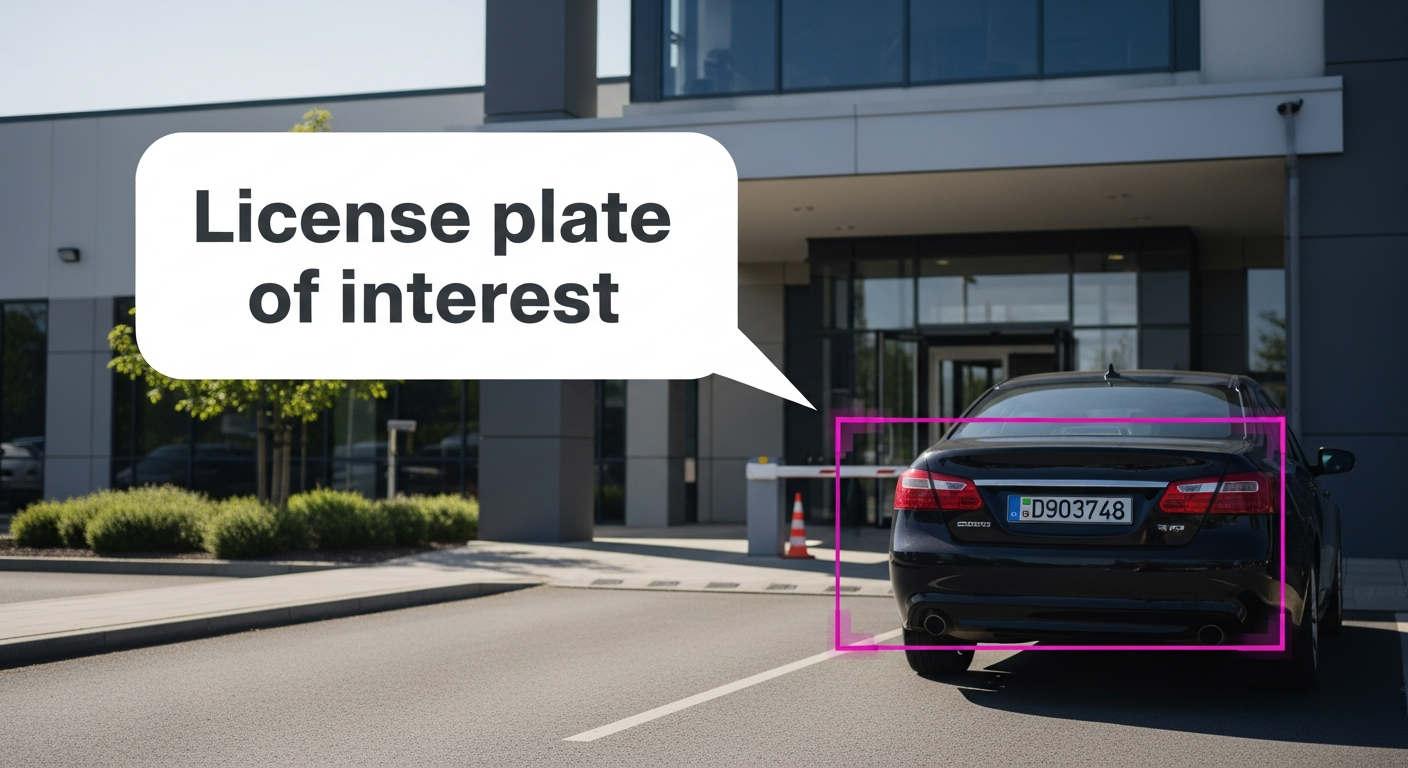


Retail shrinkage exceeds $100 billion annually in the U.S., with organized retail crime (ORC) representing a growing portion of total loss (Source: OREATE AI). For Loss Prevention Directors, the challenge intensifies because 66% of retailers report that ORC groups now operate across borders, complicating recovery efforts (Source: ECR Loss Prevention Council). The frustration is twofold: security systems that only record incidents after the damage is done, and the time-consuming nature of manual reviews.
Traditional video systems are inherently reactive. They capture evidence of a theft, but often too late to intervene. To shift from reactive documentation to early detection and risk mitigation, many retailers are turning to license plate recognition (LPR) data. By treating video as a rich dataset rather than just a visual feed, retailers can identify repeat offenders, disrupt ORC patterns, and standardize security responses across multiple locations.
This guide explores how to leverage license plate data to address repeat offenders, using your camera infrastructure to protect assets and improve safety.
Key terms to know
- License Plate Recognition (LPR): technology that uses optical character recognition (OCR) to automatically read vehicle license plate characters from digital images.
- Vehicle Attribute Search: advanced AI analytics that identify vehicle characteristics beyond the plate—make, model, color, and distinctive features like roof racks or bumper stickers. This proves critical when plates are missing or swapped.
- Hotlist: a database containing license plates of interest, such as stolen vehicles, known repeat offenders, or vehicles associated with active investigations.
- Organized Retail Crime (ORC): large-scale theft and fraud activity conducted by groups of professional shoplifters. Recent data shows that just 10% of offenders account for two-thirds of retail crime losses (Source: Precise ParkLink).
Mapping LPR solutions to loss prevention roadblocks
Loss prevention leaders manage complex environments where integration headaches and resource constraints are common. The following table outlines how license plate data directly addresses core frustrations in retail security operations.
| Core frustration | How license plate data addresses it |
|---|---|
| Reactive security systems | Shifts operations to early-warning alerts by flagging known offender vehicles as they enter the parking lot. |
| Time-consuming investigations | Shortens investigation time by allowing teams to search by plate, color, or vehicle type in seconds. |
| Integration nightmares | Modern LPR connects with Video AI platforms to unify data across locations, avoiding siloed systems. |
| Coverage gaps | Extends visibility to the perimeter and parking lot, capturing data before suspects enter the store. |
| Inability to prove ROI | Provides measurable metrics on recovered merchandise and reduced incident response times. |
Understanding license plate recognition in retail
License plate recognition technology has evolved from simple optical reading to advanced machine learning capable of operating in complex retail environments. The global AI video analytics market is expected to reach $64.48 billion by 2035, driven by demand for smarter, automated detection (Source: SNS Insider).
How modern LPR systems function
- Image capture: specialized cameras capture high-contrast images of vehicles entering or exiting parking lots, using infrared technology to see in low-light conditions.
- OCR processing: the system converts the plate image into a text string using neural network-based algorithms that learn from new plate designs and fonts.
- Data analysis: advanced systems go beyond the plate, analyzing the "Vehicle Fingerprint" to identify make, model, body type, and color. This proves vital for identifying vehicles where plates have been removed or swapped.
- Hotlist comparison: the data is cross-referenced against internal hotlists (known repeat offenders) and external databases (stolen vehicles/NCIC).
- Real-time alerting: when a match is found, the system sends a real-time alert to the security operations center (SOC) or store management, enabling rapid response.
Strategies for identifying and tracking repeat offenders
Identifying high-risk individuals before they enter the sales floor is critical for reducing shrink. With repeat offenders driving the majority of loss, intelligence becomes your most valuable asset.
Building effective hotlists
- Internal incident data: populate hotlists with vehicles linked to prior documented theft incidents, return fraud, or safety violations at your locations.
- Cross-location intelligence: in multi-store environments, a vehicle flagged at one location should trigger notifications across the entire network. This disrupts the mobility of ORC groups who often target one store after another (Source: British Retail Consortium).
- Law enforcement collaboration: where legally permitted, incorporate data on stolen vehicles or wanted subjects to enhance perimeter security.
The early-intervention workflow
- Detection: an LPR camera at the parking lot entrance detects a vehicle on the hotlist associated with a known shoplifting ring.
- Verification: a notification is sent to the SOC or Loss Prevention Manager. The operator verifies the plate and reviews associated notes (e.g., "Suspect associated with electronics theft").
- Observation: floor staff are notified to provide "customer service" presence in high-risk departments, signaling to the suspect that they are being observed.
- Resolution: the suspect, realizing they are monitored, often leaves without attempting theft, or evidence is gathered for law enforcement if a crime is committed.
Connecting LPR with the retail security ecosystem
One of the primary frustrations for retail security directors is managing disparate systems that don't communicate with each other. To be effective, license plate data must integrate reliably with your broader security infrastructure.
Connecting video AI and POS data
By linking POS timestamps with LPR data, investigators can verify if a vehicle in the drive-through or curbside pickup area matches the transaction details. This correlation reduces internal fraud and "sweethearting" at the register. Connecting these data points also creates stronger evidence packages.
Case Study: All Star Elite
All Star Elite, a sports apparel retailer with 80 locations, deployed a unified video surveillance and AI search platform to standardize investigations. By centralizing their data and using AI search capabilities, they reduced cash shrink from approximately 6% to 1%—an 83% reduction. Their investigation efficiency improved by over 50%, dropping incident resolution times from hours to minutes (Source: Spot AI).
Shortening investigation time
- Smart search: modern Video AI platforms allow investigators to search for vehicles by attribute (e.g., "White Truck" or partial plate "ABC") across authorized cameras and locations in seconds.
- Case management: automated LPR data can populate incident reports with precise times, dates, and vehicle images. This creates organized evidence packages that help law enforcement build stronger cases against repeat offenders.
Navigating privacy, compliance, and legal risks
Retailers must balance security objectives with privacy rights and legal compliance. Mismanagement of data can lead to reputational damage and legal hurdles.
Data retention and governance
- Defined retention periods: industry standards typically suggest a 30-day retention period for LPR data unless it is part of an active investigation. This aligns with privacy best practices and helps mitigate "surveillance mosaic" concerns.
- Purpose limitation: data should be used strictly for security and loss prevention purposes. Policies must explicitly prohibit using LPR data for marketing or tracking protected activities.
- Audit trails: systems must maintain rigorous logs of who accessed the data and why. This accountability is crucial for defending against claims of misuse.
Legal frameworks
- Fourth Amendment considerations: courts have largely ruled that license plates are public information and do not require a warrant to capture in public spaces. A federal judge recently affirmed that automated license plate readers do not violate Fourth Amendment privacy rights (Source: Courthouse News).
- State-specific regulations: as of January 1, 2026, new state privacy laws took effect in Indiana, Kentucky, and Rhode Island (Source: JD Supra). Retailers must ensure their deployment complies with these evolving local ordinances regarding transparency and data sharing.
Real-world operational impact
Disrupting organized retail crime
In one documented instance, a shopping center operator used centralized LPR data to identify a vehicle visiting multiple retail tenants. By correlating 15 separate visits, the security team identified a coordinated theft ring targeting specific high-value items. The aggregated evidence package—including vehicle movements and video footage—enabled law enforcement to build a strong case, disrupting the ring's operations.
Improving parking lot security
A mid-sized retailer deployed LPR cameras at parking entries and exits. The visibility of the system, combined with real-time alerts for known offenders, created a deterrent effect. Over three months, the retailer saw a significant reduction in parking lot theft and vehicle break-ins compared to the previous year.
Comparing LPR solution providers
When selecting a partner for license plate recognition, consider how the solution fits into your existing stack. The following table compares key providers, highlighting Spot AI's focus on unification and ease of use.
| Feature | Spot AI | Flock Safety | Leonardo (ELSAG) | Rekor |
|---|---|---|---|---|
| Primary focus | Unified Video AI & Operations | Community Safety & LPR | Law Enforcement & Mobile | AI & Roadway Intelligence |
| Deployment speed | Minutes (Plug-and-Play) | Varies (Hardware dependent) | Varies (Vehicle/Fixed) | Varies (Software/Hardware) |
| Camera agnostic | Yes (works with existing IP cameras) | No (proprietary hardware) | No (proprietary hardware) | Yes (software focused) |
| Search capability | Natural Language & Attribute Search | Vehicle Fingerprint Search | OCR & Hotlist Search | AI Vehicle Recognition |
| User interface | Modern, Cloud-Native Dashboard | Law Enforcement Centric | Officer Centric | Data Analytics Centric |
Strategic implementation for loss prevention excellence
To successfully implement license plate data into your loss prevention strategy, follow these operational steps:
- Conduct a site assessment: identify high-risk ingress and egress points. Ensure cameras are positioned to capture clear plates at choke points.
- Standardize data governance: draft clear policies on data retention (e.g., 30 days), access rights, and hotlist criteria before going live.
- Integrate with the SOC: ensure your Security Operations Center has workflows in place to verify and act on notifications immediately. An alert without a response protocol is just noise.
- Train your teams: educate staff on the difference between a "match" and a confirmed threat. Emphasize that LPR assists decision-making—it doesn't replace human judgment.
- Measure and refine: track KPIs such as "investigation time saved" and "incidents resolved via LPR" to demonstrate ROI to executive leadership.
Unifying video intelligence to get ahead of retail crime
Rising organized retail crime and pressure to minimize shrinkage demand a shift from reactive observation to early detection and better coordination. License plate data helps identify repeat offenders, improve perimeter awareness, and streamline investigations.
By integrating LPR with a unified Video AI platform, loss prevention teams can connect data sources, shorten investigation time, and create a safer environment for customers and employees. The technology builds a responsive, data-informed security workflow that supports your team.
Get started
"You don't have time to dig through hours of footage. Spot.ai gives you actionable intel fast—PPE compliance, motion events, license plates, you name it. All from a clean, easy-to-use dashboard."
- Kristen G., Operations Leader (Source: G2)
See Spot AI's video AI platform in action. Request a demo to explore how unified video intelligence can help you mitigate risk and streamline retail security operations.
Frequently asked questions
How does license plate data help with loss prevention?
License plate data identifies vehicles associated with known repeat offenders or organized retail crime groups before they enter the store. This allows security teams to shift from reactive reporting to proactive monitoring, potentially deterring theft or gathering evidence more effectively.
What are the benefits of using LPR in retail?
Primary benefits include faster investigation times, the ability to track repeat offenders across multiple locations, improved parking lot security, and objective evidence packages for law enforcement. LPR also acts as a visible deterrent to potential criminals.
How can retail stores effectively track repeat offenders?
Retailers can track repeat offenders by maintaining a centralized hotlist of vehicles linked to prior incidents. When these vehicles are detected at any location within the network, real-time alerts notify security teams, enabling a coordinated response across the entire retail chain.
What are the compliance risks associated with LPR?
Key compliance risks involve data privacy and retention. Retailers must adhere to state laws regarding monitoring transparency and avoid retaining data longer than necessary (typically 30 days). Misuse of data or lack of proper audit trails can lead to legal liability and reputational harm.
How do license plate readers connect with existing security systems?
Modern LPR solutions connect with Video Management Systems (VMS) and Point of Sale (POS) data via open APIs. This allows retailers to correlate vehicle arrivals with specific transactions or video footage, creating a consolidated view of security events without replacing existing hardware.
About the author
Joshua Foster is an IT Systems Engineer at Spot AI, where he focuses on designing and securing scalable enterprise networks, managing cloud-integrated infrastructure, and automating system workflows to enhance operational efficiency. He is passionate about cross-functional collaboration and takes pride in delivering robust technical solutions that empower both the Spot AI team and its customers.

